Science communication can be made more globally inclusive by considering the needs of the Global South (sometimes referred to as “developing nations”).
American psychiatrist and best-selling author, the famous Dr. M. Scott Peck, once said, “Share our similarities, celebrate our differences.” I often think about this quote amid discussions of diversity concerns in academia. The world has diverse populations, different cultures, and multiple languages, and yet we face a problem of inclusivity and representation in the academic world. We are rich in information and yet poor in our understanding of so much about the population we live in or know of around us.
One area of the world where science communication (often called SciComm) can garner a larger following is the Global South. Keep reading to learn about the Global South and ways SciComm can be made more inclusive to people living around the world.
What Is the Global South?
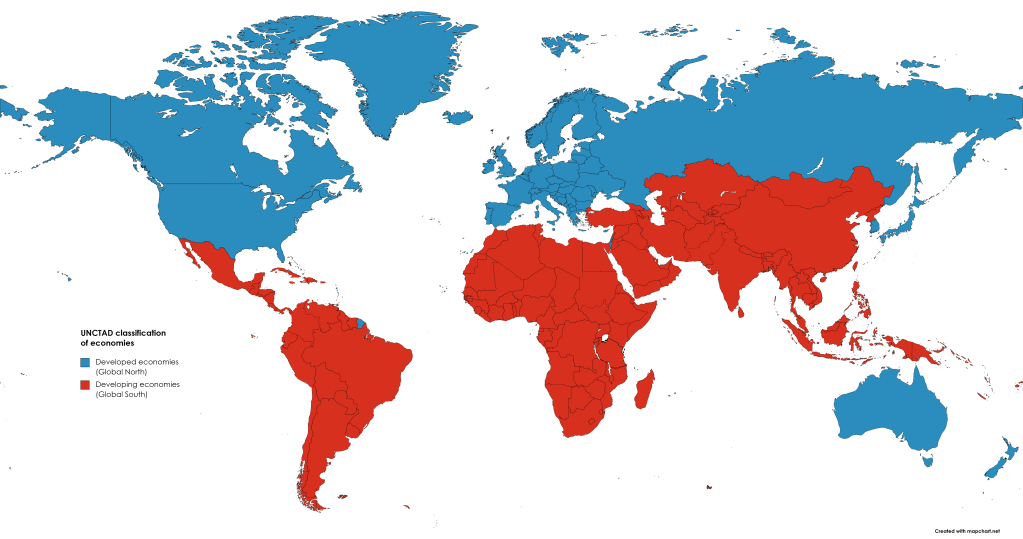
The terms Global North & Global South are commonly used terms to describe countries that are grouped by their development and wealth. The division between these regions is based on economic, social, and political factors, such as levels of industrialization, income per capita, healthcare, education, and access to technology. The Global North is generally seen as having more economic and political power, while the Global South is seen as being marginalized and economically disadvantaged. United Nations Conference of Trade and Development (UNCTAD) developed classifications of Global North and Global South nations which are shown in the map below from Wikipedia. Global North nations are depicted in blue, while Global South nations are shown in red.
In recent years, there has been growing recognition of the importance of addressing global inequality and promoting sustainable development that benefits all countries and regions. Efforts such as the United Nations’ Sustainable Development Goals seek to promote a more equitable and sustainable global system, recognizing the interdependence of different regions and the need for cooperation and collaboration in addressing global challenges.
Science Communication Challenges in the Global South
Science communication is crucial for sharing scientific knowledge and insights with a wide range of audiences, including policymakers, fellow researchers, and the general public. The ability of scientists and communicators in the Global South to share their work and viewpoints with a wider audience is, however, constrained due to the stark differences in scientific communication between the Global South and developed nations. Despite constituting about 80% of the world’s population, the Global South and its concerns are often represented in academic research and scholarship.
Some of the challenges of SciComm (and academia more broadly) in the Global South include:
- Language barriers
- Restricted access to resources and infrastructure
- Lack of access to information (also called information poverty)
- Limited financial support, materials, spaces, and mentorship
The United Nations also names problems beyond the academic world, such as weak post-pandemic growth, changing climate, and high inflation. Imagine trying to do research amidst drought, fires, and floods.
Collectively, these obstacles highlight the need for more equitable and inclusive science communication that acknowledges the distinctive viewpoints and contributions of scientists and organizations in the Global South.
Breaking Through Language Barriers in Global South SciComm
In simple words, science communication (SciComm) involves using different forms of communication (such as articles, videos, podcasts, illustrations, and so on) to educate the public and boost awareness of science. SciComm is a skill that helps not only the public but also researchers conducting science. Though relatively well-established as a concept in the developed world, it is a new concept in the Global South.
The main problem for SciComm in the Global South is a language barrier. Most SciComm is made for English-speaking populations. There are very few bilingual and multilingual channels for SciComm, despite the fact that 6,900+ languages are spoken worldwide; of those, about 2,197, are spoken in Asia, which, except for a few countries, belongs to the Global South.
The language barrier poses a huge challenge to those from developing nations. Scholars from these nations have been forced to learn and be fluent in reading, writing, and speaking English to be able to study and work, even migrating to English-speaking nations for better opportunities in academic spaces. As Renee Desjardins writes: in 2009, an estimated 15 million people worked with scientific information regularly, 67% of them in nations where English was not the first language; however, over 80% of scientific publications were in English.
In many countries, people speak regional languages that differ from the official language, even if it may be English. The lack of access to scientific information in regional languages can limit the participation of local communities in scientific activities, discussions, and policy-making processes.
While language barriers keep science siloed, SciComm can bridge the gap. SciCommers can translate scientific information into regional languages to make SciComm more accessible and inclusive. This can not only promote scientific literacy but also empower local communities to make informed decisions regarding their health, environment, and society.
The language barrier doesn’t affect just academics – it affects everyone. Citizen science initiatives are less likely to succeed in the Global South if participants do not speak English. The same goes with the communication of science – if most science content is in English, it remains inaccessible to the vast majority of the multilingual Global South, home to many regional languages. Therefore, researchers and SciCommers can help make science more equitable and boost public engagement by presenting scientific research in different regional languages.
Global South SciCommers have taken up the task of creating SciComm content in the different languages that are spoken in their regions.
SciCommers in the Global South engage the public via YouTube channels and podcasts in regional languages:
- Independent organizations like Feminism in India (FII) have organized a YouTube mini-series in Hindi.
- The Vigyan Prasar, an organization within the Department of Science and Technology of the Government of India, has its popular YouTube series in Hindi, IndiaScience.
- SciComm podcasts in India’s different regional languages include Bigyan in Bengali, Janasuddhi in Kannada, Vignyan Vaani in Hindi, and Sea of Science by IndiSciComm in Tamil.
However, regional languages cannot be limited to the spoken word; there must also be an emphasis on multilingual SciComm in the written word as well. Global South SciCommers are making slow progress on writing SciComm in multiple regional languages, which is also important.
3 Ways to Broaden SciComm’s Global Reach
For science to help society, everyone in the world, including the Global South, must be part of the conversation. Science communication with worldwide reach can help everyone understand science and level the playing field for Global South nations.
Strategies to increase Global South participation in science communication include:
- Access to training and resources: The way the information is presented and communicated matters, especially for topics around scientific research. Having mentors, access to resources and tools to understand science, and training through workshops can help reach more Global South scientists and SciCommers. Dr. Marina Joubert serves as a science communication professor at Stellenbosch University in South Africa and created the first online science communications course in Africa, which as of 2021, had graduated over 500 participants. Dorcas Dupe Oseni holds remote workshops and lectures to train people around the world, including in her home nation of Nigeria, about astronomy and other aspects of space science.
- Inclusive and diverse language: Practicing presenting information to the public in different languages can help information become more accessible. Another benefit is that more people can read your SciComm. If your primary language is English, consider translating your SciComm into different languages. A great way to do this is by working with Global South SciCommers who can help you translate your content to reach a more global audience.
- Recruiting and promoting diverse voices: The importance of cultural diversity in science communication lies in the fact that it helps to broaden our understanding and perspectives of science. People from the Global South nations bring different and diverse perspectives on information and ways it can be communicated. We can also help identify works of scholars that are underrepresented in our local communities. All too often, science communication follows an English-centric narrative, highlighting Western attitudes, values, and ways of living. Therefore, embracing cultural diversity in science communication is crucial to ensure that scientific knowledge is both accurate and accessible to all and that it reflects the richness and complexity of the world we live in.
SciComm for a Better, More Inclusive World
While still in its infancy, science communication in developing nations can promote a more inclusive understanding of science and its interface with society. Global South SciCommers can bridge the gap between scientific research and the wider community in developing nations by finding the right tools in community outreach and by applying understanding of local communities to make science more accessible.
Those of us who are SciCommers in the Global South know that we must promote more awareness and opportunities for sharing knowledge. The main concerns relate to the knowledge gaps observed between the scientific community and society at large. One of the ways to advance a holistic Global South SciComm approach is to find different modes of communication for different communities: for example, SciComm for rural areas may differ from urban SciComm. Only by acknowledging our unique role as Global South SciCommers can we unlock the full potential of science to build a more equitable and sustainable future for all.
About Nikita Ghodke
Nikita Ghodke is a science communicator, cognitive neuroscience research assistant, and aspiring speech-language pathologist based in India. Being a person with disabilities herself, Nikita advocates for underrepresented groups in academia, including developing nations, and values open science, transparency, and inclusivity. As a SciCommer, Nikita hopes to translate her work into different regional languages in the future.
 Fancy Comma, LLC

3 thoughts on “Why We Need the Global South in Science Communication (and How to Get There)”