By the Fancy Comma, LLC Team
Note: Fancy Comma has affiliate partnerships to support its blog content. We may earn commissions for products purchased via affiliate links.
Making “intentional communications choices” in the form of science communication strategy can help your message be more effective, write #SciComm researchers Besley and Dudo in their book, Strategic Science Communication.
Tweet
“This book is about science communication strategy,” write John Besley and Anthony Dudo in the introduction to their book, Strategic Science Communication: A Guide to Setting the Right Objectives for More Effective Public Engagement. “We wrote it for our colleagues in the scientific community who want to take an evidence-based, long-term approach to communication.”
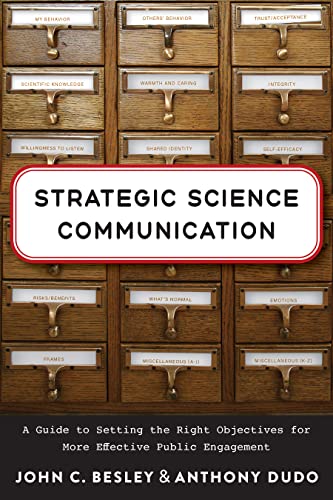
“Intentional communication choices” to help achieve science communication goals
In Strategic Science Communication, Besley and Dudo break down some of the goals that science communicators may have when writing, describing twelve different communications goals ranging from showing warmth and integrity, to demonstrating your competence on a given subject, to sharing what others think is “normal.”
To Besley and Dudo, strategic science communication is all about “intentional communication choices” to achieve goals. Large, overarching goals might be to further scientific understanding, build trust with the general public, or gain buy-in from important stakeholders such as lawmakers on international and global issues that involve science. The goals could also be smaller, less lofty goals such as to be perceived as an authority on a topic or to communicate in a friendly manner. The larger goals, such as trying to get a lawmaker to understand the scientific nuance of an issue, can often be helped by the smaller goals, such as appearing relatable and approachable while communicating science.
A book two decades in the making
Besley and Dudo say they have spent almost two decades learning from the scientific community – who they define as “natural scientists, social scientists, engineers, and mathematicians, as well as the broad range of professional communicators, informal educators, and boundary spanners” – to produce the insights in this book.
The book describes Besley as “the only one in his family without a biology degree.” Instead of going the science route, Besley became a journalist and science policy analyst, advising the Canadian government on environmental policy. He left his job in Ottawa to get a PhD in communication at Cornell University, where he completed a thesis titled “Exploring media courage about local civic engagement using the relational approach to procedural justice.” In the thesis, he talks about what’s called “procedural justice,” which is the impact that fair procedures have on the ways that people think about themselves and their leaders. In his PhD thesis, Besley discussed the role that news and entertainment media play in citizens’ beliefs about the fairness of political authorities, and their feelings about being able to have a meaningful role in decision-making processes in government that affect them. Presently, Besley is Ellis N. Brandt Professor of Public Relations in the Department of Advertising and Public Relations at Michigan State University. According to his MSU bio, he “studies public opinion about science and scientists’ opinions about the public” with the goal of helping science communicators “be more effective by helping them consider evidence-based and strategic communication choices.” (Watch Sheeva’s interview with John Besley here.)
Dudo decided to become an educator after spending his college years hobnobbing with his professors and learning about the life of the mind: “reading books, mentoring students and teaching” seemed “amazing” to Dudo. He wanted to go to graduate school to pursue his dreams of becoming a professor, but he first decided to work in the marketing department at a large science museum. Through his work, he learned about the disconnects between scientists, the general public, and stakeholders, and he became curious about these gaps in communication. He learned about the field of science communication, and completed his PhD in it at the University of Wisconsin Madison. Dudo’s thesis was titled “Pathways to the public communication of science and technology: toward a model for scientists’ popularization activity.”
Currently, Dudo is Associate Professor at the Stan Richards School of Advertising and Public Relations at the University of Texas. In his research, he studies scientists and their public engagement activities; ways science is represented in the media; and the media’s contributions to public perceptions of science.
Besley and Dudo are an unstoppable duo together; both have expertise in communications, especially communicating science, and how to communicate strategically – something not often taught in the sciences. The communications sciences are a social science, so both are technically social scientists. Besley and Dudo summarize their suggestions for science communicators, who they both study, into 12 actionable pieces of advice that are easy to understand.
What you’ll find in Strategic Science Communication
Besley and Dudo wrote Strategic Science Communication to encourage interest among their colleagues in science to take science communication seriously and to provide scientists with evidence-based science communication techniques that actually work. Besley and Dudo accomplish this by going over the importance of science communication, and what happens when scientific research is not communicated clearly to the public. They also discuss a few strategies to improve science communication quality. In their discussion of ways to strategically and effectively communicate science, they condense the priorities of science communicators into twelve different strategic goals. The book also includes some examples of how science communication is done, which they have learned through their academic research into how scientists communicate and how science communication is perceived by stakeholders including the general public.
Besley and Dudo, the authors of Strategic Science Communication, start off the book by making the distinction between science communications scholars and in-field practitioners. The former refers to members of academia who write scholarly research on science communication, while the latter is a catch-all term for natural scientists, freelance writers, and journalists who actively rely on science communication for their work. Besley points out how contemporary science communication largely seems detached from the realities that science communications practitioners face on a daily basis. “As we got to know the people involved in the practitioner community, we realized that our position as social scientists in advertising and public relations departments was helping us think about communication somewhat differently than many of our colleagues, and we found an appetite for our ideas. We also heard tough critiques of the available research…,” they write in the book’s introduction.
The book consolidates and summarizes developments in science communications scholarship, linking them to practical problems that science communication writers have in the field: “…[W]e want the scientific community to turn to social science when faced with communication challenges and opportunities,” Besley and Dudo write. They refer specifically to their work in communication science, though Fancy Comma has also advocated for better science through sociology (another field in the social sciences).
The book provides useful ways to communicate science based on real-life cases – a practical framework for understanding the goals of science communication. Putting those strategies into practice is important because science communication is still hampered by a gap that exists between the usefulness of contemporary science communications literature and the habits of the science communicators themselves. This is due to a lack of communication and cooperation between science communicators and researchers, according to Besley and Dudo. The science communication research community in particular has operated mostly in isolation from practitioners due to demands for journal publications taking precedence over figuring out whether research on science communication has any practical relevance. Besley and Dudo noticed this isolation and lack of cooperation through their networking with science communications researchers and practitioners when they were doing survey work for the National Science Foundation.
Interestingly, Besley and Dudo describe their qualifications in the book as a way of establishing what are known as “competence beliefs.” They don’t claim to be the world’s foremost science communication experts, but they’ve worked in the field long enough to have some things to say. As they write, competence beliefs make you more likely to believe someone and take seriously what they have to say.
When communicating scientific facts and research to the public, Besley and Dudo believe a combination of experience on what works and what doesn’t, as well as strategies proposed through science communication research, can both be helpful. Integrating lessons learned on what to do and not do can make the difference between whether your message is communicated clearly or not – something many science researchers are trying to solve through the discipline of science communication. In addition to emphasizing the importance of considering the experience of science communication practitioners, the authors also mention the importance of diversity and inclusion. The author cites the importance of having a diversity of thought and backgrounds in the research environment in order to avoid being locked into groupthink. Not only is diversity and inclusion an important thing to encourage on the researcher’s end, it also helps in making scientific research more accessible to the public as US society grows more diverse. Incorporating the perspectives of previously marginalized peoples puts more emphasis on scientific topics that would otherwise be ignored.
Making science more diverse through strategic science communication
A contributing factor to the lack of diversity in science is researchers showing a lack of interest in engaging with the public. Either due to lack of desire or difficulty, much science communications research is restricted to academic circles, which is a far more ethnically homogenous space than the wider public. This lack of interest can be seen in the overwhelming focus from science communications writers and researchers on knowledge transfer. The authors argue that many of the problems that science communicators face is due to their overemphasis on addressing some kind of knowledge deficit the public may have. Instead, Besley and Dudo argue, there are other objectives that can and should be addressed through science communication such as projecting warmth or competence. In Besley and Dudo’s concept of science communication, science is a dialogue between the non-scientist public and scientists, one in which both sides learn, benefit, and grow.
In an era of mass communication and social media, communicating scientific findings can be just as important as the research itself. The field of science communication exists to help researchers better convey their findings to the general public. However, the challenge that science communications faces is translating theoretical ideas derived from research into practice. The authors investigated how this can be done by engaging in collaborative research with in-field practitioners (in other words, science communicators). Besley and Dudo learned through their work talking to and studying science communicators’ practices that they have different objectives when communicating their ideas. The two authors also learned that incorporating different viewpoints can be useful to better communicate research findings.
With Strategic Science Communication, science communication can be for everyone
The idea that a science communicator should do more than simply translate facts into something digestible to address what the scientist sees as a knowledge deficit changes how one approaches science communication. There are different goals and objectives a science communicator may have to address when communicating science, whether via writing or a talk or even art. Some of these objectives include projecting warmth, understanding, or competence of the science communicator to the audience. These objectives and more are covered in the book, with helpful advice to incorporate them into your science communication endeavors.
Working on these aspects of science communication helps in a few ways. First, strategic science communication personalizes the message more. It also makes science seem more like a way of thinking and understanding the world rather than cold facts being thrown at you. Another way that science communication can be strengthened via a strategy is that one can adjust the message to take into account different cultural viewpoints or groups. This can be done by consulting people from those groups or by including the voices of science communicators from different groups into the conversation. That way, the facts you are trying to convey reach a larger and more diverse audience, because different groups who might listen to the message are now on the same page.
The bottom line
Strategic Science Communication can help anyone who is interested in understanding ways to communicate science better. This book would be useful for researchers and journalists who cover scientific topics in particular because these are the groups that regularly have to convey scientific facts to the general public. Someone reading Strategic Science Communication will learn all the basics needed to communicate scientific research properly – and strategically – from setting objectives to determining the communications tools and strategy needed to achieve those objectives.
Pick up a copy of Strategic Science Communication on Amazon.
 Fancy Comma, LLC
3 thoughts on “Book Review: Strategic Science Communication by John C. Besley and Anthony Dudo”