By Sheeva Azma
Disclaimer: Fancy Comma has affiliate partnerships to support its blog content. We may earn commissions for products purchased via affiliate links.
I was lucky enough to remotely attend the 2024 AAAS annual meeting, which was held in mid-February in Colorado. Thanks to my membership in the National Association for Science Writers, I got a press pass to attend as a journalist (for FREE!). I attended as many virtual science policy sessions as possible with the goal of helping my fellow scientists better understand this space through my coverage of the sessions! Check out a full list of the recap blogs here. In the next few weeks, I hope to recap some of the key points of these sessions for those interested in science policy.
You can’t get much better than the AAAS when it comes to science policy. They are based in DC and work closely with all three branches of the government. ESEP is an initiative of the AAAS that unites people from multiple disciplines in policy. In the session I attended called “Engaging Scientists and Engineers in Policy (ESEP) Town Hall,” many panelists gave a laundry list of ways students can get into science policy. Here they are!
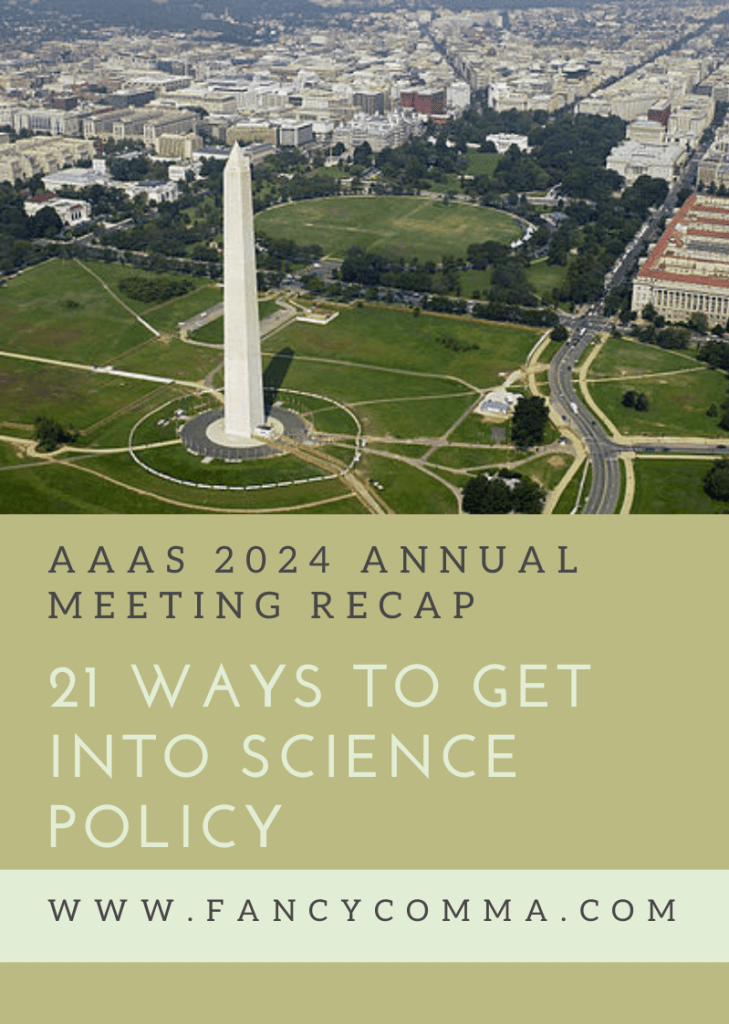
21 Ways to Get into Science Policy as a Scientist: AAAS 2024 Annual Meeting Recap
- Start figuring out what organizations do science policy and what the overall landscape is. (The Fancy Comma blog can help!)
- If you are a PhD student, consider becoming a AAAS Science and Technology fellow after you get your PhD— there are other programs as well that allow you to do this at varying stages in your career…
- …That said, you don’t have to get a PhD or wait until your PhD is done to work in science policy. Understand the role of science in policymaking. Build relationships with other students interested in science policy and create connections and networks, building capacity and opportunity to get more involved.
- Get engaged with your professional scientific society, as they often do advocacy. Different scientific societies have websites with resources and action alerts. Sometimes they also have days where they fly in people to Capitol Hill Days or policy advisory committees for which they need people.
- Be persistent – if you’re interested in a specific policy or topic, keep at it.
- Network! Talk to lots of people. In Washington, DC, “It’s not who you know, it’s who you get to know.”
- Do as many things as possible – don’t limit yourself.
- Don’t discount the role of the judicial system – laws and judges tell you that they don’t make policy, but policy is everywhere, even if it’s hard to define.
- Stay humble. While you might be a science expert as a scientist, you might not be a policy expert. Stay curious and keep learning.
- Get involved with laws you care about and advocate for them.
- Acknowledge and respect all of the factors that go into policymaking – culture, economics, politics – things beyond science.
- How you talk matters. Study how to build human connection through things like improv and theater! Learn about science communication to explain why issues are important to other people.
- Join a local science policy group chapter. Many universities have a chapter of the National Science Policy Network.
- Consider taking a free, online course on how to speak to government.
- Be mindful of the culture differences between science and policy – read Two Cultures by CP Snow or check out Sheeva’s YouTube video on the topic.
How to get involved in science policy if you don’t have a PhD and work full-time in another job
- Participate in local activities. Look at county- and civil-level boards where you might be able to share your expertise. Arlington, Virginia has E2C2, an energy and climate board.
- Attend meetings at city, county, or university level that can be good places for changemaking. All of this work adds up. Find opportunities that don’t require a lot of time.
- Participate in email campaigns to contact members of Congress – you can send emails and make specific talking points to policymakers to help persuade them on an issue.
- Participate in congressional visit days where you go to Capitol Hill and talk to lawmakers – these incorporate some elements of training, help you schedule meetings with legislators, and are a great way to meet people working on issues you care about.
- Get to know your political officials – especially state and local officials. Tell them that you care about the issues and share your expertise.
Perhaps the most obvious bit of advice, which you can do when you have a bit of insight into the political process:
- Consider running for office! (We can support you in your political communications if you choose to do so, by the way.)
Upskill and learn science communication to inform policy for free!
Read all of the AAAS 2024 Annual Meeting recap blogs here! You can also improve your science communication and science policy skills by checking out Fancy Comma’s FREE resources.
 Fancy Comma, LLC
10 thoughts on “How to Get into Science Policy as a Scientist”