By Sheeva Azma
At Fancy Comma, we often talk about ways that sociology, the study of society, informs and improves science as an enterprise. Today, we are talking about ways sociology informs and improves women’s lives by examining the ways women contribute to the “social safety net” here in the US.
Note: Fancy Comma has affiliate partnerships to support its content. We may earn commissions for products purchased via affiliate links.
I can’t imagine how disillusioned working moms feel…picking up the slack for everyone in their lives and being expected to do so.
What is a social safety net?
What I know about safety nets, I learned about watching Nickelodeon. In the 1990s, kids traveling through obstacle courses covered in green slime was the pinnacle of entertainment. Sometimes, at the end of the course, or if the kid failed traveling, say, monkey bars, they would fall onto the safety net, and their turn would end.
That’s what I know about safety nets – literal nets that protect you from demise. So, when I heard the phrase “social safety net,” I assumed that meant a safety net to pick up the slack for society – and it seems that I was right.
Sociologist Jessica Calarco of the University of Wisconsin-Madison wrote a new book derived from tons of interviews with women who have kids under age 18. She says that women are the “social safety net” of the US, in lieu of having a real safety net for the US through policy solutions. Calarco recently gave a seminar sponsored by the Population Reference Board, a nonprofit based in Washington, DC, that I tuned into via Zoom on June 27, 2024. The chat was called “How Women Became America’s Safety Net,” which is part of the title of Calarco’s new book, Holding It Together: How Women Became America’s Safety Net.
Safety nets were valuable in Nickelodeon because they reduced the danger the kid faced going into the obstacle course. It’s the same with social safety nets, according to Beth Jarosz of the PRB, who introduced the talk. “Policies can uplift people – or leave them behind…today we are going to unpack some of the ways women are asked to hold it together,” stated Jarosz.
Though unlike the people Calarco interviewed and wrote about, I don’t have kids, I do feel like a social safety net in some ways. Since I left graduate school, I’ve had to balance following my passions with my need to pay the bills, which has led to some quite unglamorous tradeoffs.
Being a safety net is more than just being the good mother, daughter, friend, etc., that we all strive to be in our lives. According to Calarco, a safety net means you pick up the slack no matter what for other people, very often to the detriment of your own life ambitions and goals, often because you have no other choice, just to make everything work.
Instead, Calarco says, better social policies can help support working mothers (and caretakers in general, she adds, though caretaking responsibility often falls to women) so that they don’t have to give everything up when life takes a turn.
Working mothers face many somewhat stereotypical “safety net” barriers. When things get chaotic in their family’s lives, they are expected to pick up all the slack, quitting their jobs so that their partner (if they have one) can focus more on breadwinning, or so they can care for their aging parent, or take care of the kids to save money since childcare is so expensive. I’m not a mom, but the examples go on and on, I gather. According to Calarco, instead of women being forced to do these things, society – and specifically, policy – should support women.
Calarco and the other three speakers outlined a portfolio of policy asks: things like making childcare more affordable, paying child and senior care workers more, and creating commonsense policies that don’t needlessly deprive families of resources, such as birth taxes, which economist Tiffany Green, PhD, also of UW-Madison, discussed.
Introspecting on my role in the social safety net as a woman business owner
Listening to the seminar, I wondered: am I part of the “social safety net”? I’m freelance because it fits in with my busy life, and because I decided I would no longer sacrifice my personal life to put in the demanding hours needed for a high-powered career as a woman in science. As such, I haven’t seriously considered returning to a 9-to-5, even though it would pay more, because it just doesn’t fit with my life anymore.
Maybe I picked up the slack for society when I left my PhD program with a Master’s and picked up freelancing, freeing up tax dollars to help train other scientists, and started my own business doing short-term writing gigs I could quit at any time if needed to attend to other duties. Being a small business owner has its own set of challenges, and while I’ve been lucky to build a sustainable business over the past few years, being a woman in this space has made things more difficult.
I pick up so much slack even as a woman in business. It’s okay with me that I don’t fit the cookie-cutter businessman stereotype – I prefer working in yoga pants and being friendly and working hard rather than being pretentious and wearing suits all day. The social aspect of being a businesswoman has factored heavily into the economic success of my business, though – sometimes for the better, but not always. I don’t get discouraged when people criticize me, because I’m used to it from being a woman in science. However, people in this non-academic real world are not like the science colleagues I had in grad school.
As a freelancer, potential clients I’ve talked to have no issue being rude and dismissive in discovery calls. Also, people always tell women they are being timid and to ask for more, but when I do, sometimes my clients withdraw the job entirely. This all means I have less cash flow, so ironically, I am less of a candidate for business loans.
That’s actually pretty standard for women in business, writes Forbes. Actually, I don’t really have it too bad, according to them. Forbes says women entrepreneurs worldwide struggle with balancing responsibilities, fear of failure, and an inadequate support system, among other things.
Do these things make me a safety net? In Calarco’s world, technically, no. I also do not really find the talk relatable to my life, but it’s true that moms are way more of a safety net than I am, since they also have child-raising responsibilities which I don’t. I anticipate the trade-offs there are … not great. During the Zoom, I asked Calarco: “You tell stories of many moms. Did you look at unmarried women at all in your research and in what ways do they contribute to this safety net? If anything these women have lots more time to give to others and feel pressure to conform to norms about women in society.” We didn’t have time to answer that question, but I am very curious about it. As the birth rate falls to its lowest, as another panelist – demographier Karen Benjamin Guzzo of University of North Carolina, Chapel Hill – explained, more and more women are opting not to have kids because they have to get their ducks in a row, and apparently, people are delaying having kids because they, like me, can’t escape being the social safety net as they try to forge ahead in their lives and careers.
If I were a working mom, I would be quite angry at way our work lives are expected to fulfill a masculine ideal which working moms have no chance of meeting. I can’t imagine how disillusioned working moms feel having to balance it all in today’s world, basically picking up the slack for everyone in their lives and being expected to do so.
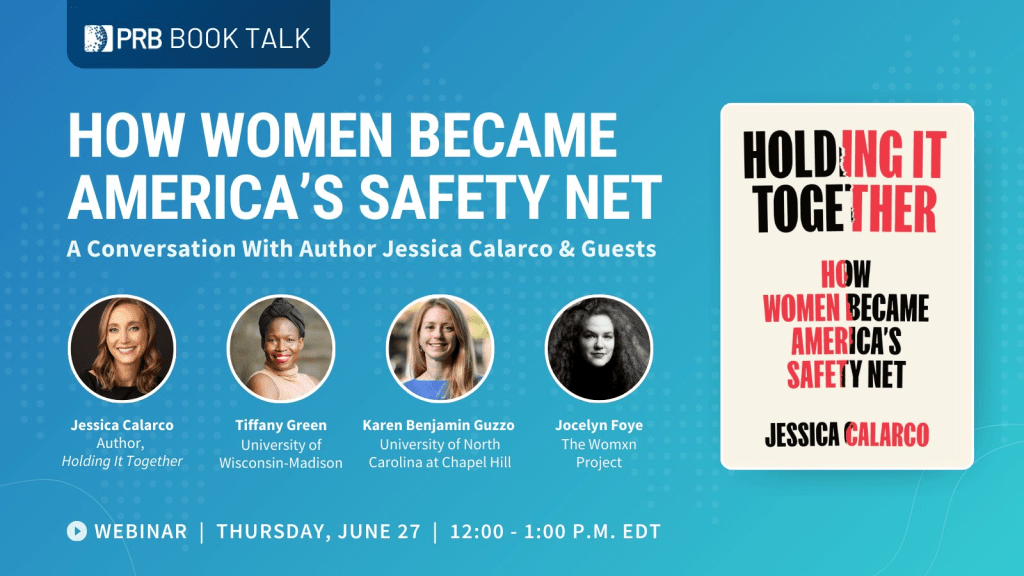
The PRB, who sponsored the talk, is a nonpartisan nonprofit focused on studying population data – stuff like where people live, how many kids they have, and so on – to improve people’s health and well-being through evidence-based policy.
When I was in graduate school, I had a free morning to go see Hillary Clinton speak. My only real memory of the talk is her telling us that we should feel lucky as women in the US, since things are so much worse elsewhere. So, I was shocked when Calarco showed this slide…
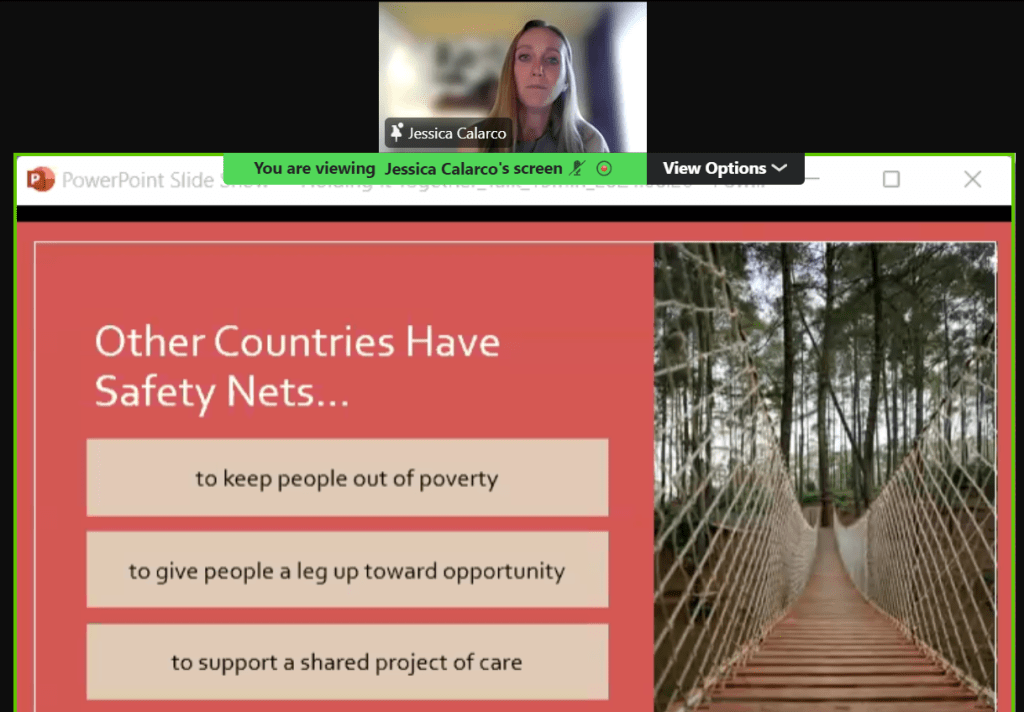
Other countries have safety nets, she said, but in the US, we have a “[do-it-yourself or DIY] society, forcing people to manage that risk on their own” leaving many families “teetering on the edge of collapse.”
“Women’s unpaid and underpaid labor helps to maintain the illusion of a DIY society,” said Calarco. “We haven’t collapsed because women, disproportionately, have held it together,” she said.
What does women being the “social safety net” look like in the US?
Women hold 70% of the lowest wage jobs, she stated, and of course, stuff like being a mom or taking care of your parents is uncompensated.
“To facilitate this kind of exploitation, the US has tried to trap people in motherhood” with nowhere to hide when people ask them for even more, according to Calarco. What’s more, the effects of this disproportionately affect marginalized groups. In the absence of a safety net, women can be forced into a “motherhood” trap where they are forced to fill in other gaps in our economy and social safety net.
Calarco spent over 400 hours interviewing moms and their partners of different political and socioeconomic stripes. Here are a couple of example case studies, which I have paraphrased here:
Brooke grew up in a rural, working-class family in Indiana. When she got pregnant by accident in college, her parents couldn’t pay for college or childcare, so she dropped out of college. She lived off of welfare and worked for minimum wage in retail, and eventually transitioned to a minimum wage job in childcare. Though she wanted to go back to college to become a nurse, she couldn’t make it work, partly because she didn’t trust her parents to raise her kid. Five years later, she still worked in childcare, and hadn’t gotten her degree.
Patricia worked from home full-time, while her husband was a construction worker. Together, they made less than 30K. While Patricia could make more money, she took her customer service job because she could work from home and save money on after-school care for her kids. When COVID happened, Patricia’s kids interrupted her work constantly. She reduced her work to 4 days a week to have more energy for her kids and more time to rest – unexpectedly, she was also pregnant with kids.
Seeing that Patricia had more free time, they asked for car rides in Indianapolis, which has a terrible public transit infrastructure. She ended up divorcing before her kids were born, and luckily, the people she had driven around in the pandemic paid her back and drove her around to her doctor’s appointments.
Attempts to DIY society have decimated families, including systematically marginalized families, says Calarco. “It’s impossible for women not to get stuck…because we’ve left them with nowhere to turn for support…and nowhere to hide when people ask them for even more.”
More privileged women have it easier because they can dump it all on someone who has less privilege than them, but in general, responsibility falls to women, even when men can fill in the gaps.
Even children help support the DIY safety net, as older kids can provide childcare to younger kids to help mothers “stay employed” and “return to paid work,” says Calarco.
“We already know what the problem is and we already know the solution. The solution is to build the kind of safety net that would actually protect us,” says Calarco. She advocates for a child tax credit, more time to spend with kids, and for “institutions to step up and be humane.”
What would an improved social safety net look like?
The panelists had a lot of ideas to create a social safety net, and surprisingly, none of them involved expensive social programs (as I thought they might). Here they are:
- Take health care, home care, child care, and care in general out of the for-profit market. Marginalized women are pushed into these jobs, which don’t work within a profit-driven model.
- Care for the people who care by providing care workers with paid family leave and vacation time, and caps on weekly hours, so that they still have the time and energy to take care of everything in their lives, including themselves.
- High quality childcare for parents, so that women don’t have the full childcare burden in their families
- Looking to the tax system to see how we can use that to reduce poverty, as many of the most impoverished households are run by women
- Reevaluating our thoughts on the birth rate and thinking about who society thinks should be having more babies and who shouldn’t (for example, unmarried teen moms) and how that fits into social biases
- Social change so that work culture is less toxic for women
- Realizing that a social safety net is an investment, not something we are doing because women are not doing their jobs
- Avoid falling into the trap of thinking that improved birthrates will create a better social safety net, and use policy levers instead – instead of trying to boost the birth rate to have a good labor force in 20 years, we can change immigration policies, for example.
- Help men understand that care work is important and meaningful so that women don’t feel like they are “doing everything”
- Support more nonprofits that support women and girls
- Advocating for existing social programs such as child tax credit, universal free lunch, and medicaid expansion
Despite all of the work needed to boost the social safety net, overall, the panelists were optimistic, both due to their ability to organize to advance their goals, and due to seeing young people make good decisions about life despite all of this. As economist Tiffany Green stated, “staying in the work and seeing that no matter how we despair…there have been people who have…been working to expand access to childcare for a long time. […] Progress was never going to be linear. For me, it’s staying in the work and working to uplift the people who are doing that work.”
Calarco also says that part of the work to build a strong social safety net is to “reject myths” that divide us and help us stay stuck in the status quo.
Pick up a copy of Calarco’s new book, Holding It Together: How Women Became America’s Safety Net, on Amazon.
What are your thoughts on the social safety net? In what ways do you contribute to it? What policy solutions would you like to see? Chime in below in the comments or get in touch.
 Fancy Comma, LLC
2 thoughts on “Being a Woman in the US Means Being Part of the “Social Safety Net””