By Sheeva Azma
This blog is part eight of “A Scientist in Politics,” a blog series about how I got into political campaigns and science policy as a scientist.
Skip to part 1 | 2 | 3 | 4 | 5 | 6 | 7 | 8
Working on the Nikki Haley and Kamala Harris campaigns taught me a lot about what sexism looks like in the political world. While both campaigns lost, I gained many invaluable lessons from this year’s election cycle.
As someone who works as a science communicator and political communicator, alike, I have learned to live my values. That way, even though you may not always please everyone, you stay true to yourself and your vision for the world. The other thing about living your values is that, in the process of doing so, you can meet others who share your same values that you did not know about. Working to elect two women presidents this election cycle, on both sides of the aisle, I learned a lot about that.
One of my life’s values is elevating and supporting women who are working hard to bring hope and change to society and defeat toxic, cynical narratives about what is and is not possible in the world. However, this work is quite difficult; it’s not something one can accomplish in an election cycle, but rather, it is another small slice of my life’s work. That’s what I learned this past election cycle, working on two presidential campaigns with lots of momentum that ended up both losing — Nikki Haley and Kamala Harris. The two candidates are quite different in their policies but to me, they had a lot in common…first and foremost, breaking the glass ceiling and broadening women’s participation at the highest levels of government.
You have to choose your battles in politics, just like anywhere else…and once you single-mindedly dedicate your efforts to something, expect naysayers to show up. You will meet tons and tons of people who do not share your same views and just don’t see the world the same way you do, and that’s okay. We are all entitled to our own political views.
The amazing thing in this work is that you will sometimes find rare overlaps with people with whom you may not even really think you have anything in common! It’s a much-needed, yet all-too-rare glimmer of bipartisanship and, more broadly, humanity, that I observe in life. I really enjoyed the opportunity to work on both political campaigns and do feel that I have helped advance the position of women in the political world, even if it’s too early to know in what ways.
Anyway, if you are wondering how such a thing would be possible this election cycle, I explain it all below. Feel free to chime in with your own questions in the comments!
Working on the Nikki Haley Campaign
I spent the months of January through March 2024 working to elect Nikki Haley because I was tired of the toxic, male-dominated narrative. I did a whole YouTube video about it.
At that time, Haley was facing off against Donald Trump and others in the Republican Primary. As a political moderate, I often vote for Republicans, so it was not a difficult decision, though it was a bit of an impulsive one. I wondered if the Haley campaign would even let me help out since I am a Democrat, but they actually never asked about my political views and did not judge me. The one thing we all had in common was our love and respect for Nikki Haley as a woman boldly taking on toxic masculinity in politics. As our volunteer organizer reminded us: we get to do this work. It was work that had never been done before on this level.
It was, honestly, cool to work on a Republican campaign as a Democrat! Working on the Nikki Haley campaign, we were all united in our pursuit of elevating women to the highest political office here in the US. I have previously worked on Republican and Libertarian campaigns, and since my own political views transcend party boundaries, it is cool to connect with people who have different political leanings on issues that we have in common. I definitely recommend it!
Working with a small, dedicated team, I helped the Nikki Haley campaign become the first woman to win a Republican primary (Washington, DC primary) and the Vermont primary. Nobody was making us do this. Despite everything going on, and despite the political atmosphere, we chose to persevere for the future of our nation.
During the New Hampshire primary, it helped that I had lived in the Northeast, because I enjoyed the opportunity to chat with my old neighbors. I took it upon myself to call everyone I could in New Hampshire during the run-up to their primary, letting them know about events happening near them with Nikki Haley and New Hampshire Governor (and fellow MIT grad) Chris Sununu. Haley captured 43.28% of the vote in New Hampshire to Donald Trump’s 54.35% – sure, we did not win, but we captured a large number of votes!
Haley dropped out in March, but not before surpassing 3 million votes. She continued to gain votes despite no longer being in the race, maxing out at over 4 million votes, according to Wikipedia’s math (I actually looked for a better reference to include here, but there was surprisingly little positive news coverage of this historic presidential run in the media).
Leading Spanish-Language Phonebanks with Arizona Democrats
The presidential race continued without Nikki Haley, and narrowed down to Trump and Biden once more, as it had in 2020.
In April 2024, I was approached by the team I worked with in the Arizona Democratic Party to help elect Sen. Mark Kelly and downballot Democrats to lead Spanish-language phonebanking. The Arizona Democrats’ Spanish phonebanking is the only program of its kind in the nation. We spoke to Spanish-speaking people in Spanish, given that 30% of Arizona speaks Spanish. We phonebanked in Spanish in the 2022 midterms and started up again this summer to first help elect Joe Biden, and then when he dropped out of the race, Kamala Harris.
This works the same way as “normal” English-speaker outreach, but everything (voter outreach scripts, volunteer trainings, etc.) is in Spanish. While the media has said a lot about Trump’s ability to rally Latino voters around the US, his lead over Kamala Harris in Arizona was only about 5% — and we managed to elect Ruben Gallego, the first Latino US Senator from Arizona. A Harvard grad and Marine with a working-class background, Gallego won because voters found him relatable, and we helped get him there by canvassing in Spanish in a border state that is 33% Latino.
When Trump won on election day, there was no mention of our Spanish-language phonebanking. I believe that reaching voters in their primary language was a way to be able to rally their support for a popular candidate in Ruben Gallego.
Losing the presidential race in Arizona was tough, both for me and the others with whom I worked. It feels too early to know what the correct next steps are, but I feel grateful to have eked out a Senate win despite losing the presidential race. The work continues and though it may take a different form, I am grateful for the opportunity to have been a part of it.
Attending My First Political Rally in Arizona
One of my favorite memories of the 2024 election cycle was touching down in Phoenix, Arizona, where I was lucky to be invited to attend an August 9, 2024 political rally. It featured many high-profile guests such as Sen. Mark Kelly, former Rep. Gabby Giffords, then-Congressman and Senate candidate Ruben Gallego, and others in Glendale, Arizona.
When I was invited to the August 9 rally, the Vice President had not been announced yet, so I made my last-minute plans to attend without knowing who Harris would pick as her running mate. On August 6, Harris chose Minnesota governor Tim Walz as her running mate, and so I showed up on August 9 ready to cheer them on in their new campaign. I even did a vlog about it on the Fancy Comma YouTube (my first “real” vlog)!
As a campaign volunteer, I welcomed rally attendees, distributed water bottles, and coordinated transportation for persons with disabilities. It was quite hot outside in Glendale in August! I also took it upon myself to cheer as loudly and spiritedly as possible at the rally despite the fact that my back and legs hurt after standing for so long.
What motivated me to participate in this political rally was partly my desire to see the candidates I helped elect in 2022 but also service to my fellow Democrats who likely would want to attend the rally but did not have time. The logistics involved in attending a rally in Arizona with a week’s notice was stressful and, while all I wanted to do was rest my aching body after volunteering for several hours in the hot Arizona sun, I put that aside and focused on helping kick off what would be a historic campaign.
Founding a Grassroots Harris-Walz Coalition, “Scientists For Harris”
In July 2024, when Joe Biden dropped out of the race and Kamala Harris said she’d take over the presidential campaign, I immediately founded “Scientists for Harris,” which I envisioned as a grassroots coalition of scientists who would make science heard at the ballot box by electing the first woman president who is the daughter of a woman in science (a former cancer researcher).
I created an account for Scientists for Harris on X and used my copywriting skills to come up with a tagline: “We are scientists for Harris-Walz + a pro-science Congress reminding everyone what’s at stake on 11/5/24.” I eventually connected with the national Harris-Walz campaign and we got added to the list of grassroots coalitions (think “Swifties for Harris,” “Women for Harris,” etc.). We were able to strategize and come up with ideas to help get out the vote. It was amazing being part of such a grassroots effort. All successful political campaigns are inherently grassroots, and the grassroots momentum was very exciting in this race, even if we did not ultimately win. Scientists are not a crucial “swing vote” for politicians, so they are often overlooked in the political process, but that comes with a price in policymaking, as scientists don’t always have the place at the table that they should. So, I vowed to help restore science’s role at the ballot box as founder of Scientists for Harris.
We had just over 20 scientists formally “join” Scientists for Harris, and in the early days of the presidential campaign, we met weekly to brainstorm ways to get out the vote for Kamala Harris and spread the word about what her election would mean for science, the STEM workforce of our next generation, and women and historically marginalized people in science and STEM careers more generally. We had many good conversations.
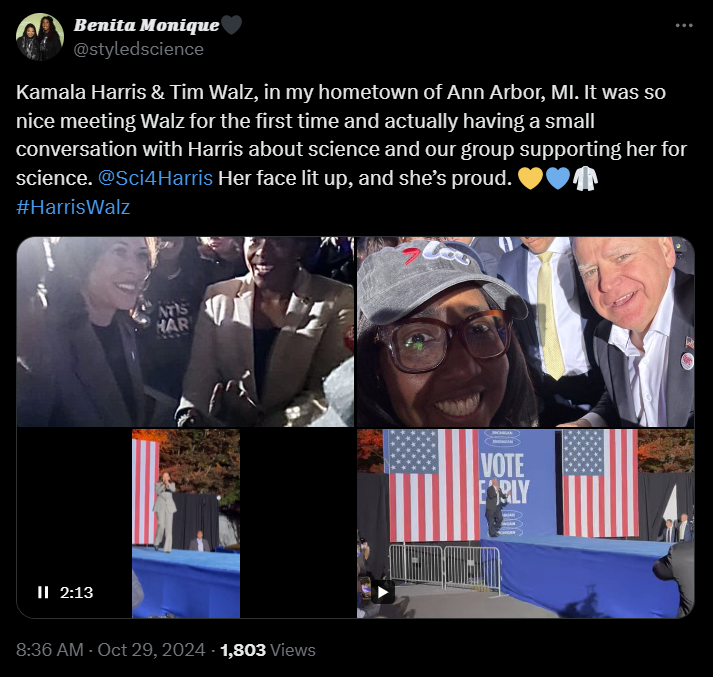
Scientists for Harris did a deep dive into Harris’s campaign speeches, social media posts, and the like, and we learned that she’d actually done a lot for scientists as a politician. We also started a Medium blog where we talked about what a Harris-Walz administration would mean for science, and authored an article about ways Kamala Harris could improve the STEM workforce. In the final days to get out the vote before the election, members of Scientists for Harris attended rallies across the US. One member of Scientists for Harris met Kamala Harris and told her about Scientists for Harris, as she posted on X!
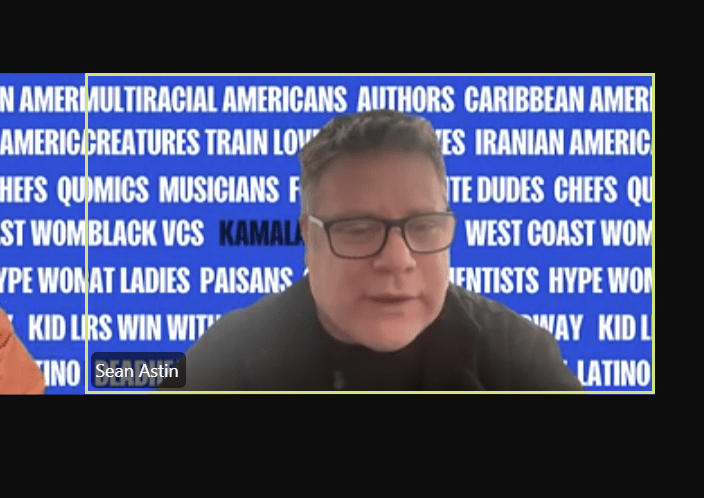
We also sponsored a daylong phone-a-thon on Saturday, November 2, with the other official grassroots Harris-Walz coalitions (Swifties for Harris, Geeks for Harris, and so on), which approximately 700 people attended. Guest speakers included Sean Astin, who plays Samwise Gamgee in the Lord of the Rings series. Representing Scientists for Harris at the phonebank, I called voters in the battleground states of Georgia, Nevada, and Arizona.
On election night, another member sent me a logo she created for the group, which we then posted about. So, if Harris runs again in 2028, we are prepared!

You may remember that the 2024 election results took a while to roll in and, at the beginning, Donald Trump had a large lead and many races were undecided. It was tough, since the election postmortem had started without the results fully counted. Patience — and unplugging from the news and social media — paid off as the Arizona Senate race was one of the last races to be called. Amidst a tough election cycle, it emerged as one of the rare Democrat wins as Republicans gained control of the presidency, House, and Senate.
I felt many conflicting emotions after the 2024 elections. I deleted the Scientists for Harris X account and Gmail account because I felt all was lost, like my work had never happened. After a few days, though, I decided to restore them. Feel free to follow Scientists for Harris on X, even though we have 0 followers on X at the moment. We used to have a lot more: on November 5, 2024, which is when I took the below screenshot, we had 326 followers!
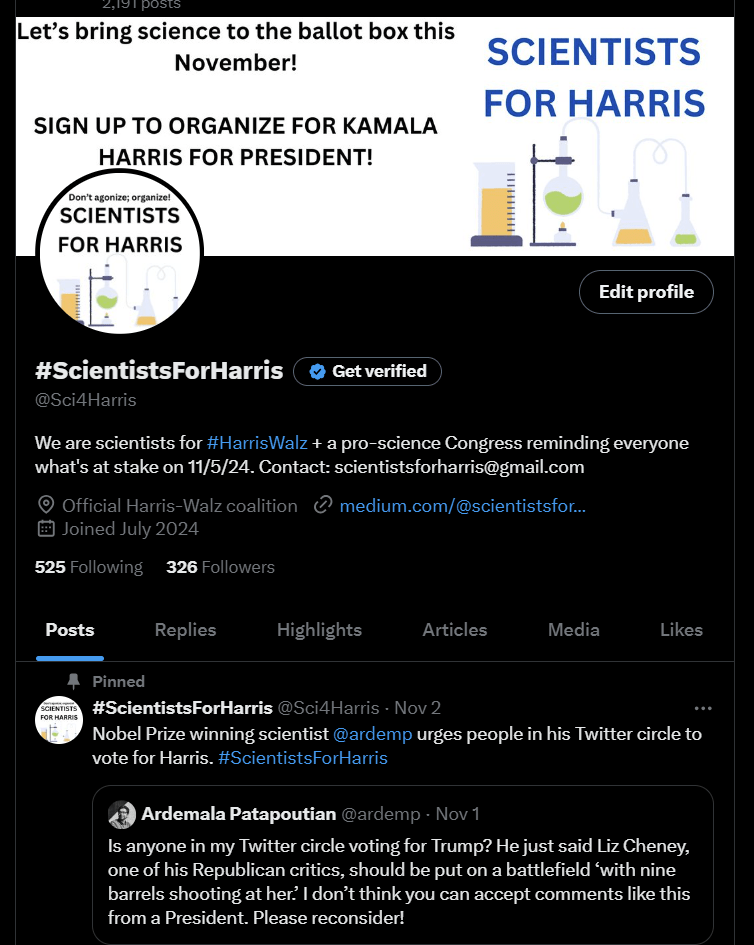
Check out the tweet we pinned above from Ardem Patapoutian, who was a Nobel Prize winning scientist for Harris! (He ended up deleting that post on Election Day.)
I ran our social media page (www.x.com/sci4harris) from July to Election Day 2024, amplifying the voices of scientists organizing for Harris and talking about Harris’s pro-science, pro-STEM agenda. I love the idea that scientists could help decide an election. We are so attuned to important issues, have a knack for analyzing and interpreting data (such as the polls, which were way too close – within the margin of error – in the lead-up to Election Day!), and know about the challenges that face the scientific community as well as society at large since we are often working on them.
Volunteering with My Local Democratic Party
I was a poll worker in 2008 in Washington, DC, and that was a long, exciting day, but I did not have time for that this election cycle. (Read about that experience here.) Instead, I volunteered with my local Democratic party as a poll runner. This meant I visited a couple of local polling places to ensure that polls closed properly and all the votes were counted. I also took a picture of the publicly-posted poll results and shared them with the local Democratic Party to help them with their recordkeeping efforts.
It was all hard work, but it was worthwhile work I enjoyed
I did all of this while working two, sometimes three jobs, and not sleeping. It was not for the “glamour” of helping elect a candidate, and I made great personal sacrifices to do it all, including all but halting Fancy Comma’s work for a couple months. I wrote a newsletter about that.
Sen. Mark Kelly, a former astronaut, repeatedly reminded me, wherever I saw him on the airwaves, that hard work is key. Kamala Harris often repeated the saying “hard work is good work” on the campaign trail as well.
Working on both sides of the aisle was hard work, and it was good work, and it was work I got to do. We have yet to see the full results of this work in elevating the status of women leaders, but I am excited about what the future may hold. I have been through my fair share of crushing political defeats, and I always come back stronger and learn a lot.
What I Learned
If anything, this election has reinforced to me the role sexism plays in our judgement calls when it comes to electing our leaders. Just because we did not elect a woman president does not mean we should continue ignoring the important role of women in many spheres including as well as beyond politics or even the idea of women as a social safety net discussed by sociologist Jess Calarco.
It was interesting to observe the media narratives as someone who has faced sexism as a woman in science. It was pretty common for people to bash either Harris or Haley as “stupid” or “incompetent” or otherwise incapable of and unqualified for serving in the nation’s highest elected office. When politicians said stuff like that, the media and people were quick to follow.
A couple of more tangible skills I gained from this experience involved community building and organizing. I learned that presidential campaigns are not about your views or your vision for the US but about whether you can help people understand why your candidate is the best person to fulfill the people’s vision for the US. It’s not a “sexy” process but it is one we undertake every four years to ensure that we have a leader elected by the people. I also learned the scientists have a crucial role to play in adding to the discourse in a way that does not politicize science, which was rarely discussed in this election. I would love to see a political cycle in which support for science becomes a voting issue.
There’s a lot more work to be done. The second Trump administration now has the difficult job of running the country for the next four years. For me, personally, there is the emotional work of healing from the election as someone who worked on the losing side, and there is also the more practical work of staying attuned to the news to see what is happening with the President-elect’s science and health picks in the ongoing political discussion about what we should have done better in the COVID pandemic.
There remains, also, a need to engage scientists in discussions of science in the policy world. I wrote a guide on how to get involved in political campaigns as a scientist here, and I intend to keep blogging about science policy in ways that will help scientists be a greater part of the political process, regardless of their personal political leanings.
I intend to be a quiet observer of the next few months, seeing where there are opportunities for bipartisanship, and I hope people working in the political spaces will hire me to unpack complex science and technology policy issues for them.
This post is part eight of a blog series called “A Scientist in Politics.” Read the other parts:
Part 1: Growing up Democrat in a red state
Part 2: Political organizing as a break from MIT
Part 3: A science PhD student in Washington, DC
Part 4: Leaving academia but not science
Part 5: Running the political gamut and working in Congress!
Part 6: Why can’t I stay away from politics?
Part 7: The 2022 midterm elections
Part 8: Working across party lines for a woman president
 Fancy Comma, LLC
4 thoughts on “A Scientist in Politics, Part 8: Working across party lines for a woman president”