By Sheeva Azma
It can be frustrating to watch political campaign seasons heat up as a scientist. It’s rare to hear science issues talked about, and when they are, they are often highly politicized.
Sometimes, it feels like facts mean nothing to people running for office, but it doesn’t have to be that way.
Scientists and science communicators can help!
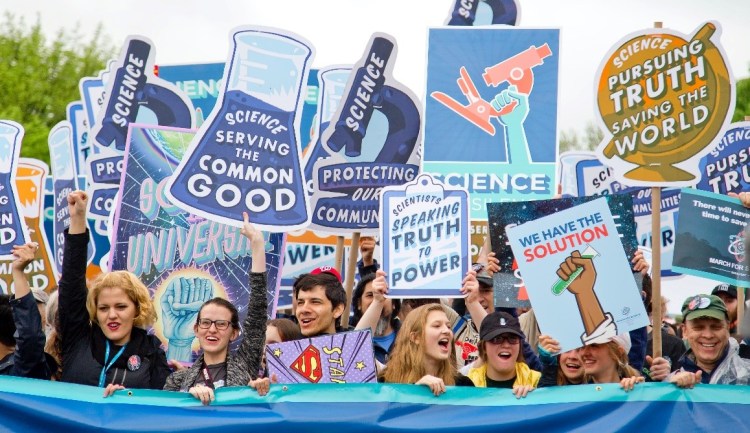
If you’re frustrated with the way politicians talk about science, you can offer your skills and experience to help them do a better job.
If you have political experience, you can apply to be a paid campaign staffer, but a lot of the time, this work is done for free.
Here are some ideas to help you plug into political campaigns as a scientists or science communicator.
- Look at down-ballot races, such as local and state races. “All politics is local,” as the saying goes. Not only will you be able to make more of an impact in local races, but as smaller races, they often need more support.
- Build up campaign-related skills. Reach out to the local political party with which you are registered to see what local races are happening, and volunteer to go door-to-door or make calls for a candidate you support.
- Offer to help a political candidate build a science community, and give the campaign key talking points on science issues in a nonpartisan way that can rally broad support. For example, in the 2024 elections, I founded “Scientists for Harris,” which became an official coalition of the Harris-Walz campaign.
- Put together a speaking toolkit for a candidate. That could include important and salient messaging, as well as rapid response communications, which is tough to do for science issues unless you have a science background.
- Volunteer your expertise for the betterment of the campaign. For example, if there’s a debate coming up, offer to be a resource about scientific issues.
You might be asking: this sounds like a cool job, but how can I actually get to do this?
One way is to come up with a cold email template with your credentials, previous science communications work, and so on. (If you have prior political campaign experience, it would be good to mention that, too.)
In your message to the campaign team, lead with your expertise, and offer to use your science expertise to make their campaign communications more impactful.
Another way to do this would be to volunteer with a campaign, and use your time there to figure out what might be needed in terms of science communication. Candidates might need help with messaging, speechwriting, and more. You might even leverage your background directly when talking to voters to engage them on science issues and talk about why the candidate you’re working for is the best choice.
However you approach it, make sure you reiterate your science background and your desire to help the campaign craft narratives around science and technology.
Have you worked as a science communicator on a political campaign before? What lessons did you learn and what advice do you have for people seeking to get into this space? Comment below!
 Fancy Comma, LLC