By Sheeva Azma
I may be a science writer and policy consultant, but one thing people may not know about me is that I have also been a US government/civics educator and curriculum developer. Talking to science-minded people, I have learned that this viewpoint is somewhat unique.
Yes, we live in dynamic times as scientists and science policy professionals, but perhaps thanks to my civics and government knowledge, I am less fearful that most. I have also worked in Congress, where I learned that it is a completely separate branch of government that can choose to align with the executive branch, but does not always.
As time goes on, and executive actions on science continue, more and more scientists are being affected. Scientists may feel fearful and powerless and wonder if there’s a way forward in the United States’ support for science that does not jeopardize their already tenuous careers. It seems clear to me that many of these actions are unconstitutional, but our government is designed to be slow and clunky, not “move-fast-break-stuff,” so we must remain patient until the dust settles.
Still, it seems like every day, a new grant or funding mechanism is cancelled. In March, I spoke at the Oklahoma Capitol about it all as part of the global Stand Up for Science day of action.
As a science policy professional, my advice to scientists is to learn more about the way the political world operates, and about how power and influence works. (This power comes directly from the people who vote and is also wielded by Congress and the President on the voters’ behalf.)
Keep reading for five super concrete, actionable ways scientists can do more and fear less amidst changing political tides. Above all, curiosity about government and its functions — and ways that voters shape our government — is essential for creating a sustainable US science infrastructure that can survive political whims.
No, this is not one of the Fancy Comma science policy blogs that ends with a compelling call-to-action like “Call your Senators!” but sometimes, just learning stuff can be powerful. As Marie Curie said, “Nothing in life is to be feared, it is only to be understood. Now is the time to understand more, so that we may fear less.”
Understanding a bit about government and policymaking can help you better direct your science policy energies…so let’s get to it.
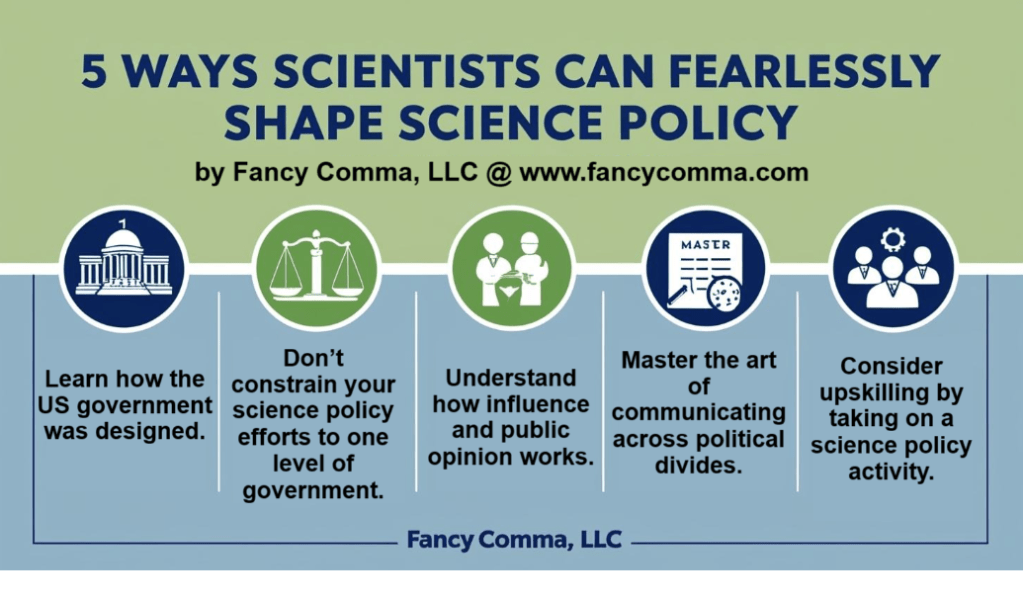
1. Learn how the US government was designed.
The US government is characterized by its three branches — legislative, executive, and judicial — which have various checks and balances on each other. The functions of each branch are defined in the US Constitution. You can read the Constitution here.
If you work in one of those labs where your experiments end up being developed over a series of really deliberate lab meetings, good news — the Constitution was developed the same way. A trio of founding fathers (John Jay, James Madison, and Alexander Hamilton) published a body of essays known collectively as The Federalist or The Federalist Papers in which they explored various aspects of what their ideal government might look like. They wrote these essays to persuade people that they had good ideas about how their proposed government might help serve everyone. Scientists can therefore learn a lot about how to get people to agree with you in government just from how the Constitution was created alone.
You can read The Federalist Papers online for free here. In these essays, the founding fathers explore ways to create a federalist government: one that protects against tyranny at the highest levels while also giving people rights that cannot be taken away from them by any level of government.
For more background on federalism as a system of government, check out this explainer video.
Also check out these blogs we’ve written:
- I also encourage scientists to learn about how science fits into all three branches of government.
- Science has less of a direct place in the Supreme Court, since lawyers are generally trained according to the humanities tradition, but you can read more about science as it’s used in courts here.
- Lastly, I encourage you to read about how science funding has worked since World War II. A blog I wrote on Vannevar Bush, the first presidential science advisor, is a good place to start.
2. Don’t constrain your science policy efforts to one level of government.
The great part about science policy is that there are at least three levels on which your efforts can happen: federal, state, and local. If you’re frustrated with what’s happening in the federal government, and it all feels hopeless there, direct your efforts more locally. This can provide you a break from dealing with federal aspects of lawmaking while creating a greater and more immediate impact in your local community. If engaging with the pettiness that can be local politics is crushing your soul, look to state or national politics.
For more on engaging in science policy in federal, state, and local government, check out these blogs we’ve written:
- 21 Ways to Get Involved in Science Policy as a Scientist
- Engaging in State and Local Policymaking as Scientist
- Get Involved in Science Policymaking at the State Level (All 50 US States!)
- Science-Informed Policymaking for State Governments
- Working in Congress as a Scientist
- A Scientist’s Guide to Staff Roles in the US Congress
3. Understand how influence and public opinion works.
Public opinion is what elects candidates to office. As scientists, we have a different viewpoint of society than non-scientists, and since we are in the minority, it is useful to look to what most people are thinking and feeling. Politicians and other organizations also frequently engage in what is called “public affairs,” which is a whole field dedicated to shaping public opinion through various means.
Learn more about public opinion and its influence on science policy in these Fancy Comma blogs:
- Will Scientists Heed the Data on Public Trust in Science?
- Public Affairs: An Entire Field Dedicated to Leveraging and Shaping Public Opinion
- A Scientist’s Guide to US Political Campaign Roles (I wrote this guide for those who wish to take on the challenge of electing a pro-science candidate.)
4. Master the art of communicating across political divides.
Wherever you choose to focus your efforts, don’t insult lawmakers with whom you disagree. Figure out ways that you agree with them and commit to working with them.
It’s on you to make yourself relevant and approachable to lawmakers, not the other way around. That’s how power and influence works.
It’s incredibly rare to unseat a lawmaker with whom you do not agree, unless you have a large, grassroots movement of voters who agrees with you (and even then, the odds are never completely in your favor to unseat an incumbent). So, learn to work within the system.
For more on working through the communicative and logistical aspects of science policy, check out these Fancy Comma articles:
- Working with Policymakers across Divides
- Non-Partisan Science Communication on Capitol Hill
- Comparing Scientists’ and Non-Scientists’ Use of Science in Congress
- Best Practices for Taking Science to Congress
5. Consider upskilling by taking on a science policy activity.
Science policy is not a glamorous activity. It is a necessity given the lack of scientists in politics. Your science policy involvement will also likely be unique to your interests, skills, and experiences as a scientist and the outcomes you wish to achieve.
Check out our science policy blogs for more information on being a policy-informed scientist. Here are a few to start with that I recommend.
- What Is Science Policy?
- 21 Ways to Get Involved in Science Policy as a Scientist
- An Intro to Policy Analysis (and why scientists already rule at it)
- Scientists, Here Are 5 Steps to Become a Science Policy Consultant
- A Scientist’s Guide to US Political Campaign Roles
- Working in Congress as a Scientist
- A Scientist’s Guide to Staff Roles in the US Congress
What else would you like to know about scientist involvement in science policy? Comment below.
 Fancy Comma, LLC
One thought on “5 Ways Scientists Can Fearlessly Shape Science Policy”