By Sheeva Azma
From the hyperlocal and unglamorous to the glamorous and downright self-sacrificing, working in science policy can have it all.
From small to large, no action is too insignificant (or too much) when it comes to science policy. As scientists, perhaps we take federally-funded science for granted. It can also feel weird to step into the policymaking role and advocate for something we clearly love sooo incredibly much. Well, that’s what we should be doing as scientists operating in a federally-funded landscape.
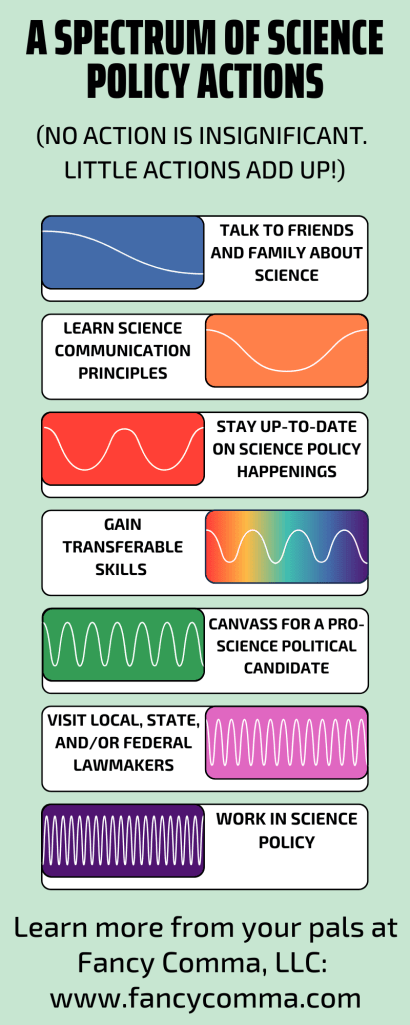
Think of science policy involvement as a spectrum.
At one end of the spectrum is the hyperlocal, small things that add up. In science, we always seek the big Nature paper or the day where we get good data for once. This is not that. Having conversations with loved ones and even random people about science, the science you do, the importance of science for society, and the need for federal science funding is still important, though unglamorous, work.
At the other end of the spectrum is the glamorous and, along with it, stressful life of working in science policy. Landing a prestigious Congressional fellowship with AAAS (there’s only one or two per year, as far as I know) is the science policy equivalent of landing a first-author paper in Science in terms of its competitiveness.
Interning in Congress — something I’ve done in the policy world as a scientist — is a bit less competitive, so maybe a step or two down on the #SciPol spectrum from working full-time in a paid, prestigious fellowship. I have previously blogged about my experiences in Congress, the things I did on a day-to-day basis, and the unglamorous reality of what it was really like working for free as a Congressional intern with a Master’s in Science.
There’s a lot more in between (and, if you’re creative, you can probably think of a lot more examples of things that might go on such a spectrum).
For examples of what a “science policy spectrum” might look like, I modified a diagram of the electromagnetic spectrum (yes, the electromagnetic spectrum, from radio to gamma waves, is still represented – you can check out the original image here).
To say a bit more about the analogy of science policy involvement being like the electromagnetic spectrum: talking to friends and family about science is low-effort and low-commitment, yet still valuable — so to me, it’s like radio waves, which carry low energy but bring delight in the form of radio broadcasts. Gamma waves, such as those found in cancer therapies and certain medical imaging techniques, are very powerful and high-energy, but they carry their own set of challenges as a result. I compare those high-energy, shorter waves to science policy involvement by working directly with science policy stakeholders to create evidence-based policies to help people.
Does that make sense, my science-loving friends? For more, check out my infographic here:
So, now that I’ve told you about my idea of the science policy spectrum, let’s get into the essential skills you might need and the types of jobs you might consider as you figure out your ideal level of science policy involvement.
10 Essential Skills for Science Policy
Wherever you wish to situate yourself along this spectrum, there are some essential skills to work on developing. These skills can be gained in science and adjacent to science, and are transferrable to a wide range of careers.
Essential skills for scientists working in policy include:
- Strong written and oral communication, and especially the ability to explain complex science to non-experts (learn more with our FREE SciComm resources!)
- Research and analytical skills to gather, evaluate, and synthesize evidence for policy decisions (you’ve already done a lot of this as a scientist, just with different datasets)
- Understanding the scientific process and evidence-based policymaking
- Strategic thinking and the ability to develop, implement, and evaluate policy
- Interpersonal, networking, and consensus-building skills for working with diverse stakeholders
- Leadership and management abilities for coordinating projects or teams
- Traits that help bridge the gap between science and policy cultures, such as curiosity, openness, humility, and respect
- Awareness of how government and policy processes work, including practical policy writing (briefs, memos, one-pagers)
- Audience analysis and tailoring messages to policymakers’ needs
- Problem-solving and resilience when navigating complex or uncertain policy environments
10 Types of Science Policy Jobs
Science policy roles span government, non-governmental organizations, advocacy groups, think tanks, and more, allowing scientists to inform and shape policy decisions at multiple levels.
Scientists can work in the policy world in many ways, including:
- Advising policymakers as science advisors or technical experts
- Managing science-based programs in government, industry, or the nonprofit world
- Engaging in advocacy to influence policy decisions
- Communicating science to policymakers, stakeholders, and the public (we do a bunch of this!)
- Writing technical reports and policy briefs for agencies or consulting firms (we’ve done a lot of this as well!)
- Participating in science diplomacy and international collaborations
- Educating the public and/or policymakers about science-policy intersections, such as via science policy consulting
- Conducting policy-relevant research and data analysis for government or think tanks
- Working in legislative roles, such as congressional staff or committee advisors
- Joining science policy fellowships, including at the state level (where available), to gain hands-on policy experience
Upskill with Fancy Comma’s FREE Resources for Scientists
For more, check out our FREE science policy, communication, journalism, and marketing resources. If you’re a scientist working in policy — get in touch! We’d love to learn more.
 Fancy Comma, LLC