By Sheeva Azma
Creativity is a consequence of a life well-lived.
Do you ever have that feeling that you want to write something amazing and life-changing, but can’t figure out what? That happens to me a lot.
(If you’d like to hire me to write something amazing and life-changing, check out our services and get in touch!)
You can now go to ChatGPT (or my favorite, Perplexity.AI) when you’re feeling uncreative and draft something really quickly, but for me, using generative AI tools to write still feels like thinking inside of the box. I do not really understand how people can feel more creative using what equates to software that predicts how often words occur together in sentences and gives you more sentences based on that.
Isn’t that the most inside-the-box thing ever?
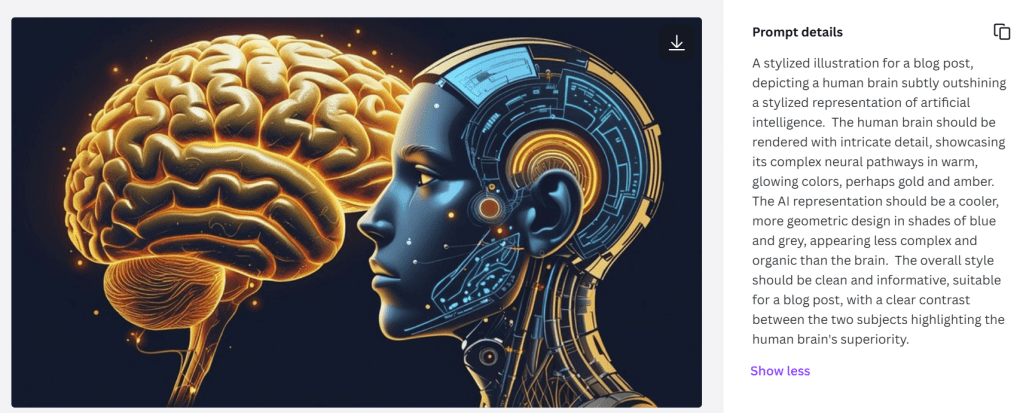
While I am a writer and sometimes a graphic designer, I am not a visual artist. Below is an image I generated with Canva‘s AI tool in like, a minute at most? Here is the prompt I gave it: “make an image for a blog that shows the human brain being superior to AI.” It came up with its own internal prompt to do this (see the text on the right), which I find entertaining. In working against its own self-interests, it still did a good job.
Still, a large language model does not have access to my human experiences and knowledge. Those are two things I value as a writer.
I get why people use AI, and I now use it in limited ways to save time (as I did with the image above — but for the text of this blog, I did not use AI, besides a couple of Google searches, which now have AI elements). When I was working 12-hour days and getting burnout in the pandemic, I might have had some glimmers of good ideas, but I did not have any time to execute on them, nor did I think I could be the person who got those ideas out in the world. I was way too overworked and was not taking care of myself.
Looking back, even generative AI would not have saved me back then. There was a knowledge gap on how to communicate science well and existing resources did not cut it. You can’t train an AI model unless you have some information to feed it. In fact, that’s what gave me the idea to start the Fancy Comma Blog in the first place. I did not enjoy making work my entire life during COVID, but, hey, as a pandemic science communicator, you gotta do what you gotta do.
Long story short, once I started to improve my work-life balance, my creative productivity as a writer increased immensely. Below is a list of five things that have helped me be more creative in my pursuit of a balanced life.
1. Work less and sleep more.
This is the longest bullet point in this blog post, and it’s because I am obsessed with sleep and its effects on my overall health and well-being. How your sleep schedule looks like is called “sleep hygiene,” and I am obsessed with this concept.
(If you’re one of those people who can barely get enough sleep, consider that taking naps can also give you a restorative benefit!)
There’s so much scientific evidence by now that shows that sleep is good for brain function — and that not sleeping enough impedes brain function.
Since I’m a neuroscientist, let’s just get right into the science: sleep deprivation reduces cognitive function (though the linked article suggests that exercise might mitigate that somewhat), impairs memory and your ability to perform goal-directed tasks (such as writing), and makes you prone to dangerous things like car accidents. What’s more, during sleep, your brain is in a maintenance mode in which your brain cleans itself up and forms your long-term memories.
For years, I had bad sleep hygiene without knowing it. I drank coffee at 7 pm and wondered why I was still awake at 3 pm; I stayed up late on my laptop and wondered why I felt so awake (answer: the light emitted by electronic devices signals to your brain that it is daytime!).
Now I wear blue light glasses when I write to block out the bright LED light that keeps me awake, and I limit caffeine consumption.
It’s tempting to stay up all night and write, and I’ve been there. I relish my time asleep because I know that it is helping me live a better life, even if it takes time out of my day that I could spend doing other stuff. I just now save my sleepless writing episodes for those days I wake up at 2 am and can’t go back to sleep.
2. Live life.
One challenging thing about being a writer is that your work takes you away from people. The writer’s life is a solitary life, for the most part. However, you need something to write about. I guess you could write about the coffee mug that you use every day and the various levels of hotness that your coffee ends up being by the time you drink it, or what the wall behind your computer looks like, but let’s face it, writers are people, too, and we need life experiences to be better writers and humans.
People often brag about closing their laptop and being done with work, and I never understood that until I started working towards work-life balance. I wish we could glamorize taking time away from work as a society as much as we glamorize the hustle. Consider me your anti-hustle hype woman!
3. Do the things you love.
One annoying thing about my early freelancing career (let’s say from 2013 to 2019ish, before I started Fancy Comma) was that I was always working…or forcing myself to sit in front of my laptop since I could not concentrate, and thought I could get myself to work more.
Weirdly, novice copywriters these days won’t have the excitement of writing 1000 words on marbled concrete anymore, since ChatGPT can do that. What an odd thought, as that was the motivating reason I was drinking two large coffees at 11 pm many nights as a 30-something freelancer, gearing up for an all-nighter since I already could not sleep due to the stress of being an early-career copywriter. Yeesh.
So, instead of forcing yourself to sit in front of your laptop in hopes of getting work done, live life. Ask ChatGPT for the 1000 words on marbled concrete…or whatever the topic of the day might be. Technology has made it possible!
4. Don’t ignore the ideas you get in your downtime.
One day, I was on my way to go running — like, I was literally pulling into the parking lot of my favorite running trail — and I got one of those ideas that was so good, it shocked me.
It was this: since all I do on the blog and YouTube and various other social media channels is educate people on working as a writer with a science background, why don’t I just turn that into a science communications course?
So, I did, and you can check it out here. I wrote a syllabus, and then recorded them as lectures, which you can find here.
It was such a great idea that The Open Notebook adopted a similar model about a year and a half later for their science journalism syllabus. (Whispers) I’ll never know if they read my curriculum before they developed theirs, but look at the way the webpage is structured — it mirrors ours so closely!
THAT’S how good of an idea it was…and I might never have gotten it if I didn’t close my laptop, put on my running shoes, and physically leave my house that day.
I love when I get an idea so good, it changes the world, and I want to do more of that…but that requires living life, and is not easily accomplished sitting at home (yes, that’s as much of an introvert pep talk as it is a life lesson I have learned).
5. Find inspiration in every corner of your world.
There’s this idea called bricolage that I wrote about for the Fancy Comma Newsletter and it’s basically that you can create new ideas by consuming information from a diverse variety of sources. If you read that newsletter, I talk about how I get ideas for communications based on commercials, Keeping Up with the Kardashians, my favorite YouTube makeup influencers, and more.
Not into high-brow reading? Hey, as a science communicator that’s even better than being into highly scholarly and technical stuff, if you ask me, since most people you will communicate with do not have a science background! Don’t let your scientific colleagues shame you out of consuming the content that you love. Use it to your advantage. Bring your love of The Bachelor (or whatever other reality TV show) to your work and apply the lessons you learn about the way people present themselves on that show to how you present scientific concepts.
That’s all I’ve got! What questions do you have about creativity and living a well-balanced writer’s life? What has worked for you? Chime in below in the comments.
 Fancy Comma, LLC
One thought on “Yes, You Can Be a Writer and Build a Life You Love in our AI Times (Here Are 5 Ways)”