By Sheeva Azma
Fancy Comma has affiliate partnerships to support its content. We may earn commissions for products purchased via affiliate links.
Jorge Luis Borges’ philosophical short stories were a perfect accompaniment to my intense science and math MIT education.
In early 2001, I was writing my first ever college paper in Spanish at a computer cluster at MIT (the one in building 56, to be specific) when I realized that I had no idea how to write Spanish characters — the letters with accents and the tilde, to be specific. So, I typed my essay out using the letters on the American keyboard, printed out my essay, added tildes and accents to the letters I needed to, and submitted it. I don’t remember what grade I got, but I ended up learning how to use accents in the text editor I was using, Emacs, later (any other Emacs fans out there?).
I had done some research and figured out that, since I had tested out of having to take a college English course, I could minor in Spanish Language and Literature if every single one of my electives was a Spanish Language and Literature course. So, that’s what I did, and I graduated with my minor in 2005, and a deepened love of Spanish Language and Literature.
Taking any form of humanities course at MIT was a welcome break from the challenging math-and-science heavy coursework. I was good at writing, and the environment of the courses was also so much more humane than our STEM courses. My chemical engineering classes felt like a mental workout in which we just learned how to work endless equations, while my Spanish language and literature classes had a more relaxed pace. Even though it felt like I was always sleep-deprived in Spanish class, we often had interesting discussions about life, literature, and the history of Latin America, and learned Spanish (or practiced Spanish, for the case of my many Spanish-speaking classmates) in the process. Sophomore year, I was barely surviving in my intro chemical engineering courses (back before I switched to neuroscience), but I pulled off an A in Hispanic Film and Literature. I wasn’t as lucky my senior year when I got A’s in my neuro courses but a B in my Short Stories of Spain and Hispanic Literature class.
Despite my lower grade, I am really a fan of short stories because I don’t always have the time or attention span to read a novel. I also got into writing as an award-winning writer of short stories in high school, myself, and I really appreciate short stories as an art form. You can say a lot without writing a lot of words.
So, maybe that’s why one writer I really like in Spanish-language literature is Argentine short story writer Jorge Luis Borges. His stories, which, according to Wikipedia, influenced the 20th century magical realism genre in Latin American literature, have various themes such as mirrors, labrynths, and infinity. They spoke to me. I have since learned from Wikipedia that he was friends with Pope Francis (before he was the Pope), and that he went blind by age 50.
Another reason I really liked Borges’ short stories is that I spent significant time in class and in essays analyzing them, and even though I would sometimes get the wrong answers in lecture in my science classes, it was easier to understand and analyze short stories without being publicly shamed by my professor. That’s in contrast to one of my thermodynamics classes in which I prided myself in knowing a right answer, but my professor wasn’t impressed, telling me I knew the answer because I read ahead. Nope, nothing like that in Spanish class, where everyone was actually kind and actually listened to each other, with the limited mental battery we had left from our other classes.
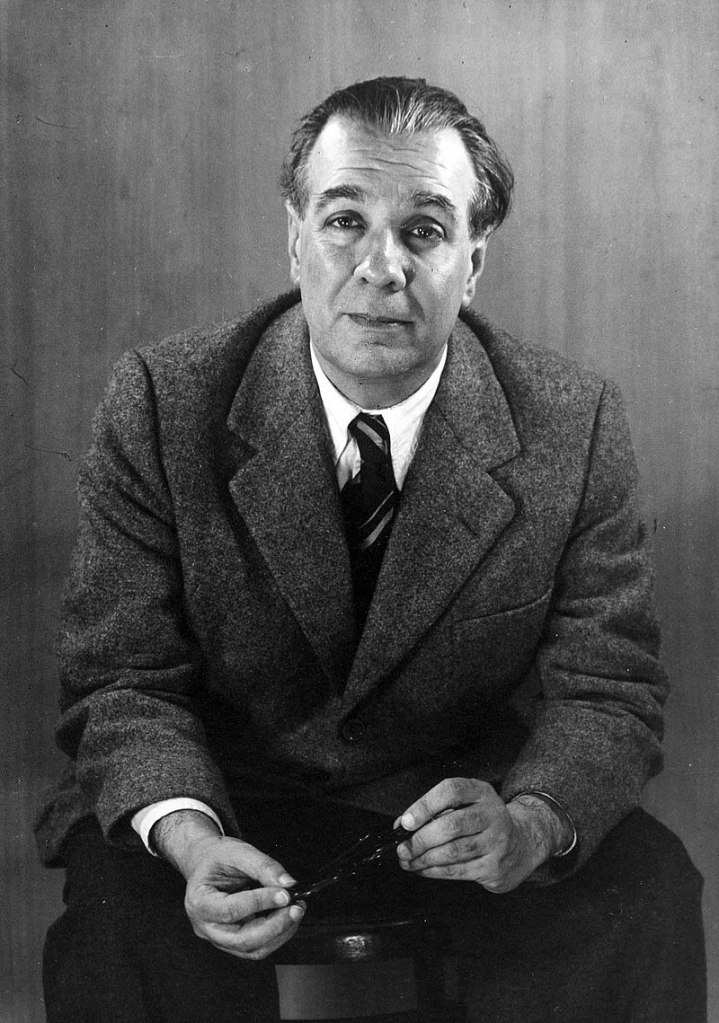
My favorite stories from Borges
The most comprehensive set of short stories by Borges can be found in Collected Fictions, but I have included links to his other works at the bottom of this post.
Who are the inventors of Tlön? The plural is inevitable, because the hypothesis of a lone inventor—an infinite Leibniz laboring away darkly and modestly—has been unanimously discounted. It is conjectured that this brave new world is the work of a secret society of astronomers, biologists, engineers, metaphysicians, poets, chemists, algebraists, moralists, painters, geometers… directed by an obscure man of genius.
Jorge Luis borges in “Tlön, Uqbar, Orbis Tertius”
“Tlön, Uqbar, Orbis Tertius” and “Library of Babel” – You can find these short stories online in various corners or can purchase Labyrinths or Collected Fictions, which have these stories in their collections. These stories are about magical worlds created from the author’s imagination. The stories also blend elements of philosophy, linguistics, and mathematics, with a very scholarly, almost historical vibe.
The universe (which others call the Library) is composed of an indefinite, perhaps infinite number of hexagonal galleries.
Jorge Luis borges in “The library of babel”
“Funes, His Memory” also known as “Funes, the Memorious” — you can find it online around the web or as part of a collection of short stories. It is in both Labyrinths and Collected Fictions as well. The story details the author’s memory of a character named Funes. In piecing together this recollection, Borges goes on various other tangents relating to various scholarly topics, mentioning both John Locke and Jonathan Swift, and overall, leaving the reader feeling like they just read a brand new type of scholarly work (which they did).
The two projects I have mentioned … are foolish, even preposterous… but they allow us to glimpse, or to infer, the dizzying world that Funes lived in.
jorge luis borges, “funes, the memorious”
There are so many other short stories I love by Borges, such as “Death and the Compass,” “Emma Zunz,” and “The Aleph,” but you will have to check them out yourself. Check the first few pages of the samples for each of these books to see which stories you can find in them. If you’re trying to read more on a budget, check your local library rather than buying these books!
- Collected Fictions, known as the most comprehensive selection of Borges’ short stories, was described as “weird and entertaining” by an Amazon reviewer.
- Labyrinths
- The Aleph and Other Stories
- Selected Non-Fictions
- On Writing talks about Borges’ views on writing.
- The Book of Sand and Shakespeare’s Memory is a collection containing some of his very last stories written at the end of his life, including the story “Shakespeare’s Memory,” which is considered his final story, and was published in 1983.
- On Mysticism was published posthumously, thanks to Borges’ widow, in 2010 (Borges died in 1986).
- Selected Poems is available in paperback only, but has been described as a “must-have” by an Amazon reader.
If you’d like to read about Borges and have scholars contextualize his works for you, check out The Oxford Handbook of Jorge Luis Borges.
Read more of our book reviews here and here! Subscribe to our blog so you do not miss new posts.
 Fancy Comma, LLC
