By Sheeva Azma
Fancy Comma has affiliate partnerships to support its content. We may earn commissions for products purchased via affiliate links.
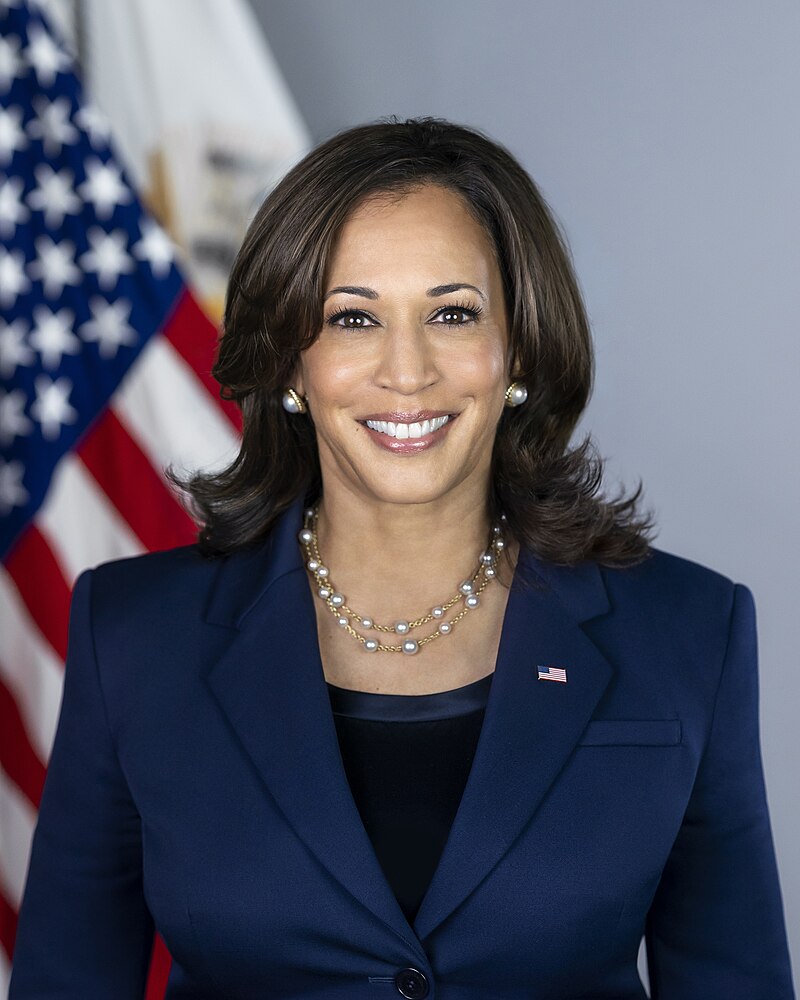
“One hundred and seven days were not, in the end, long enough to accomplish the task of winning the presidency,” writes Kamala Harris in her campaign memoir, 107 Days.
Before I review 107 Days, I should note that I was a Kamala-Harris-for-president early adopter, if such a thing can exist (I guess it does exist as the K-Hive — but that’s for fans of Harris, not people already working on her campaign before it started).
I was working on the Biden-Harris presidential campaign as a volunteer with Arizona Democrats for most of 2024, and the moment Harris announced she was running, I created Scientists for Harris, which became an official Harris-Walz sanctioned coalition that found me on important Zooms between substitute teaching gigs. I was one of the lucky ones invited to attend one of the very first Harris-Walz political rallies in early August 2024 (where I was also a volunteer, and about which I made our first vlog).
Given all of that, I do not write this review as an objective assessment of the book, which has only netted 3.3 out of 5 stars on Amazon as of writing this review in late September 2025. To be honest, especially as a woman working in various male-dominated fields, I do really want to see Kamala Harris become the first woman president, and reading this book just made me feel more confident in that belief.
107 Days is not a post-mortem of a failed campaign. It’s one of those books that you get from deep, reflective contemplation…reframing the crushing defeat on the campaign trail as the basis of a renewed campaign. The book does not shy away from sexism and racism and, refreshingly, comments on both. She remarks that politics is a contact sport…which suggests to me that perhaps she is ready for another round?
“[…T]he higher you rise in the political food chain, the harder it gets. This is not a genteel profession. You must be ready to brawl,” Harris writes.
Though the Harris-Walz campaign stop in Arizona took up all of my mental (and physical) energy as a volunteer that day and in the ensuing couple of weeks, it didn’t get discussed in her book except to say that it had already happened on August 10. Womp womp. However, she did allude to the “blisteringly hot” Arizona weather later and even acknowledged that “so many people stand behind a candidate, doing unglamorous, indispensable work”. She also recalls this conversation from one day before the election:
“What are you most proud of?” one reporter asked me. “My team,” I said without hesitation. They had put their lives on hold.” — Kamala Harris in her book, 107 Days
Though I had already spent the 107 days of this campaign behind-the-scenes as a volunteer organizer, I purchased this book because I wanted an insider perspective of what it was like to lead this campaign and to learn more about things like: what was the social media strategy like? Who was the policy person and why were there so few policies put out? Who was the lead speechwriter?
Well, reading this book, I got my answers:
- Harris was daunted by the thought of leaving the daunting campaign work to a team, but decided not to “micromanage”;
- She gave the go-ahead to establish a TikTok presence early on in the campaign; there was a dedicated policy person, but not enough time to come up with policies to reverse damage Harris cites stemming from the first Trump administration; and
- The lead speechwriter was a fellow named Adam Frankel. Before Harris’s speech at the Democratic National Convention, she prepared with Greta Gerwig, writer and director of 2023’s Barbie movie.
Indeed, this book answers all my burning questions about the inner workings of how such a short campaign worked. It appears it felt like just as much of a frenzied slog, if not more, to Harris, as it felt to me.
On the second day of her campaign, she made an intentional decision to work with existing resources, which brought its own challenges: “I didn’t have time to build a new plane; I had to fly the aircraft available. It would have been a self-inflicted disaster to blow it up, 106 days from the election.”
I did not have time, she writes, referring both to the short nature of the campaign and the amount of work ahead of her to undo policies she found harmful. “In this short campaign, I just didn’t have time. I had to triage issues so that key information could sink in,” she writes in the chapter titled July 25. “I did not have time, in 107 days, to undo ten years of Trump’s demonization of immigrants,” she recounts in the chapter titled September 27.
I was surprised to learn about science’s prominent place in the Harris campaign. Perhaps it should be no surprise, given that Harris’s mom was a scientist herself. “My mother had two goals in her life: to raise Maya and me, and to cure breast cancer,” Harris writes.
I was excited to read that Harris’s senior policy advisor, Ike Irby, is a climate scientist. I have heard from the grapevine (more specifically, I want to say from talking to fellow scientists in Scientists for Harris) that when it came to AAAS Science Policy and Technology fellows, Senator Harris’s office always had a Fellow working on climate issues. That seemed to make sense as she certainly mentions climate often in the book, and the need for climate action, especially in the context of natural disasters.
I recalled my glimpse of Senator Harris’s office in the halls of Congress as I made my way to a briefing when I interned there in 2017. Her office was noticeable because it was right by security, and by the main entrance of the Senate Office Building — which meant it was likely very loud, but apparently not too loud for scientists to work there. Back then, I had also wondered to myself if she had presidential ambitions — and I guess she did!
Going back to the book, Harris criticizes President Trump’s choice of Robert F. Kennedy, Jr. to lead the Department of Health and Human Services, a choice she called “irresponsible.” In the last chapter, she calls out the “destruction of scientific research” and suggests that President Trump feels he has a mandate to carry this out, though she states that he does not.
In the last chapter, she calls out the “destruction of scientific research” and suggests that President Trump feels he has a mandate to carry this out, though she states that he does not.
I also enjoyed the anecdote she shared about visiting the famed Pasteur Institute, where her mom had once worked, on a trip to Paris: “I was speaking informally with the scientists there about how I wished politicians would more closely follow the scientific method: testing a hypothesis and adjusting according to results, rather than coming in with the Plan, as if they had all the answers up front.” I love that! We could benefit from science being more infused in politics more generally, and that can start with scientists learning to upskill as much as it can be facilitated by politicians engaging in hypothesis-testing.
She mentions at least a couple times in 107 Days that, as Vice President, she was the tie-breaking vote in passing the Inflation Reduction Act, a 2022 U.S. federal law that made significant investments in climate and energy via tax credits, grants, and other incentives. She also mentions her belief that artificial intelligence (AI) should be used “for public interest.”
I also learned some relatable and fun facts about Harris. Did you know, for example, that Kamala Harris is a huge fan of the show Shark Tank, and her favorite thing to do is to Google the businesses and see how they did years later? I find that very relatable, especially as a big Shark Tank fan myself.
I recommend reading 107 Days if you are interested in a deep dive into Harris’s policy decisions, and especially if you are looking for a refreshing break from the current governmental science policy. As a scientist, you may actually agree much more with Harris on some of her policy views, especially on climate and environment, than you might with the Trump administration or even previous administrations. It is interesting to see such a pro-climate stance, but perhaps that is not surprising for a candidate from California, a state which faces many climate challenges such as droughts and wildfires.
In case you’re wondering how Harris felt losing the election, I can say that her feelings, as described in the book, felt remarkably similar to mine. Here’s what she felt right after her election loss:
All I could do was repeat, over and over, “My God, my God, what will happen to our country?” — Kamala Harris in 107 Days
I’m excited that she has published this book and optimistic about what it means for our society and nation. I’d love for you to read the book for yourself and make your own decisions about her platform. You can find it on Amazon here.
 Fancy Comma, LLC
