By Sheeva Azma
Fancy Comma has affiliate partnerships to support its content. We may earn commissions for products purchased via affiliate links.
Even though I never voted for George W. Bush, I respect the tough decisions he had to make as president and admire his commitment to public service.
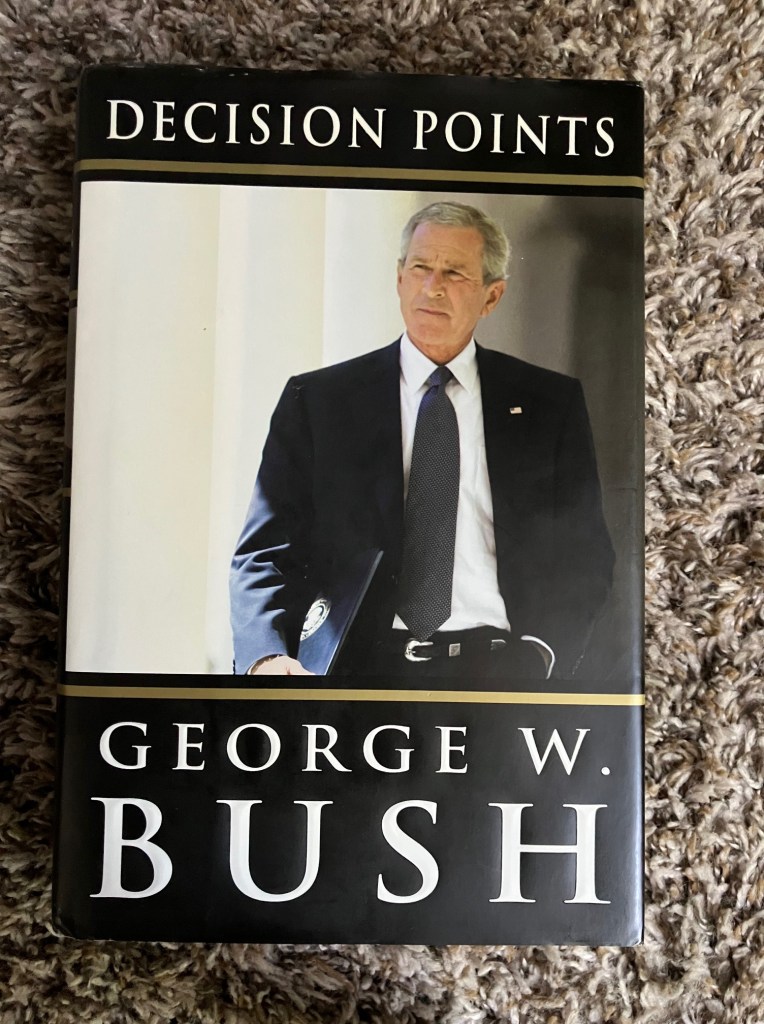
I didn’t vote for George W. Bush either time he ran for president, but I enjoyed his memoir, Decision Points.
Over time, I came to find George W. Bush (aka “Dubya”) relatable as a person, even if I still did not always agree with his political views. Most of his presidency occurred during my college years at MIT in cobalt-blue Massachusetts, and by the time I left for college, I had already campaigned for Dubya’s 2000 opponent, Al Gore.
I’ve always found Dubya to be one of the more relatable politicians out there, and even if his views became more and more unpopular during his presidency, at least they were well-reasoned, as I learned from his memoir, Decision Points.
A couple years ago, I found Decision Points, on the clearance rack of a local bookstore for only $3, so I bought it. It sat on my to-read pile of books (yes, of course I have a physical to-read pile…I also have an electronic version on my Kindle) until the end of 2025. At that same bookstore, I also found a memoir by Dana Perino, who served as Press Secretary in the Bush administration, for $3.
The whole Dubya presidency happened so quickly and dramatically. I was a senior when the Supreme Court decided on Bush v. Gore. A few months later, just days after I arrived at MIT, 9/11 happened, and I watched it live on TV…and just went to class, since MIT did not cancel classes until later in the day. Years later, I have decided that the fact that I casually watched that happen on TV and then went to class is a testament to my ability to persevere. I don’t think I will ever forget how it felt to see that and carry on with my day.
Everything that happened in the ensuing years felt like way too much work punctuated by a blur of incomprehensible war news. To be honest, it was not a great time. I felt defeated in way too many ways, including politically.
In 2004, the US had just embarked on what would become two very long wars, and I wrote an article about why Dubya’s opponent, John Kerry, would make a better president. That was for Counterpoint, a now-defunct MIT/Wellesley magazine. My article was published in the October 2004 issue, just a month before Election Day. It sounds so much like me, just younger and way more idealistic [click here for a downloadable PDF of my article].
After reading Decision Points, I now have a slightly more nuanced perspective of the challenges Dubya faced as president, including the wars. Even if I don’t necessarily agree with all of the decisions, I can at least appreciate them and get Dubya’s behind-the-scenes perspective and rationale.
The memoir is meant to detail a few of his key decisions — not just political, but also personal, like his decision to stop drinking. He talks a lot about what he was doing on 9/11 and after, and has several chapters dedicated to his decision to go to war in Iraq and Afghanistan.
According to his book, he viewed the 9/11 attacks as an act of war, which is why he became a wartime president pretty much overnight. Maybe I should not have read so much Drudge Report as a freshman in college (my doom-refreshing would definitely be what we now call doomscrolling in today’s internet bandwidth!); it was jarring to see this evolve so quickly in short headlines and sound bytes. However, reading the story behind his decisions, including his recounting of the front-line workers at Ground Zero telling him to declare war, it all makes sense to me now. How would I have known any of that? I was just trying to learn as much STEM as humanly possible at MIT. Would knowing the backstory, back then, have changed my viewpoints? Honestly, probably not.
What motivated Dubya to persevere in the war effort surprised me — the way he describes it in the book, it was mostly his interactions with people, especially his interactions with military families. In his memoir, he describes getting letters from people whose kids were killed in action, encouraging him to persevere. He also relates a story about an orthopedic surgeon whose son died in action, who then enlisted in the military and went on to serve in Afghanistan, himself.
Maybe the war made sense to Dubya because he, himself, was a veteran of the military (something I didn’t really realize or even think about when I was in college). A Texas Air National Guard veteran and former pilot himself, it makes sense why Dubya connected so deeply with his fellow soldiers and felt united with them and felt so motivated to eradicate the US’s haters, so to speak. His connection with the military did not end after he left office; he is a multitalented man and, after he left the White House, he embarked on a project of painting the people he sent to war.
Decision Points dedicates several chapters to 9/11, the ensuing wars, and war strategy such as “The Surge,” which was an all-out effort to stabilize Iraq in 2007. It also talks more generally about Dubya’s “freedom agenda” to help countries around the world establish democratic governments — it’s a task that is easier said than done, and one that I still believe cannot happen unilaterally.
Beyond all the war discussion, some things surprised me about this book and about Dubya’s legacy. For example, one huge accomplishment of Dubya’s time in office was Medicare reform and, specifically, the establishment of Medicare Part D to pay for prescription drugs. Another humanitarian accomplishment was the establishment of the President’s Emergency Plan for AIDS Relief, or PEPFAR, which was established shortly after Dubya’s State of the Union speech in 2003 thanks to Dubya’s consultations with experts such as the now-often-maligned Anthony Fauci, who served as the Director of the National Institute of Allergy and Infectious Diseases (NIAID) from 1984 until retirement in 2022. PEPFAR was administered through USAID, which Donald Trump disbanded just after he was sworn in for his second term as president in early 2025. As such, currently, PEPFAR is administered through the State Department, and continues to be funded by Congress, as it was established by a Congressional act.
Other things about this book just aged shockingly poorly. For example, it is well-known that Dubya realigned federal agencies to create the Department of Homeland Security, which has been made more powerful in the Trump 2.0 era. I wonder what Dubya would say if you asked him about Trump’s immigration policies today. It’s also clear that Dubya’s idea for the Afghanistan war’s endgame was a lot more structured and intentional than the way it actually ended up going down in 2021, creating a power vacuum that emboldened the very people we spent just about two whole decades fighting against.
There are so many things he discusses in the book that are relevant today…and there are points of disagreement that we have. For example, I still disagree with Dubya that making illegal immigrants legal through amnesty is a violation of the rule of law (as he says).
However, I respect that he had to make some tough choices.
Did I mention that Dubya considered sending the National Guard to Louisiana after Hurricane Katrina due to looting, but all of his advisors informed him that, due to the Posse Comitatus Act, it was illegal to send federal forces to do law enforcement?
His presidency ends with the housing crisis and banks failing due to shady lending practices from banks…which had to get bailed out by other, larger banks.
In the end, the Dubya years apparently felt as chaotic to Dubya as they did to me. “The nature of the presidency is that sometimes you don’t choose which challenges come to your desk. You do decide how to respond,” he writes. His discussion of these events is masterful. He doesn’t make blanket statements — his arguments are all very well-thought-out and deliberate, much like the decisions he made. He uses precise language and doesn’t make sweeping generalizations. It makes you realize that, at the end of the day, he is a smart guy, regardless of what people say, even if that just meant that he knew what experts to ask to help him make decisions.
Check out Decision Points or read more of my political memoir reviews.
 Fancy Comma, LLC