Read Sheeva Azma’s blog series, “A Scientist in Politics.”
I’m both a science writer and policy consultant. Being a scientist in policy, or even a science communicator (let alone a professional science communicator in political communications) is not an established career path in science. People ask me how I did it, so I wrote a series of blogs to explain.
By the way, if you’re interested in working in Congress or on political campaigns, check out the guides I wrote to campaign staffer jobs and Congressional staffer jobs I have written since publishing this blog series. Anything else you’d like to know about working in politics as a scientist? Reach out!
By the way, if you, too, want to get involved in political campaigns, check out our free downloadable PDF on ways you can do so as a scientist.
“A Scientist in Politics” by Sheeva Azma
Part 1: Growing up Democrat in a red state
Part 2: Political organizing as a break from MIT
Part 3: A science PhD student in Washington, DC
Part 4: Leaving academia but not science
Part 5: Running the political gamut and working in Congress!
Part 6: Why can’t I stay away from politics?
Part 7: The 2022 midterm elections
Part 8: Working across party lines for a woman president
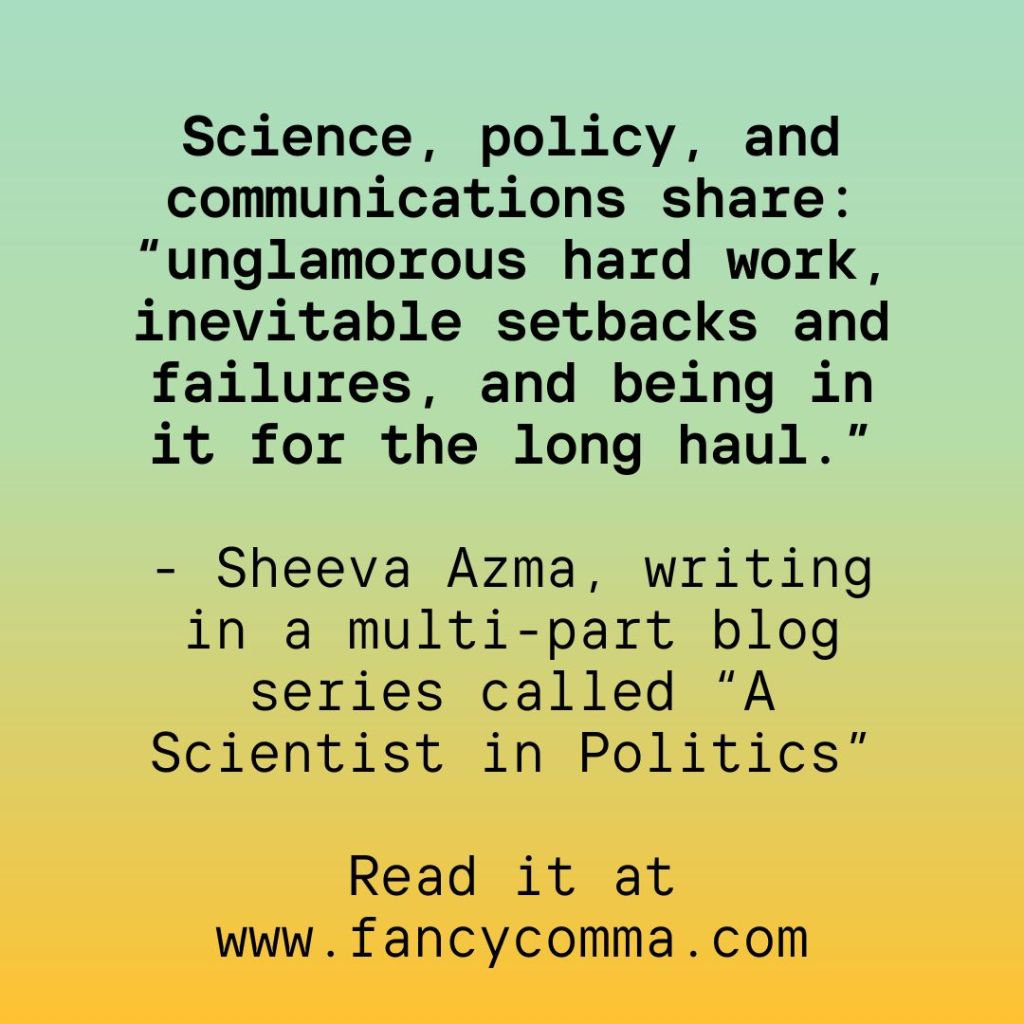
Pursuing all three (science, policy, and communications) has been a nonlinear, often uncertain lifelong endeavor. It probably helps that all three have the following aspects in common: unglamorous hard work, inevitable setbacks and failures, and being in it for the long haul. If you are a relentless learner (which all scientists are) and enjoy a challenge, you can succeed…but it takes a keen eye for opportunities, time management skills (to balance it all), and the desire to eat, sleep, and breathe all three.
It wasn’t until 2022, when I was preparing to chat on a science policy podcast called When Science Speaks (listen to my episode here!), that I realized that using my skills, knowledge, and expertise in science, policy, and communications together could be powerful. Together, this trio can: rebuild trust in science and deepen scientists’ conversations with society; help people live better lives through science-informed policies; and help policymakers take part in the complex, often jargon-filled discussions of the global science and technology landscape. What’s more, scientists can learn lessons from policymakers, who are themselves expert communicators, to better explain science.
I wrote the “A Scientist in Politics” series to share my experiences and empower scientists to make an impact. I view my journey unifying my three passions as a winding, uncertain, lifelong path of exploration. Like climbing a mountain, my journey has led me to a new and uncommon view of science and society. Join me — check out my free guide on ways scientists can get involved in political campaigns.
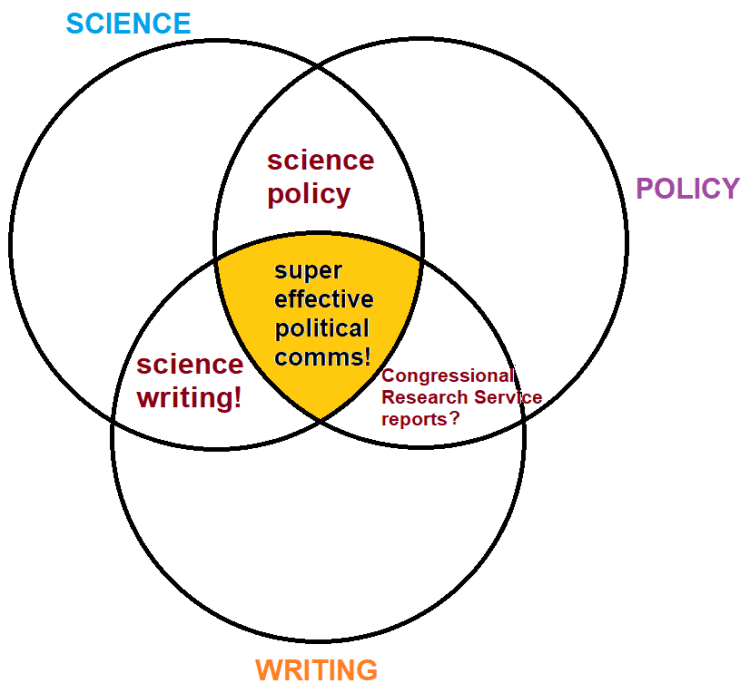
By the way, after spending 10 years as a scientist, being a science writer since 2013, and having lived my whole life as a lifelong politics nerd, I see the overlap between the three areas in the following way, as I’ve written:
To learn more about ways I bring my skills, knowledge, and expertise to Fancy Comma, check out our services page or read my articles on the Fancy Comma blog.
 Fancy Comma, LLC