By Sheeva Azma
Can understanding the sociology of science, or the ways in which our research questions are shaped by ourselves as scientists and by society, humanize science?
If you’re a scientist, you’ve learned about the scientific method and how to develop and test hypotheses. You probably haven’t thought about the ways that the science you do is shaped by the people who perform it – even yourself as a scientist.

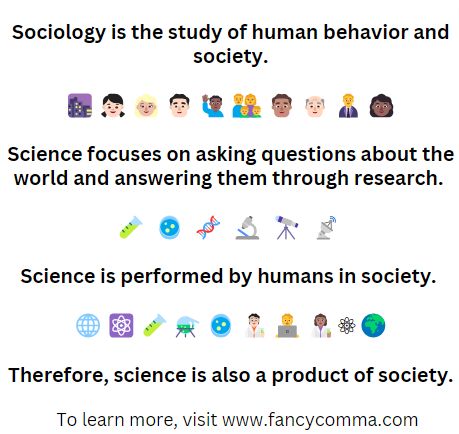
You can download this image here (right click and select “Save As”).
That’s not meant to be an indictment of scientists. I state this because the lens from which we develop hypotheses can greatly impact and shape the research being done – yet we never think about this, and definitely do not ever learn about this over the course of our scientific training, from kindergarten all the way through undergraduate, graduate, postgraduate, and other forms of science and science-adjacent training.
As a scientist turned science writer, I would love to see science communication (and the many issues involved in making science dialogue effectively with society) at the forefront of graduate and undergraduate science programs. I provide science communication tutoring and mentoring services, but I feel that that’s not enough. As scientists, we need to work to make science reflect the fact that it is, fundamentally, a human activity – performed for humans, by our fellow humans.
Keep reading to learn more about ways sociology of science can help inform science training and reform toxic science culture. If you’re from a university and are looking for an experienced science communicator to speak to your students, you can learn more about our science communications training services.
Fancy Comma Works to Help Break Down Barriers between Science and Society
Becoming a scientist requires the ability to analyze and evaluate information critically. Yet society – and even scientists – view the scientific process as a means to an end rather than a process. To most people out there, it seems like we do science to learn something about the world – to get a result. While that’s true, the results are not absolute truths, but rather, approximations of the truth as close as we can gather using the tools available to use as scientists. How many times have I seen a science study reported on the news as the be-all, end-all, when there were either methodological flaws or the reporting was actually even wrong? I noticed this a lot in the pandemic (and blogged about it). I have also blogged about ways to critically interpret and vet the rapidly emerging pandemic science.
One aspect of Fancy Comma is to help scientists be better able to communicate science so that science can be better utilized to improve society, lead to new laws, and generally promote better living through scientific understanding. We have previously discussed science communication methods such as telling science as a story and using strategies to portray science as a process rather than as a result.
Fighting an Uphill Battle to Make Science More Inclusive
As a science communicator advocating for science communication as an established part of undergraduate and graduate science programs, I find it tough to fight against a tide that wishes to keep scientists separate from society and “too busy” to engage with the people who are supposed to benefit from scientific understanding – the general public. When I think about it, it’s just another aspect of dehumanizing toxic science culture. The dehumanization of scientists makes us think of ourselves as vessels to produce scientific discoveries. If we’re not doing science, then our lives are pointless. Toxic science culture makes us forget that we are humans trying to do what at times feels impossible – to push the boundaries of human knowledge. In toxic science culture, science becomes a platform to “publish or perish,” an extremely toxic and unrealistic way of working, as I’ve blogged about previously.
In toxic science culture, people must give up their personal lives and interests to be successful. Those who do not prioritize their life in this way fall by the wayside. A “leaky pipeline” of science trainees, for lack of a better word, slows down the scientific process. Questions that started to be asked never get answered when people leave science. This slows down research and makes research questions less insightful. I recently spoke to four successful science communicators who “Mastered out” of their science PhD programs to become writers. Efforts to contextualize science in society are met with so little support that they must be conducted outside of the system. When people who care about the impacts of science, and its interconnection with society, are pushed out of the system, this makes the system worse.
Learning from Game Developers to Improve Toxic Science Culture
This isn’t the first time I’ve noticed that toxicity in work culture leads to less applicable output. Kevin Ho and I wrote about toxic video game development culture for The Xylom. As we learned through our reporting, a product being developed (whether a science work or a video game) influenced by the people who are involved in the development process. Game developers work long hours dictated by corporate leadership, sacrificing their mental health in the process. What’s more, as we’ve previously blogged, a lack of diversity in game developers (often called “game devs” for short) has led to a noticeable lack of diversity in video game storyline development.
Toxic game dev culture marginalizes people who are unwilling to sacrifice their personal lives for the sake of driving forward the company mission, causing people to leave (or be fired). Structural inequity pervades in toxic environments such as game dev and in science because work culture and the people who do the work are not a priority. When we think of these types of product development processes as a means to an end, rather than a process involving humans, the end result can be tragic. People’s mental health and careers take a backseat to the overall goals of an organization, at whatever human cost.
Organizations that make an effort to believe the human aspects of society and the world can make themselves immune to toxic culture. In game dev, a new school of thought has emerged from the concept of human factors engineering that seeks to take the developer into account to set corporate goals. This means that “crunch,” a several-week period in which game devs work long hours to bring a product to the market, can be reworked into a continuous cycle of improvement based on timely feedback during normal business hours rather than what essentially amounts to several weeks of all-nighters. GC, a software developer that writes the blog Faster Safely (and one of Sheeva’s early freelancing clients) has talked about the role that human factors can play in creating better software development culture.
I believe that scientists can bring about similar change to make science culture less toxic. One way is to humanize science by understanding the sociology of science.
Humanizing Science by Understanding Sociology
One way to rehumanize science is by bringing in another field of study that is dedicated to the investigation of humans and the societies in which we work, play, and live: sociology. Case Western Reserve University quotes the American Sociological Society in their definition of the field of sociology. They write that sociology addresses the most challenging issues of our time through a social lens:
“Sociology is the study of social life, social change, and the social causes and consequences of human behavior. Sociologists investigate the structure of groups, organizations, and societies, and how people interact within these contexts. Since all human behavior is social…[sociology has] broad scope and relevance for research, theory, and application of knowledge.”
Sociology provides new vantage points to examine the world, including science, from human and social perspectives. Any aspect of society – whether it’s crime, the job market, behavior patterns, social inequality, social change, educational reform, understanding the family unit, or issues relating to war and peace – can be understood through a sociological lens.
Sociology provides new vantage points to examine the world, including science, from human and social perspectives new to scientists.
Sociology can be used to study science, which is foundationally a human activity. Kelly Tabbutt, our resident sociologist, has written about the intersection between science and sociology often. Introducing the concept of “sociology of science” in our April 2022 newsletter, Kelly writes: “The sociology of science focuses both on science as an institution, looking at changes in scientific knowledge, methods, or interpersonal or organizational power dynamics, and on the relationship between science and social structure and human experience.”
We talk a lot about the human aspect of science on the Fancy Comma blog. Stay tuned for future insights about the intersection between science and sociology – the “sociology of science.” Subscribe to our blog if you haven’t already, and make sure to subscribe to our newsletter, as well.
How would an increased focus on the sociology of science improve undergraduate and graduate science education? Feel free to chime in below in the comments.
Hire Fancy Comma for People-Centered Science Communications Services
Fancy Comma provides people-centered science communications training for scientists at all levels: from science students to graduate trainees, postdoctoral fellows, and established investigators. At the core of our efforts is highlighting the human aspect of science to help scientists communicate effectively within society. Whether you need to communicate science to the general public as part of an outreach event, maintain a social media presence, give a talk to a group of non-scientists, or make a sales pitch for your spinoff company, we can help. Contact us for more information.
If you’re affiliated with a science program at a university and are interested in hiring Fancy Comma for science communications training, get in touch.
 Fancy Comma, LLC
7 thoughts on “Science as a Human Activity: Understanding “Sociology of Science””