By Sheeva Azma
Because I am a member of the National Association of Science Writers, I could attend a virtual, two-day conference on science and the courts for free. While it happened in person from September 21-22, 2023 at the Washington, D.C. headquarters of the American Association for the Advancement of Science, I attended remotely via Zoom. I was only able to attend the first day of the conference, and I’ve already blogged about the first, second, and third sessions, all about the Daubert test.
Here’s a recap of the fourth session of the day I attended, which was on global perspectives on judicial systems, and ways to improve “justice for all” globally. Read all of the recaps here.
The conversation was moderated by Alain Norman, Senior Program Associate in Science and Law at the AAAS Center for Scientific Responsibility and Justice. The panelists were Scott Carlson, who directs global programs at the American Bar Association, and Prateek Sibal, who works on digital transformation at UNESCO, which is part of the United Nations. More specifically, UNESCO stands for United Nations Educational, Scientific and Cultural Organization.
The title of the session was “An International Perspective: Supporting Judges at a Global Scale.”
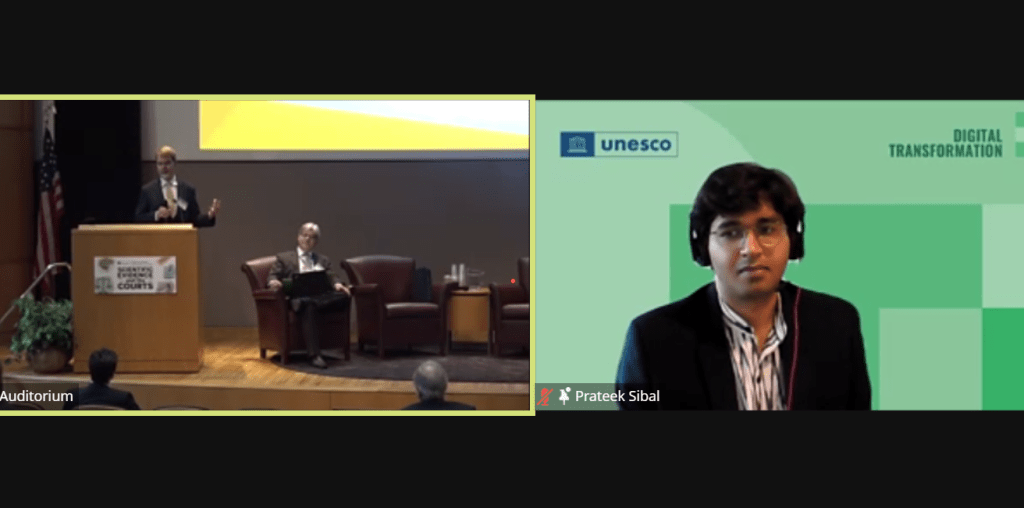
I took a screenshot of the panelists over Zoom. One was in-person in Washington, DC, and one was virtual, like me:
Working towards Global Rule of Law
The first speaker was Scott Carlson of the American Bar Association. He is Associate Executive Director of the Center for Global Programs at the American Bar Association. He started out as a pro bono lawyer in Albania. He kicked off his talk with a discussion of the rule of law, which is a political ideal that states that the laws apply to everyone, including political officials, such as lawmakers. The rule of law can be understood by this simple phrase: “Nobody is above the law.”
Carlson first defined the rule of law and the need for “supremacy of the law, equality before the law, accountability to the law, fairness in the application of the law, separation of powers, participation in decision-making, legal certainty, avoidance of arbitrariness, and procedural and legal transparency.” That’s a tall order for any nation, isn’t it?
In defining these needs for global justice, Carlson quoted a report by the refugee agency of the United Nations, the UNHRC, about justice in conflict and post-conflict societies. The United States doesn’t count as a post-conflict society, but I enjoyed this quote from the report, which I dug up to write this recap:
“Justice, peace and democracy are not mutually exclusive objectives, but rather mutually reinforcing imperatives.”
I learned that millions of people globally live in “extreme justice conditions,” as Carlson stated. That includes modern-day slavery, as well as 12 million people who are stateless, and cannot apply for legal identity in any country. Furthermore, at least 2 million people live in places that are so dangerous that it’s impossible to seek justice at all. That’s why the American Bar Association has over 100 programs in different nations, and about a third of those programs focus on judicial reform.
The UN also has Sustainable Development Goals, often abbreviated as SDGs, aligned with increasing justice, aligning with ABA global justice objectives. The SDGs are numbered and you can check them all out on the UN website. The UN’s SDG #16 seeks to “increase access to justice for all,” which fits into ABA’s work to increase global justice. Carlson mentioned that Pathfinders is a program that helps ABA help advance SDG 16.
The “Justice for All” report, which you can find on the Pathfinders website, came out in 2019, and it was a game-changed for global justice. It argued that people should be at the center of judicial reform.
So how does the ABA help support judicial reform? They developed their own Judicial Reform Index or JRI to measure the rule of law in what they call “emerging democracies and transitioning states.” The JRI rates nations’ justice systems in a 30-point assessment.
Carlson also mentioned the Political Economy Analysis, which is a separate assessment conducted by the United States Agency for International Development (USAID). The PEA asks where the real power lies, and who might promote or block reform.
A lot of Carlson’s talk was devoted to explaining the JRI and its many facets. Truth be told, I got a little lost here, since I am not a lawyer and this was my first time even hearing about global judicial reform and learning that it is a thing. It’s actually a very comprehensive index with many parts, including educating judges, making sure they represent the actual people they serve in terms of minority and gender representation. There’s also an assessment of the accountability, transparency, and efficiency of judicial systems.
Measuring corruption is also a big part of the JRI. In many countries, judges are paid so poorly, for example, that they can be bribed easily. One part of the JRI asks: are there structural safeguards against this and other types of political interference and manipulation? One such safeguard, used by the US Supreme Court, is guaranteed tenure.
Other questions the JRI asks are: Are there disciplinary processes for corrupt judges? How are cases assigned? How are judges represented? There are many different parts, and at this point, I honestly lost track. I did come away with an idea of the JRI as a very comprehensive way to measure justice and its application in society. There was also a section about the user experience of the court process, which stems from the idea of people-centered justice. Is it easy to go to the courtroom? Carlson stated that you need data for that; you have to ask people about the user experience as you approach the courthouse.
Lastly, Carlson ended his talk with the people-centered justice approach. He gave an example of a farmer with an irrigation rights issue. Do they know where they can go to seek justice? What is the pathway that they might take? Looking at the intersection of systems, society, and services can lend insight into those questions.
Using Technology to Improve the Judicial System
Prateek Sibal of UNESCO spoke next. Sibal’s website describes him as “a technology policy researcher with interest in transnational governance of artificial intelligence (AI), ethics of information and media economics.” UNESCO’s goal is to advance world peace and security via international cooperation on education, arts, sciences, and culture. Working in the UNESCO Digital Policy Lab, he consults UNESCO on ways to use digital mechanisms to improve policy, having done so in various international governments.
First, Sibal talked about the UNESCO Judges’ Intiative, which trains judicial system members such as judges, prosecutors, and lawyers, as well as law enforcement and security forces. Lessons learned from the Judges’ Initiative included that strong partnerships between regional human rights courts and a local network of judicial actors are essential. Another lesson was that trainings helped, both at the national and regional levels, to promote best practices and jurisprudence, which is the theory or philosophy of law.
Next, Sibal discussed the role of artificial intelligence (AI) in improving the justice system. Areas where AI can help the justice sector include e-discovery and document review, predictive analytics and automated decisionmaking support, language recognition and analytics, dispute resolution, risk assessment tools, and digital file and case management.
In fact, UNESCO has a massive online open course on AI and the rule of law. It covers AI tools that can be used in justice systems, as well as opportunities and risks with judicial system AI. Sibal mentioned that currently, the course is available online in seven languages, and has enrolled 4500 people from 140 nations. Sibal stated that UNESCO wants to affect change on an institutional level, not just on an individual level. Upcoming courses in the works for UNESCO include a training toolkit on AI and the rule of law (draft available here); an advanced free, online course on AI and the rule of law; and guidelines for generative AI for the judiciary.
AI will only become more important in the justice systems around the world as they digitize. More and more courts are holding online sessions, which means that they must pay more attention to bias, discrimination, privacy, and freedom of expression in the digital transformation of justice systems globally.
AI can support UN’s SDG 16 to increase justice for all by reaching people in their own languages, and simplifying some of the concepts,” says Sibal. As a result, judicial systems can become more people-centric, faster, and more accessible.
What are the downsides of such technology? Sibal stated that one downside is internet connectivity, as can be seen in the COVID pandemic, when a lot of countries moved to virtual courts, but it was not always possible. A second downside is that AI systems can be build on bad data: “garbage in, garbage out” as the famous saying goes. AI mirrors biases in society and shows it to us, Sibal stated, so now we must try to address those biases and make AI more inclusive and fair.
Learn More about Science’s Role in the Justice System
If you want to read my blog recaps of the other sessions I attended at this conference, check them out here. You can also watch this session and, actually, all of the conference sessions on YouTube.
 Fancy Comma, LLC
There seems to be a linkage between children’s rights (a legal ban of corporal punishment) and the peacefulness of the countries of the world. Austrian peace researcher has compared worldwide data to develop a “culture of violence scale” showing the level of domestic violence in different countries. According to his publications it makes perfect sense, that children’s protection – SDG 16.2. – is part of the SDG 16.
Really interesting – thank you for sharing that!