By Sheeva Azma
Fancy Comma provides science communication (SciComm) mentoring and training among our many services, and you know, sometimes, a good way to learn how to do something is to learn how not to do something. Should I be thankful for the below example, since it teaches me to communicate better, or should I continue to be angry at the many lives it has taken away from us? I am not sure.
If you ask me, no example does a better job of communicating the importance of ethics in public-facing science communication than the tobacco industry.
Scientists have known that smoking cigarettes causes lung cancer since at least 1950. I am writing this 74 years later, and cigarettes are still on the market. How can an industry that kills 8,000,000 a year continue to persist? Maybe it’s because tobacco is one of those things that thrived under slavery, and moving to a tobacco-free world means saying “no” to all of these Big Tobacco people who are still profiting from it. My mind is boggled when I think of all of the injustice wrapped up in an industry that I find illegitimate and immoral.
Why does the tobacco industry even exist, if it’s known that the products they sell cause cancer? Beats me. If I had to guess, I would say that it’s due to their large wealth amassed from addicting people to something that literally kills them. Money equals power in our world.
Then again, if a consumer of your products dies, isn’t that less money in your pocket?
Maybe that’s why Big Tobacco has moved on to new pursuits to make us all unhealthy. The same tactics used to make Big Tobacco products more addictive are now being used in the junk food industry to make that more addictive, too. In the 1980s, Big Tobacco company Philip Morris bought and combined two food companies, Kraft and General Foods. Research from the University of Kansas, reported in Fortune magazine, found that between 1988 and 2001, “tobacco-owned U.S. food companies produced more highly-palatable foods than those not owned by tobacco giants.”
It’s certainly no coincidence that, between 1988 and 2012, people in the US got much, much unhealthier. Sadly, that also means that we, as people who buy processed foods, help subsidize Big Tobacco.
It feels like everyone’s been trying to stop Big Tobacco from their rampage to become wealthy and powerful at the expense of, well, everyone. In the 1990s, many states, including Oklahoma, sued the tobacco companies for damages which they then used to set up smoking cessation and other programs to help people break their unhealthy habits. Oh, and then there was the whole thing about secondhand smoke, too, which meant that even exposure to smoke could cause health problems, even cancer. We didn’t learn about any of these things from tobacco companies, though.
The most incredible thing about the huge power struggle that has been going on with Big Tobacco is that the industry continues to deceive and mislead people about its products.
Amazingly, recently, a federal court ordered these companies to be a bit more transparent. One day, I stopped into a gas station to pick up some snacks, when I saw a large sign plastered on the window. As a science and health communicator, I was stunned. It looked like this:
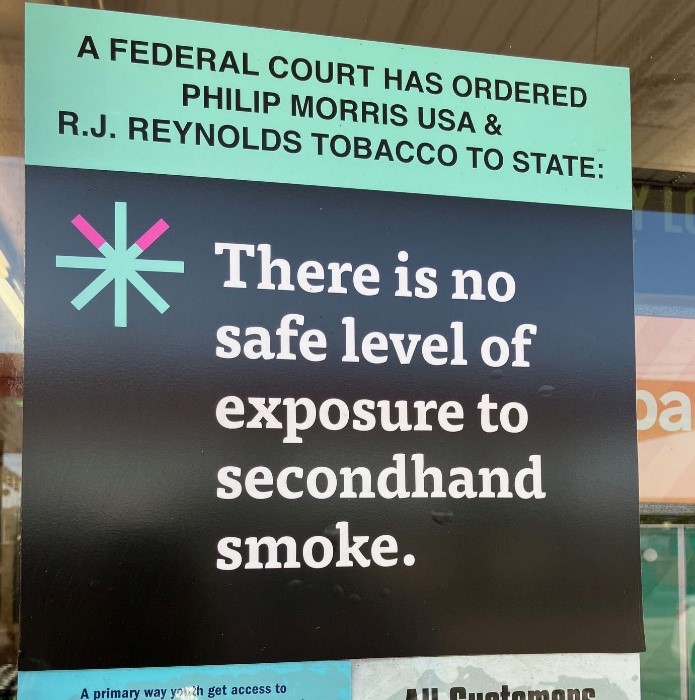
I did some research and discovered that it was a US court-ordered poster from the federal Department of Justice. There’s actually a bunch of them! You can check them all out here. These are great examples of court-ordered SciComm!
I could go on and on about the unethical messaging that we see every day, not just from this industry, but also from other industries. I hope that this example serves as a reminder that, firstly, science communicators’ work is highly needed, and secondly, if you hide things from people in your marketing, eventually, you will be forced to grapple with the truth very publicly. There are very specific laws banning deceptive marketing practices in the United States and elsewhere, and even if a company can get away with this for a little while, eventually, people will notice, and legal action will ensue.
Who knows…maybe in a few decades, we will see labels like this on our junk food, too.
The takeaways? Obviously, don’t be evil, but also, never let a federal court decide your strategic communication. Don’t be that person (or organization).
What do you think about all of this? I’d love to hear your opinions in the comments.
Learn more about unethical communication
Communicating ethically is a huge part of science communication that doesn’t often get discussed. Read about six types of unethical communication, frequently asked questions about unethical communication, more examples of unethical communication in SciComm, or check out unethical communication book recommendations,
Hire Fancy Comma, LLC to communicate science ethically!
Are you looking for guidance in your science communication endeavors? We offer SciComm mentoring and training services. Check out our SciComm mentoring and training services, or visit our Services page to see all the ways we can help you in science communication.
 Fancy Comma, LLC
One thought on “A Case Study in Unethical Communication from Big Tobacco”