By Sheeva Azma
Fancy Comma has affiliate partnerships to support its blog content. We may earn commissions for products purchased via affiliate links.
“Anti-science each year is now responsible for the loss of thousands of lives,” writes Peter Hotez, MD, PhD. “Combatting this menace … is an essential moral imperative.”
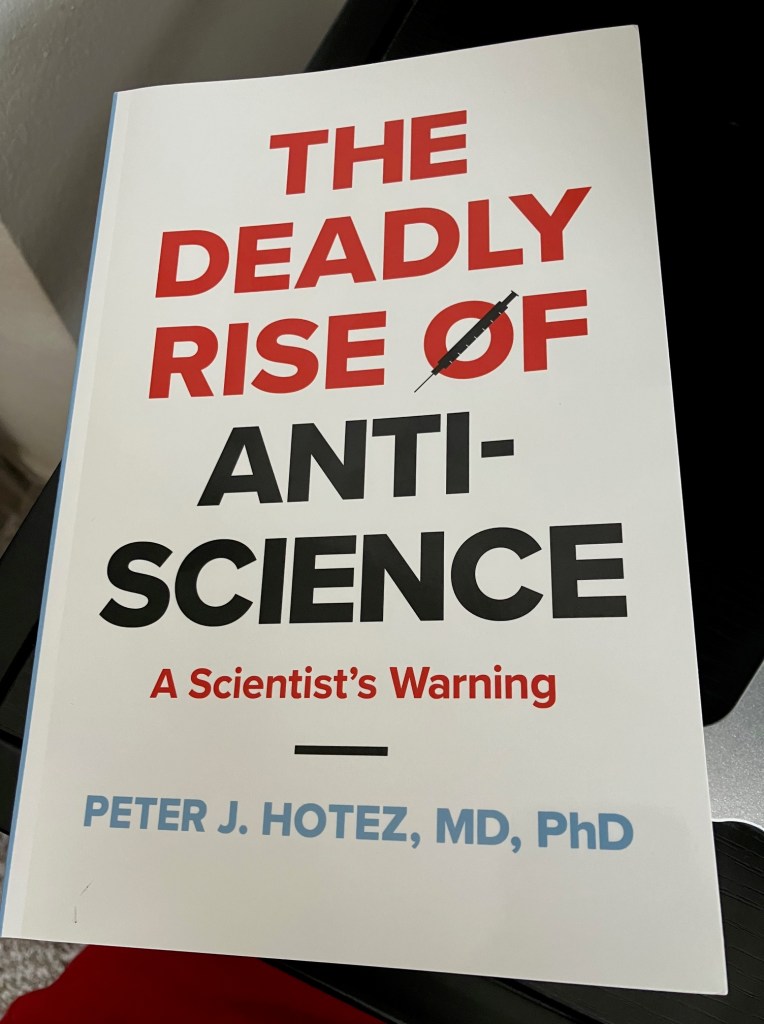
If I could summarize my book review of Dr. Hotez’s new book, The Deadly Rise of Anti-Science, in one sentence, I would just say: scientists, just read this book.
The full name of the book is The Deadly Rise of Anti-Science: A Scientist’s Warning. When I received this book in the mail, I sat down and read it cover to cover immediately. It is a book that summarizes well what I have observed about the dialogue about vaccines and public health in the COVID pandemic.
Here’s a bit of a long story about why you should read this book from my own personal experience as a pandemic science communicator:
I have been following Peter Hotez, a somewhat well-known pediatrician and infectious disease researcher, on X back when it was called Twitter (and was owned by its legacy owners) during the pandemic. At that time, finding accurate information on COVID vaccines seemed scarce, even in mainstream media, so Fancy Comma published explainers of each vaccine in development. I assumed the New York Times would beat us in publishing explainers, but we beat them to it by several months, thanks to the tireless work of Nidhi Parekh.
Around the same time, I was working on public-facing vaccine communications in my office in Oklahoma City, which was only 1.9 miles away from where some notorious anti-vax protestors running their small business, I had learned. It was a weird, but not really scary, time as people were protesting against vaccine and mask mandates on my work commute and I didn’t really get why they weren’t convinced yet that mRNA vaccines are actually pretty cool.
In reality, these people who were super against vaccines and masks were a small minority of the vaccine hesitant. I became obsessed with figuring out why some people I knew were vaccine hesitant and asked them about their views. It turned out they supported science but had had weird experiences with vaccines themselves.
I wrote about my own efforts to combat healthy skepticism and vaccine hesitancy in the pandemic in my book, Science X Marketing, but Dr. Hotez’s book is much more focused on the specific battle that scientists have had to face in “selling” their work to the people. Dr. Hotez calls out the self-serving work of lawmakers who seek to stay in power by acquiescing to demands from their constituents rather than following the science.
To be honest, I have really struggling to find some kind of pro-science middle ground in this discussion. I even voted for Donald Trump in 2020 because he was the only politician that really seemed to understand that we really needed a COVID-19 vaccine.
When there was middle ground, this called the political “optics” of the moment into question (remember when Donald Trump got booed for talking about getting the COVID vaccines that he helped make a reality?). I remember that, as both Dr. Hotez and I note in our books, the GOP Judiciary once tweeted (and then deleted): “If vaccines work, why don’t they work?”
The middle ground was there, or at least, I found it. In the COVID pandemic, I did all of the things you might expect a scientist and MIT grad living in a red state to do. I wrote my lawmakers with a super-strategic white paper I wrote about communicating about vaccines and public health to the vaccine hesitant in Oklahoma, and worked tirelessly to build Fancy Comma to help train scientists in ways to communicate science to policymakers that might actually work.
Most of my lawmakers, including our conservative governor, agreed about vaccines’ utility for public health. However, it was tough and I got super burned out.
I wondered why I had spent almost 20 years studying science and even graduating from MIT if so many other people could just ignore it. I also learned that one person cannot do the job of public-facing science communication in times of crisis. It felt like I was one of the only people in the world with the skills needed to help keep the world healthy, and that was way too much responsibility. In my mind, I was a SciCommer Tony Stark, but one who would, unlike others I saw out there, bridge divides to unite people about the power of science to help us live better lives.
I often watched the news while I worked, and Dr. Hotez would often tweet about his media appearances on places like CNN and Fox News and I would eagerly tune in. I appreciated his confident, no-nonsense explanations on vaccines that reassured me that, even though I did not understand the mRNA technology, getting an mRNA vaccine would be a safer choice than getting COVID. Unlike other science communicators I would see on TV, his comments seemed immune (pardon the pun) to the commentators’ and general public’s skepticism.
Dr. Hotez was one of the only people who I felt understood the complex intertwining of policy and science involved in explaining why people should get the jab to reduce serious risk of hospitalization and death.
It turns out that, as I learned in his book, The Deadly Rise of Anti-Science, this is in part due to his frequent visits to Capitol Hill when he was a professor in DC at nearby George Washington University. Dr. Hotez currently teaches at Baylor School of Medicine in Texas, and after studying neuroscience and living DC, and interning in the US House, I live in Oklahoma, so maybe we have more of a similar perspective than I thought.
In a way, I feel like an observer to a complicated discussion that has been evolving, especially post-pandemic, all across the US. Dr. Hotez has been on the front lines, as he describes in his book, and it sounds like it has been horrible.
Everyone has different views, and I have been trying to figure out if there is a way forward that can include all views.
If you ask Dr. Hotez, the anti-science voices come from lawmakers, who amplify and embolden extremist anti-science views, which are then further politicized on the same few large media outlets.
If you ask me, the views do come from our lawmakers, but they are merely echoes of what they are hearing from the people who elected them. Visiting my lawmakers to talk about why they should support healthcare reforms that prioritize patient safety, I was lucky to attend the Congressional Basketball Game and that put me in the same room as Dr. Brad Wenstrup, Chairman of the Select Subcommittee on the Coronavirus Pandemic. He grilled top scientists such as Anthony Fauci about their emails and other activities during the pandemic, but he also thanked the NIH for creating the COVID vaccines (he is a medical doctor, too, like Dr. Hotez). (If you are interested in my DC trip, check out my vlog here.)
If I have learned anything from the pandemic, it’s that, despite our political views, we all have to live with each other in the same world, and that includes our science views. Science engagement is a highly personal endeavor but what is clear is that engaging in science communication that is public-facing is, on some level, crafting narratives that will resonate with lawmakers. This book will help you do that.
If you are a science communicator, check out The Deadly Rise of Anti-Science: A Scientist’s Warning. You will like it, but it will force you to reconcile the worlds of politics and science, which is, honestly, a tough endeavor. (I can say that because it is actually my job to do that activity as the founder of a science communications and policy consulting firm.)
Apply Your Science Communication Skills to Become an Unstoppable Force for Good
Read all of our book reviews and recommendations here, including our science communication book reviews. If you’re looking for free resources to improve your science writing (including science copywriting) skills, check out Fancy Comma, LLC’s resources page!
 Fancy Comma, LLC
One thought on “Book Review: The Deadly Rise of Anti-Science by Peter Hotez”