By Sheeva Azma
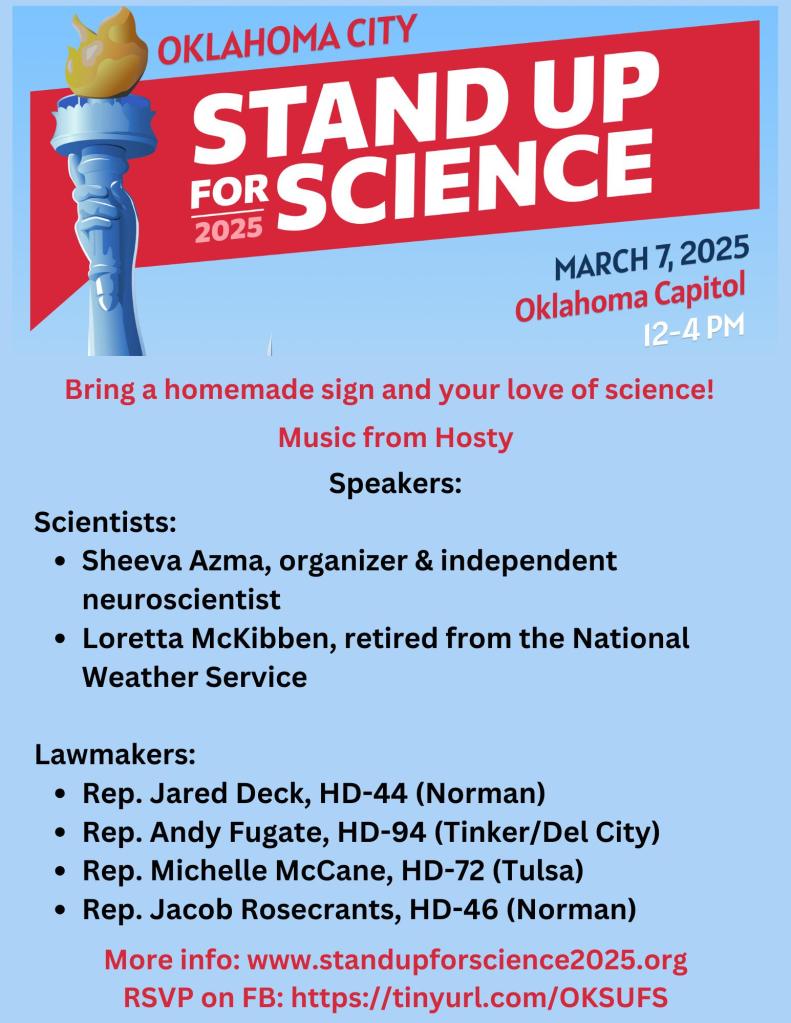
On March 7, 2025, I spoke at the Oklahoma Capitol in Oklahoma City as part of the national day of action called Stand Up for Science. Our event in OKC, which I organized, was listed on the SUFS 2025 local events website and was actually one of TWO events happening in the Oklahoma City Metro area (the other was at the National Weather Center, about a 30-minute drive away, in Norman).

I organized the Stand Up for Science event at the Oklahoma Capitol by channeling my experience organizing in Oklahoma in college, when I helped plan events for a Senate campaign — and it worked.
I was excited to see that 100 scientists and supporters of science showed up. It was the most grassroots science policy event in which I have had the privilege of participating in my lifetime. I am happy to say that since this rally, many scientists and science-adjacent federal workers have gotten their jobs back (with back pay!) — though there is more work to be done to help preserve and protect the federal US science infrastructure.
You can read more about the event in local news outlets such as the OU Daily, KFOR, and KGOU – our local NPR station.
After our confirmed speakers — scientists and lawmakers alike — spoke, we had even more speeches from the audience, which were incredible.
I gave an impassioned opening speech — my first writing and delivery of a speech since I was graduation speaker in high school.
Below is the full text of the comments I gave at Oklahoma City’s Stand Up for Science 2025 event.
Thanks to everyone gathered here today to stand up for science. My name is Sheeva Azma.
Last week, the National Institutes of Health cancelled grants they had already awarded, leaving scientists without funding.
And this week, there are 15 less NIH-funded projects and $13,353,490 less in NIH grants for Oklahoma scientists.
Hopefully, it is just a weird error on the NIH website.
But this is not a good time for science.
Scientists are being laid off across various federal agencies.
Existing lines of research long supported and grown through decades of taxpayer-funded science are being dismantled.
Political appointees are rewording the announcements for our most treasured science funding mechanisms in ways that undermine our most deeply held values as scientists.
Even federal buildings are being put up for sale, including not only buildings affiliated with the National Weather Service in Norman, as well as the Murrah building right here in Oklahoma City, site of the 1996 Oklahoma City Bombing.
That is not fair to our federal workers, and especially to Oklahoma federal workers who have experienced so much.
We, the public, need clear answers as to what funding lines and positions and leases are being terminated and why, and who exactly made these decisions.
Federally-funded research with funds allocated by expert review was a vision brought to life by the first presidential science advisor, Vannevar Bush. He marshaled our science and technology workforce to meet dire challenges in World War II. It helped us develop the nuclear bomb to defeat Nazis back then.
As of last week, Oklahoma scientists had received over $180 million this year to find cures for diseases such as Alzheimer’s, cancer, diabetes, long COVID, eating disorders, alcoholism, depression, and so much more.
This week, $13 million and 15 awards disappeared from the NIH RePORTER website.
When important lines of research cease to exist, this wastes taxpayer funds even more by impeding the process of scientific discovery that helps people.
I know this because it happened to me.
As a grad student, I independently managed two NIH-funded projects studying the effects of stress and addiction on the brain.
Five years into my PhD, taxpayers had invested hundreds of thousands of dollars in me to do science.
Yet my program told me I was not cut out to be a scientist, apologized to me via e-mail that this part of my career did not go the way I thought it would, and offered me a Master’s degree to voluntarily quit my PhD.
I took them up on it and became a science writer, but recently, I decided to finish what I started.
Last November, at no cost to taxpayers, I published a review paper on adolescents’ brain structure as related to family history of alcoholism. And I’m not done yet.
I feel very lucky to be able to do science again. But I do not wish my path on anyone.
And yet, we have so many science institutions imperiled by recent federal actions just within walking distance of where we are gathered.
And the Capitol itself has been the site of numerous anti-science protests.
In fact, I recently met a modern-day Don Quixote up here who was visiting his lawmakers, as I was.
He told me windmills are bad because their shadows cause seizures. I listened curiously and took him at his word.
I wanted to ask him, “If that were true, wouldn’t we all be having seizures driving across the Oklahoma-Texas border with all those windmills there, then?”
But I didn’t.
And a couple weeks ago, the anti-windmill bill, House Bill 2751, passed out of committee.
I have driven past anti-vaccine protests happening right here, when I was working long days communicating pandemic science.
I thought someone else would stand up for science, especially with our biomedical research ecosystem all being right here.
But nobody did.
A fellow scientist recently told me that in difficult times, we must hold on to our values.
So that is why we are here.
Lastly, I would like to note that this all starts with STEM education. K-12 STEM education helps students get higher-paying jobs. Even entry-level STEM positions average higher salaries than their non-STEM counterparts.
We’re here because we love science, but we’re also here to meet the moment. Economists’ work shows that innovation helps the US economy persevere in tough times such as these.
So today, as scientists and supporters of science, we are here to stand up for science and for the American way of life.
 Fancy Comma, LLC
6 thoughts on “Standing Up for Science in Oklahoma”