By Sheeva Azma
Before Jonny Kim was an astronaut, he was a retired Navy Seal and an emergency medicine resident who looked forward to shopping at Market Basket for its delicious, sweet cornbread.
NOTE: I wrote this article based on an interview I did with NASA Astronaut Jonny Kim, who recently launched to the International Space Station with the SpaceX Crew-10 Mission, and I pitched it to a few journalism outlets, who passed on it. The first version of my article looked sort of like this one from Wicked Local (but had way more info on Kim’s Boston ties — did you know many emergency medicine doctors in space have had Boston ties?). It is the type of article I would like to read about an astronaut as a neuroscientist: just something lighthearted, fun, and informative with a focus both on the cultural and life sciences aspects of space travel, which I rarely read about in any depth. Anyway, I hope you enjoy this article.
In April 2025, Jonny Kim, a NASA astronaut, doctor, and retired Navy Seal, will launch to the International Space Station as a flight engineer for Expedition 73.
But before Kim was slated to become the first Korean-American and seventh US emergency medicine physician living and working on the International Space Station, he was a medical resident in Boston who looked forward to Market Basket’s delicious, freshly-baked cornbread.
The Unlikely Link between Cornbread and Space Travel
In 2017, Kim and his wife were about to pay for their groceries at a Market Basket near Waltham when NASA called to congratulate him for being chosen for Astronaut Group 22, known as the Turtles. He tried to maintain his composure, but could not avoid jumping up and down in the grocery store out of excitement.
“I knew that the call was coming that day. I was very, very excited to get that call regardless of the answer and I’m still very, very thankful,” he recounted in a live interview on March 19, 2025.
“Market Basket is known for being the most affordable grocery chain in the region. Once you discover that, it’s hard to shop anywhere else,” wrote Matt Shearer of Boston’s WBZ NewsRadio via Instagram message. “I’m not surprised at all to hear that an astronaut shopped at Market Basket. You have to be really smart to be an astronaut.”
Market Basket’s mass appeal (pun intended) goes beyond its low prices, says Shearer; it’s also “a beloved local business with a CEO (Artie T!) who cares so deeply for his employees that they all went on strike to save his job. How many businesses can say that?”
Shearer went viral in 2022 after he posted a humorous news report about the closure of a Market Basket store in Billerica. Onion CEO Ben Collins deemed it “the most Massachusetts news report of all time.”
“What I miss the most from [Market Basket] was the cornbread, the fresh cornbread that they would have. It was so sweet and amazing.” Kim recounts with nostalgia about the grocery store where he became an astronaut.
“Remembering where we came from and some of the excitement we brought to our occupations is so important, especially when times are tough,” says Kim. “And so I think about that day often, and it makes me smile.”
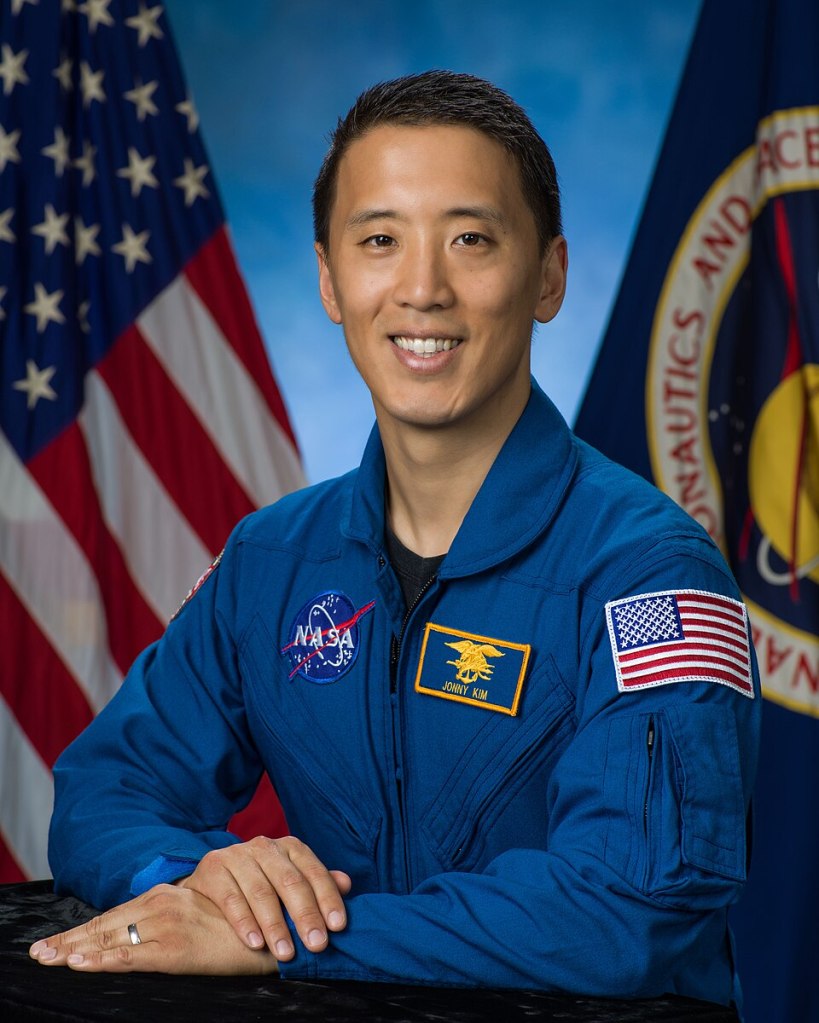
Photo Date: 8-22-2017
Location: Bldg. 8 Photo Studio
Photographer: Bill Stafford
Photo from Wikipedia in public domain
“The human body is a tech demo”
A decorated Navy Seal who completed over 100 combat operations, Kim was working as an emergency medicine resident in a joint program with Massachusetts General Hospital and Brigham and Women’s Hospital in Boston when he got the call from NASA.
In 2020, after graduating from astronaut training, Kim was selected as one of 18 astronauts of the Artemis mission that seeks to return humans to the Moon and send a mission to Mars.
Traveling to the ISS aboard Soyuz MS-27 with cosmonauts Sergey Ryzhikov and Alexey Zubritsky no earlier than April 8, Kim will spend approximately eight months on the International Space Station, returning in late 2025.
Kim had been training for the mission in Star City, Russia when he spoke to the media in the live-streaming event hosted by NASA.
“Are there any pieces of technology you are particularly interested in working with [in space]?” a journalist from West Hartford, Connecticut asked.
“I think the human body is a tech demo,” replied Kim.
“There’s a lot of experiments that I could be a part of that will help give NASA and our colleagues answers about how the body responds to long-duration space flights, which is going to be important, if we are going to do multi-year missions to Mars and beyond.”
While on the ISS, Kim will participate in a study called the Complement of Integrated Protocols for Human Exploration Research, or CIPHER, which helps NASA learn “everything possible about how humans adapt to long-duration missions in space,” according to the CIPHER website. On Facebook, Kim recently shared a CIPHER study he worked on in July 2024 examining how the body’s sensory and movement systems adapt in settings with different gravity environments. He will be conducting more studies as part of CIPHER in space and after returning from the ISS. The research foci of the CIPHER study include bone, joint, muscle, cardiovascular, and organ health; brain and behavior; sensorimotor systems; and vision.
CIPHER is a way for Kim to apply his skills as an emergency medicine physician in space. “In my previous life, I used ultrasound to assist with medical procedures and gain valuable real-time patient information. Now, I’m getting reacquainted with a probe to help NASA with medical research on how spaceflight affects change in the human body,” he wrote in an Instagram post on March 23, 2025.
Becoming the seventh emergency medicine physician-astronaut in space (and inspiring the next generation in STEM)
Despite the lack of knowledge of the effects of long-duration spaceflight missions on the human body, “A physician is rarely included in a space flight crew,” wrote emergency medicine doctors Jennifer S. Jackson and Faye T. Pedersen in 2016.
Emergency medicine physicians are even more rare in space, though their familiarity with “rapid assessment and treatment, resuscitation expertise, ability to perform a wide range of advanced procedures, exposure to diverse pathologies, and creativity in resource limited settings” make them ideal for the job.
Kim learned about NASA’s astronaut program as a student at Harvard Medical School. There, he met physician-astronaut Scott E. Parazynski, a fellow emergency medicine physician, who has completed five space shuttle missions and seven spacewalks, and who encouraged him to apply to NASA. The short list of emergency medicine physicians in space, which will soon include Kim, includes Parazynski as well as Thomas Marshburn, Anna Fisher, William Hendrick Fisher, Kjell Lindgren, and Andrew Morgan.
“The approach to solving problems and pulling apart threads” is something Kim says he has gained from his medical training.
“Understanding the logic and approach to a problem to come up with a solution” can be very useful for “life as an astronaut where we encounter a lot of different problems where we need to exercise many of the different things that we learned,” he stated from Star City.
To him, the human aspects of spaceflight are what also make it most intriguing to onlookers and especially the next generation of space enthusiasts: “That level of humility we bring to a problem, and the humility that we don’t know the answer, and we can be proven wrong, as in opening our perspective and exercising our critical thinking…sharing the love of what made us want to become scientists or seekers of truth or utilizing the scientific method…That’s what I think is our duty.”
 Fancy Comma, LLC
