By Toby Shu
Galileo came off as unnecessarily offensive when defending his theories that the planets revolved around the Sun. What if things had been different?
Fancy Comma has affiliate partnerships to support its content. We may earn commissions for products purchased via affiliate links.
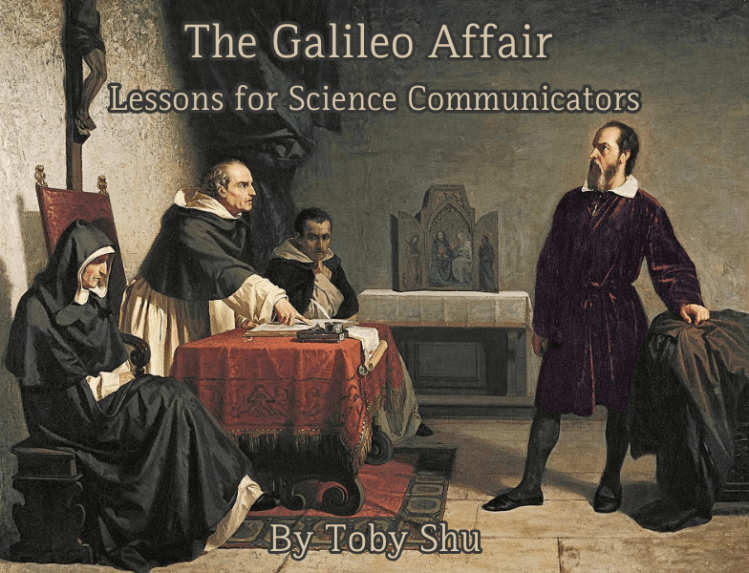
Galileo was a revolutionary scientist, taking bold and unorthodox steps to advance a new scientific paradigm while laying the foundation for modern science. At the same time, Galileo was both an excellent science communicator, crafting arguments that began to move scientists, and a notably poor science communicator, failing to convince enough people of his views and earning the ire of the Pope and Catholic Church. Though his ideas eventually prevailed, he personally lost during his life, sentenced to house arrest by the Roman Inquisition. His sentence was neither necessary nor predetermined. In this article, I will discuss what happened in the Galileo Affair—Galileo’s set of astronomical discoveries and the scientific and religious controversies associated with them—and discuss what science communicators can learn from it.
What happened
Nicolaus Copernicus published his magnum opus De revolutionibus orbium coelestium, or On the Revolutions of the Heavenly Spheres, on his deathbed in 1543. In it, he posited the possibility of a heliocentric solar system as opposed to a geocentric model. Contrary to popular belief, he did not face significant religious opposition for his views at the time. In fact, Cardinal Nikolaus von Schönberg, among other Church officials, encouraged him to publish his work.
However, Copernicus’s theory did face serious scientific challenges. His theory lacked a physics to explain the motion he was describing and why planets would move as he described (Aristotelian physics had over 1800 years to develop a coherent theory, and Isaac Newton would not be born until 1643). His model could not explain the absence of observed stellar parallax. His model could not explain the lack of observed phases of Venus. His model could not explain why Mars appeared to have constant size and brightness as it moved. His model could not explain why we do not experience the purported motion of the Earth and why the Earth’s motion could seemingly not be measured (such as by objects falling to the west as the Earth rotated). These challenges were some among many that Copernicus could not convincingly answer.
It is upon this backdrop that Galileo Galilei would invent his telescope in 1609. His telescope would convince him of the heliocentric model. It would also answer some of the objections discussed above. With his telescope, Venus’s phases were visible, as was the changing size of Mars. Nonetheless, some objections still went unanswered (or were answered unpersuasively). As Galileo’s telescopic observations knocked down some objections to the heliocentric model, his telescopic observations also challenged Aristotelian cosmology. By observing craters on the moon and sunspots, he showed that celestial objects were not perfect, unmarked spheres as the Aristotelian understanding held. Challenging the Aristotelian understanding of the world created problems for intellectual thought among both scientists and theologians.
As Galileo challenged scientific understandings and the paradigm began to shift, a religious objection was also on the rise, based on literal interpretations of Scripture, such as in Joshua, where God commanded the sun to “stand still.” Galileo managed for a time to avoid answering religious criticism, but the Grand Duchess Christina, one of his patrons, asked one of his friends, the Benedictine monk Castelli, about the religious objection in December 1613. Though Castelli gave a satisfactory answer to the Grand Duchess, Galileo wrote his “Letter to the Grand Duchess” and responded to the religious objections, offering an alternative reading of Scripture and emphasizing that the Bible should not be read to conflict with science. Galileo famously quoted Cardinal Baronio, stating “the intention of the Holy Spirit is to teach us how one goes to heaven and not how heaven goes.” This letter, despite being unpublished, circulated widely, causing Niccolo Lorini, a Dominican friar, to write to the Inquisition in Rome—a ecclesiastical court system meant to govern theological crimes (heresy, blasphemy, witchcraft, etc.)—regarding Galileo’s activities. In doing so, Galileo inserted himself into the religious debate, offering an opinion in theology, a field in which he lacked expertise.
The Inquisition took no formal action resulting from this first investigation in 1616, even though a group of consultants—theologians with expertise in science as well—deemed heliocentrism heretical and scientifically “foolish and absurd.” However, several consequential actions were still taken. The Congregation of the Index placed Copernicus’s work on the Index of Forbidden Books pending revision, and Galileo, while not being charged, was ordered not to “hold, teach, or defend” heliocentrism.
Despite this, Galileo continued to examine heliocentrism, arguing that he was not holding it as true but understanding it hypothetically. Thus, in 1632, after having it approved by Catholic censors, he published his Dialogue on the Two Chief World Systems, a dialogue between three friends: Salviati, a heliocentrist; Sagredo, a neutral party; and Simplicio, a geocentrist. The book was well received in scientific circles. However, despite initial approval from Catholic censors, the work came to be understood as a work in which Galileo combined scientific argument with strong rhetoric to advocate for heliocentrism. Moreover, it should be noted that Galileo gave geocentric arguments—the Pope’s arguments—to Simplicio, superficially named after the Aristotelian philosopher Simplicius, but with the clear double entendre of Simplicio meaning simpleton.
Thus (to skip over some details), Galileo was brought back before the Inquisition and found vehemently suspected of heresy (vehement suspicion of heresy was a term of art and a specific level of offense) and forced to abjure. His Dialogue was placed on the Index of Forbidden Books, and he was placed under house arrest, where he continued his scientific work (outside of heliocentrism) for the remainder of his life.
The scientific community would not fully accept the heliocentric model for over another 100 years, following Newton’s publication of the Principia Mathematica in 1687, with further confirmation of Newton’s work in 1738 by Maupertuis’ showing of the oblateness of the Earth, and the re-arrival of Halley’s comet in 1758.
Lessons
The first and most obvious lesson of the Galileo Affair is that scientists should be conscious of the social and political environment in which they work. While political factors should not change the results of what is published, they should be considerations in tone and method. The political context of Galileo’s time was drastically different from the political context of Copernicus’s time, and it should have been clear to Galileo that he was in a more hostile environment than Copernicus had been. Moreover, Galileo’s publication of the Dialogue was unnecessarily provocative, using strong rhetoric and insulting the Pope. While his wit may have made his work more compelling, its actual influence plummeted when it was banned and Galileo was placed under house arrest. Science communication does not happen in a bubble.
Second, scientists should be cautious when speaking outside their expertise. Even as Galileo’s work received increasing religious criticism, it was not initially examined by the Inquisition until he offered theological opinions on how the Bible should be read in accordance with science. While it may have been necessary for Galileo to respond to religious objections at some point, it was not necessary when he did, as Castelli had persuasively answered the Grand Duchess’s concerns. Moreover, as evidenced by other theological writings from the time and Castelli’s identity as a Benedictine monk, there were those who believed in heliocentrism with formal training in theology and could have responded to theological objections. By stepping outside of his expertise, Galileo angered conservative theologians, who reported him to the Inquisition. Science communicators should bolster their credibility by speaking to their expertise and letting other fields have their own experts.
Finally, scientists should adopt a position of intellectual humility, and acknowledge the limitations of their theories. As discussed, Galileo did not have a complete theory to explain heliocentrism. In other words, he lacked sufficient evidence to claim his theory was true with any real certainty and his science was incomplete. At best, he had a plausible hypothesis with major holes that still needed to be worked out. Despite this, he was known for his snide rhetoric and inflammatory style in his defense of heliocentrism, to the point that he even angered other respected scientists of the time. Given that his theory was incomplete and disrupting a scientific understanding that had lasted for over a millennium, intellectual humility would have been warranted. Intellectual humility boosts credibility and the process of science allows for doubt. Science communicators should strive to communicate what they know and what they still seek to learn.
References
Finocchiaro, The Galileo Affair: A Documentary History.

Toby Shu is a rising sophomore at Georgetown University seeking a BS in Mathematics and History. Toby is interested in constitutional law, the history of science, and the growing capabilities of artificial intelligence in science, technology, engineering, and mathematics (STEM) fields.
 Fancy Comma, LLC
