By Ella Lesher and Sheeva Azma
Scientific innovation—especially in artificial intelligence, biotech, and nuclear physics—are matters of national security, ethics, and global influence.
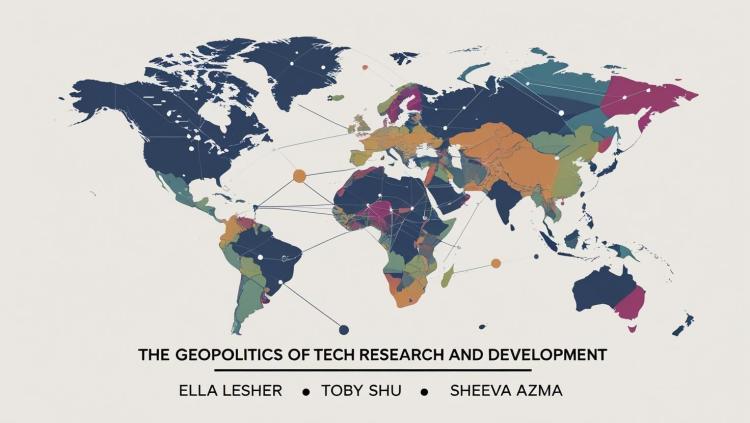
The global landscape is shifting. We’re seeing intense geopolitical competition, not just over resources or territory, but over cutting-edge technologies. Think artificial intelligence (AI), nuclear physics, and biotechnology. These aren’t just lab curiosities anymore; they’re powerful tools with immense real-world applications, and governments worldwide are laser-focused on them.
The Special Competitive Studies Project (SCSP)—a bipartisan non-profit dedicated to US competitiveness in AI and emerging technologies as they shape national security, the economy, and society writ large—held a symposium on June 2, 2025. The speakers, a former acting United States defense secretary and an AI company CEO, emphasized AI’s transformative potential for national security. The vision? Predictive intelligence and rapid decision support delivered directly to tactical units on the battlefield. However, along with the desire to innovate and keep up with emerging advances in AI, there’s a stark warning: without clear ethical guardrails and faster adoption, the US risks falling dangerously behind adversaries in AI-driven warfare.
The application of science in geopolitical settings isn’t new; neither is the application of basic science into applied research by our adversaries. The Manhattan Project — the United States’ World War II atomic weapons program — began from the accidental discovery of nuclear fission by two German scientists in 1938. By 1942, US scientists including Albert Einstein, had started the Manhattan Project to combat Nazi Germany. Read more about the history of the Manhattan Project here.
Are we in for another arms race in the era of AI and sophisticated computer chips? In the case of chip manufacturing, the most powerful chips are only produced in a small subset of chip manufacturing sites around the world. The 2022 CHIPS and Science Act sought to boost domestic infrastructure, but the US faces a long road ahead. Domestic scarcity in advanced chips means that events like wars or natural disasters can trigger significant supply chain disruptions for the US.
Sharpen your science-adjacent skills with Fancy Comma, LLC! Level up with our free resources.
In the biotech setting, the application of scientific technologies such as CRISPR has led to the world’s highly controversial and ethically questionable genetically edited babies. Germline gene editing, as was used for the “CRISPR babies” born in 2018, involves editing the DNA of reproductive cells or early-stage embryos so that the changes made would be passed down to future generations, which could potentially change the human gene pool. Geopolitically, germline gene editing risks sparking a race-to-the-bottom to modify genes to create so-called “designer babies.” The race to create designer babies with desired genetic traits, undertaken by organizations or even nations, without considering the ethics, may lead to unintended consequences for future generations that we cannot yet completely understand.
In the case of the CRISPR babies, germline gene editing sparked condemnation by the US Congress, who had already banned public funds for such editing through legislation starting in fiscal year 2016’s appropriations bill. The CRISPR babies also prompted an international discussion about whether germline editing should be banned. Indeed, germline gene editing is now banned in China, the US, and European nations, among others.
Each area of science has its own geopolitical pitfalls. As we mentioned, gene editing brings up the implications of genetically modified humans in the context of global norms and regulations. Computer chips have a slew of different associated issues, such as intellectual property protections, secrecy, and export controls. For advanced chip manufacturing in particular, there is also a need to prioritize global research collaboration versus strategic isolation.
Science and technology innovation itself faces systemic hurdles: ethical dilemmas, regulatory gaps, and the “brain drain” of talent migration. Balancing the inherent openness of scientific inquiry with pressing national security needs is a constant tightrope walk, and international tensions can make academic collaboration tense and difficult to achieve.
US science policy, in response to these challenges, must empower innovation within an ethical framework to meet strategic needs. We must pair these efforts with a global call for transparency, resilience, and agility as we navigate these complex issues together.
To see how the United States is prioritizing investments in and legislating science, you can subscribe to the FYI newsletter from the American Institute of Physics. For more about how you can use your science knowledge to support ethical, responsible, and timely application of science discoveries, check out our free resources.

Ella Lesher is a summer 2025 Georgetown University VIEW Intern with Fancy Comma. She graduated from Georgetown in 2025 with a B.S. in both Neurobiology and Government. An incoming Georgetown Law student, she is interested in science communication for lawyers and politicians to drive decision-making, especially as related to neuroscience.

Sheeva Azma is founder of Fancy Comma, LLC, a science communications and policy consulting company that is part marketing firm, part think tank, driving science forward through detail-oriented, insightful communication and analysis.
 Fancy Comma, LLC