By Sheeva Azma
People want to feel heard. A moderator helps that happen.
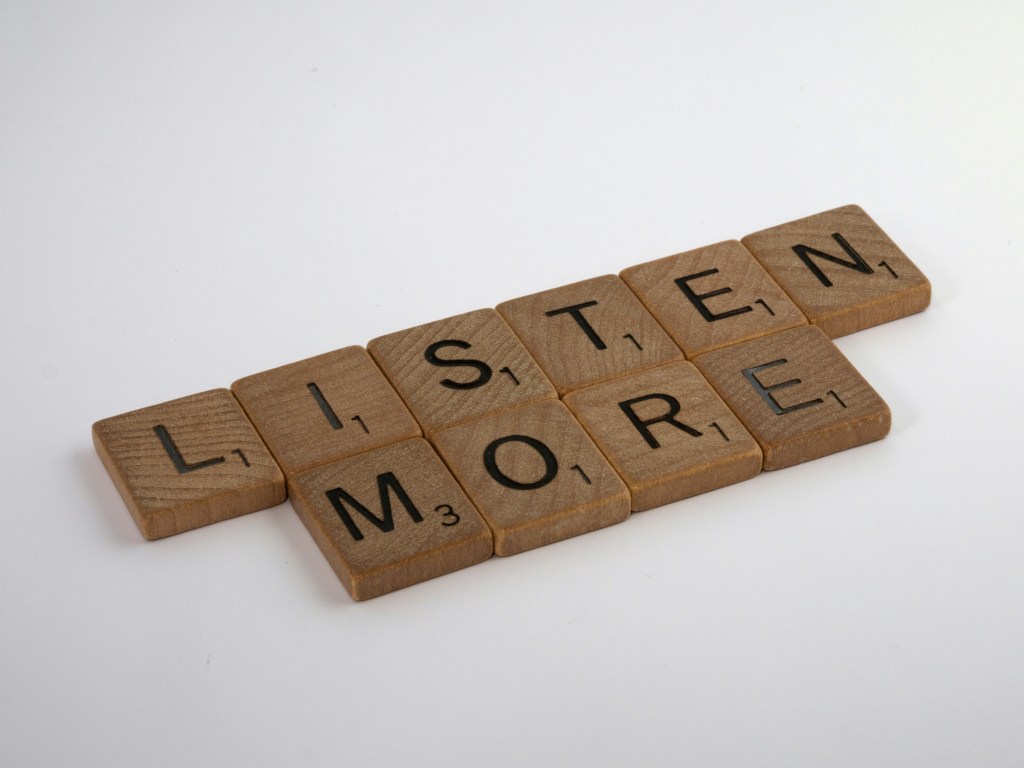
When did we become a society so obsessed with talking that we forgot to listen?
One of my greatest pet peeves in life is being interrupted, but I’ve had to learn to embrace it. As I get older and have more wisdom to share in life, it feels like fewer and fewer people want to listen.
What you’re supposed to do when someone interrupts you is to just keep talking until they stop, but I find that exhausting, so instead, I just stop talking and let them say whatever it is they wanted to say.
I learned early on in my onboarding training as a research assistant at Massachusetts General Hospital that the thing people want most is to feel heard.
It’s a lesson I’ve carried with me for over two decades.
Fast forward to this past October, when coordinating others’ speaking became my job at the National Academies’ Rebalancing the Future Research Ecosystem: From Vision to Action two-day conference.
The role of moderator goes overlooked, in my view. The moderator could interrupt the speakers or try to distort the conversation to what they want to talk about — but that’s not what a moderator is supposed to do.
A moderator has one job: to make a good conversation possible, and to do so within a given time limit.
The moderator does this in many subtle and not-so-subtle ways. My favorite not-so-subtle way the moderator keeps the conversation going is by telling people when they can and can’t speak. While I do not enjoy interrupting people, I am pretty merciless at it, when I have to be (hey, all those years of timed debating in high school and college … and beyond … come in handy now!).
As a science writer and journalist, I’ve often interviewed experts, and my favorite thing is when I can help experts shine in all of their expert glory. It has not been uncommon for me, over the past decade, to just pick up the phone and cold-call someone at a think tank or a university to pick their brain and/or ask for their hot take on a subject, as I did in the first Trump administration analyzing the US-China trade relationship (it felt like nobody else was paying attention back then, but this time around, people sure are!). This activity is part journalism, part research, and 100% using one’s listening skills.
It was tough to get those people on the phone, so obviously, I did not interrupt them. I was salivating for their juicy hot takes (metaphorically — and Pavlovianly — speaking).
Don’t interrupt experts when they are talking, I say.
Anyway, in late October, during the government shutdown, I traveled to Washington, DC, to moderate a one-hour panel on alternative models of science funding for the National Academies’ Government-Industry-University-Philanthropy Research Roundtable. I posted a photo of myself in action over on my LinkedIn.
To prepare for the event, I tried googling “how to be a good moderator,” but I didn’t find much. What helped me is watching The State of the Science Address 2025 address, which featured former Trump 1.0 White House science advisor, Kelvin Droegemeier, as moderator. (You, too, can watch the discussion here.)
I noticed a few things about Dr. Droegemeier’s moderation:
- He didn’t cast himself as an expert, but simply facilitated the conversation. If you watch the video of the address, you’ll notice that he frequently highlights the expertise of the panelists and ways he has worked with them.
- In fact, he doesn’t add too much to the conversation besides asking questions and keeping the conversation flowing in a rather expert manner. He has a PhD, and has served as a national science advisor, but you would not know that just watching him on that stage.
- Dr. Droegemeier is friendly and confident. That goes a long way, I learned on-the-job as moderator. Yes, part of the job of moderator is extracting expert insights, but it’s not just brain-picking; it’s brain-picking for an audience. That means it has to be enjoyable for the audience, not just inform them about some topic.
- Dr. Droegemeier didn’t try to micromanage the speakers; he just rolled with the punches of what they had to say. Yes, the conversation could have gotten a lot more granular at times, and I would have loved that as a listener, but let’s be real — that’s not always possible in one hour (or even two hours).
Those insights helped me a lot, as did my on-the-job experience as a moderator. Sometimes, a good moderator just helps generate new ideas and perspectives that others can delve into in further detail.
To this list, now that I have been a moderator, I can now add a #5:
5. Let the experts talk, even when you’re not sure what they are going to say — and whether you will agree or not.
It takes a really good moderator to actually listen without micromanaging the conversation topic, and I would like to think that I was that moderator.
I also had the difficult task of interrupting speakers to ask them to provide more detail or be more clear when they said something that I thought the people in the room would not understand. People hate being interrupted, and I did get some push-back from people, but what do you know — we adhered to the incredibly strict time limit of approximately one hour for all four panelists to speak and answer questions!
Before my event, I took the time to research the topic and speakers (I might have done this from my hotel bed, sipping coffee, two hours before my event, but it got done). At the event itself, I listened as much as possible (it’s tough when ideas are flying at 100 mph), then asked questions based on what I thought the audience would want to know.
In the end, in front of a room of uber-important people, and the flashes of the NASEM photographers’ cameras (not to mention the esteemed audience snapping pics of us on their smartphones – who knew we were so cool?!), I felt more like a journalist on 60 Minutes than I did a boring moderator. It was quite exciting!
Overall, I enjoyed being a moderator, but I, myself, also have so much to say. I am open to any and all requests to be a panelist or other speaker. I promise not to interrupt anyone…much.
 Fancy Comma, LLC