By Sheeva Azma
Fancy Comma has affiliate partnerships to support its content. We may earn commissions for products purchased via affiliate links.
Dana Perino declared, at the age of seven, that she would work in the White House one day…and she did.
These days, Dana Perino is perhaps best known for her work as a Fox News anchor and host of The Five. Before that, she was White House Press Secretary for George W. Bush, and before that, she got her start in politics working on Capitol Hill. She also helped Dubya publish his memoir, Decision Points (which I have also reviewed here).
She’s also an author herself (and soon-to-be novelist when her book Purple State, comes out on April 21, 2025).
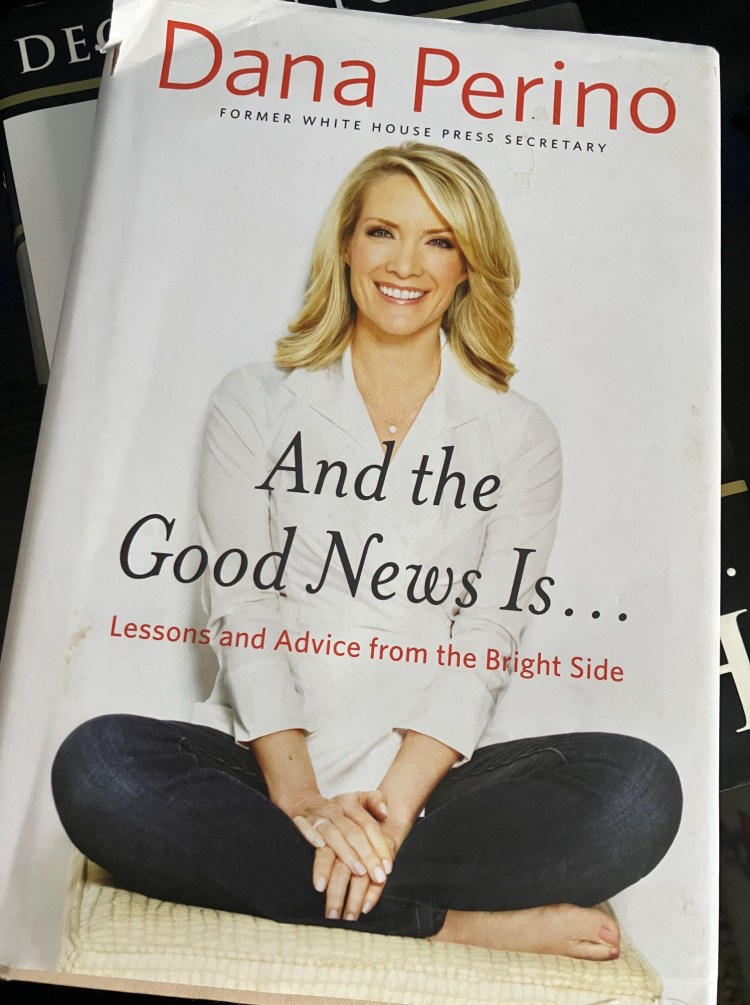
In 2015, Perino published her book, And the Good News Is…, which is part memoir, part advice for aspiring PR politicos such as myself. Because political memoirs are my favorite book genre, I picked this book up, even though I am not Republican. It was an enlightening read on what it’s like to work comms in the presidency, and her experiences are weirdly reminiscent of Obama-era comms staffer David Litt, whose book I have also reviewed here on the blog.
Perino is one of those rare people who decided what she wanted to be when she grew up as a kid…and then did that. As she writes in her book, the seven-year-old Perino traveled to Washington, DC with her family in 1979. The Perinos saw all the standard DC sights, and a family friend helped them get a tour of the White House. Her parents tell her that, when she returned home, she declared, “One day I am going to work in the White House.” The best part, besides the fact that she had a tee-shirt that said, “ANYTHING BOYS CAN DO GIRLS CAN DO BETTER,” is that she actually did work in the White House.
What looks now like a self-fulfilling prophecy was more likely a combination of determination, luck, connections (including highly intentional networking in the nation’s capital, as she says), hard work, and passion. However, as she details, it was not a straightforward path in the least.
She got her start in DC working on Capitol Hill and was working as the spokesperson for the House chairman of the Energy and Power Subcommittee in 1997 when she had a quarter-life crisis. She had spent years structuring her life to work toward her goals of becoming successful in the political world in DC, and felt like she was stuck in a rut. It was not too much longer after that that she met her husband, Peter, on a plane as she was traveling back to DC from Denver, where she formally grew up (though she says she spent many of her formative years on a ranch in Wyoming). After that, she moved to England, and then moved back stateside. She was living in San Diego, navigating city politics (a world she didn’t like too much) when she got the opportunity to work as a spokesperson in the Justice Department. She and Peter moved back to DC, and from there, she got a job in the White House Council on Environmental Quality. Once in the White House — where she’d wanted to work since she was a kid — she “hooked up with the White House communications team right away,” as she writes.
She quickly became Deputy Press Secretary, but hated the hours. She says in her book that she was tired of working 4 AM to 10 PM days that kept her away from her husband. In fact, the day she was promoted from Dubya’s Deputy Press Secretary to Press Secretary, she was planning to resign. Perino was blindsided by her own success, and really missed the simple things in life, like shopping at Target. She also says that she was shaped in not-so-great ways by the long hours of her job in political PR, and that the stress really took a toll on her.
Reading her book, I’m both inspired by her call to public service and her knack for public relations, while also wondering if big dreams of working in political PR are meant for people who can keep up with the grueling 12+ hour days. I already worked that much in the pandemic, and got super burned out, and I never want to do that again.
In her book, besides detailing her life’s history, she provides advice to people who wish to follow in her footsteps, and I did enjoy her advice. She also talks about the decline of civility in politics, which is somewhat concerning, but also a bit subjective. Is it really “uncivil” to disagree with a political candidate that does something you don’t like, or is that just democracy? There are some egregious examples of political incivility, such as January 6, but we’re so far into political incivility in our current moment that maybe she needs to publish another book about how to make society politically civil again. I would 100% read that.
Check out And the Good News Is… or read more of my political memoir reviews.

