By Sheeva Azma
Note: Though new information may emerge about science in the Epstein files, this article will not be updated. So many scientist mentions — so little time. I’ve been posting our Instagram about science in the Epstein files almost daily for over two months, so check that out for more info! You can also read all our Epstein blogs here.
As I comb through the Epstein files in a long-term endeavor to post about #ScienceInTheEpsteinFiles at least 100 times on Instagram (I’m getting there!), I often wonder…why did he bother doing all of this? Why did he fund so much science?
I mean, he was rich, so he could fund anything. Why did he choose science?
I’ve come up with a few plausible explanations.
Science helped Epstein gain clout
The first reason — and most obvious one, in my opinion — is that he needed legitimacy and clout. Jeffrey Epstein prided himself in funding science as a science philanthropist. He did it to gain clout and say he funded the work of prominent researchers. He wanted to be that rich guy with deep pockets that scientists (pretty much only men, and some of the, publicly, worst men in science) could look to for funding. Clearly, he sought control of the directions of science, and he could do that thanks to his wealth.
“I am funding a project on quantum computing at MIT, and biological code breaking,” wrote Epstein to a person named Kevin, whose full identity has been redacted, seemingly in an effort to gain even more clout.
Maybe some of this was so he could fly under the radar with his crimes — and recruit more people to be part of them. One moment he’s emailing a leading MIT brain researcher about science topics, and the next he’s inviting the researcher to his New Mexico ranch with another scientist from Harvard. It makes me sick, but it’s clear that his interactions with MIT and Harvard scientists legitimized him to scientists in his orbit, which then further legitimized him in the scientific community in general.
In particular, the Epstein files reveal that the Program for Evolutionary Dynamics (PED) at Harvard, which Epstein funded from its establishment and where even had his own dedicated office right there in Harvard Square, was a springboard for science collaborations. Numerous Epstein files emails indicate that he regularly scheduled science meetings and even seminars at the PED, and he was always sure to have his “assistants” (young women) around. (FYI: Martin Nowak, the head of the PED, is currently on paid leave from Harvard (this is actually the second time for him!) pending an investigation. He has also resigned from the Austrian Academy of Sciences.)
Harvard Square was a great place for Epstein, it seems. Besides Epstein’s office at the PED, he also had an appointment in the Harvard Psychology Department as a visiting fellow, and even rented a house in the area where he brought at least one young woman, the Harvard Crimson reports. The Harvard Crimson now describes the situation as “moral rot” — in 2003, they published an article lauding the “mogul donor” to the psych department.
Certain scientists were aligned with Epstein on his personal leanings
To put it in just a few words: certain scientists vibed with Epstein. For more about that, check out “Sciencing in the Era of Epstein” which talks about ways that scientists interacted socially with Epstein and integrated him, especially in the Boston area, into the local ecosystem.
Epstein’s “no strings attached” money appealed to scientists, who sought him out even more
Checking out Epstein’s website on the Wayback Machine (here’s one version from 2014), you can see that he boasts about “Supporting innovation in science, education and international peace accords.”
Because it’s so hard to get science funding (federal grants are funded at a quite low rate, in case you didn’t know), scientists such as Antonio Damasio (and even larger organizations such as the Alzheimer’s Association) sought to go the easy route (so to speak) and just ask Epstein for money. There are countless emails in the Epstein files where it’s just scientists and science publications (Nautilus, Neuro.tv) asking him for money because they’ve either fallen on hard times or they seek funding without any restrictions such as those taxpayer-funded science might impose — so, so much paperwork is involved in submitting a grant, with so little success.
This, to me, feels like a limitation of how taxpayer-funded science works (even moreso now that science grants have been cancelled left and right) — and it is one that Epstein used for his benefit. Find the cash-strapped (or greedy?) scientists at the top of their field that want more and more money to publish and not perish about research questions they want to control, and say you funded them while also gaining, ironically, a bit of control of their research directions.
Funding science improved Epstein’s public image (but was only possible due to the toxic structure of the science ecosystem)
Epstein’s public image was of great importance to him — so much so that after Epstein was released from jail in 2010, his friend Al Seckel became his digital PR person, trying to get good things about Epstein to rank highly on Google, editing his Wikipedia page, and so on, per The Guardian. This is also when many of his collaborations with scientists ramped up, such as linking up with the head of the MIT Media Lab, Joi Ito, in 2013, via an introduction from Linda Stone. Epstein donated $850,000 to MIT, with only $100,000 of those donations happening prior to 2013, according to MIT’s report on its Epstein interactions. In 2014, he met with the editor of the science magazine Scientific American, which further helped him in his quest to get good PR for himself and the researchers he funded.
Science made Epstein feel (or at least look like) he was focused on helping humanity, which improved his public image amidst his crimes.
Here at Fancy Comma, we have a lot of things to say about how science works as a social enterprise. I would argue that the power structure of science lends itself to this kind of thing.
Now, post-Epstein files, we have men in science resigning left and right after being able to have a storied career in science, and other male scientists named in the files basically saying things like “you wouldn’t understand if you were in my shoes,” when most women in science or others marginalized by the science ecosystem would never in a million years have those same opportunities. It’s bizarre.
Epstein gained a personal stake in science and technology by funding research
To put it bluntly: Epstein’s funding of science reflected his own warped priorities.
I was shocked to read that some of the funding Epstein provided MIT flew so under the radar that it went directly through MIT’s donations office, who provided Epstein and friends ways to donate anonymously. I guess they saw no problem with the money as long as it was flowing?
The problem is that, Kevin Ho and I talked about in our Xylom article, “Tennis for More than Two,” the people in the room shape how everything goes. Our article focused on game development, but it revealed that when the game devs (the people who make video games) are not diverse in background, the games, too, lack that depth. The same thing can be said about science: when the people calling the shots have their own motives, those motives are what prevail.
If you’re not sure what I’m talking about, think about two technologies now used worldwide that Epstein supported: artificial intelligence (AI) and BitCoin. When Epstein was funding these projects in the late 2010s, there was no guarantee that they would be ready to be used by the public sphere.
Joichi Ito, the former president of the MIT Media Lab who also led an MIT cryptocurrency project, received a lot of funding from Epstein in his heyday as president, especially at a time when cryptocurrency was in decline, QZ reports.
When it comes to AI, we can look to Epstein’s long-time friendship with the father of AI, Marvin Minsky, who was accused of sexual assault on Epstein’s island after he died in 2016.
Think about it: in what ways have cryptocurrency and AI, largely funded by Epstein in their relative infancy, been used to enable Epstein’s flavor of crimes? It’s a question I don’t have the words to talk about right now, but that doesn’t mean it’s not an important one.
Scientists made Epstein feel smart
The Epstein files are so forward-thinking on AI that it really feels like he was one of its greatest fans. He funded leading scholars in computer science, neuroscience, cognitive science, and philosophy at MIT.
I still wonder what it was like to work with Epstein because his emails are so incoherent. It’s like he knew the smart people and could speak their language, sort of, but was kind of just the rich financier in the background winning them over with all his riches. He must have known that his richness was what was so appealing to scientists, as he took advantage of it so much.
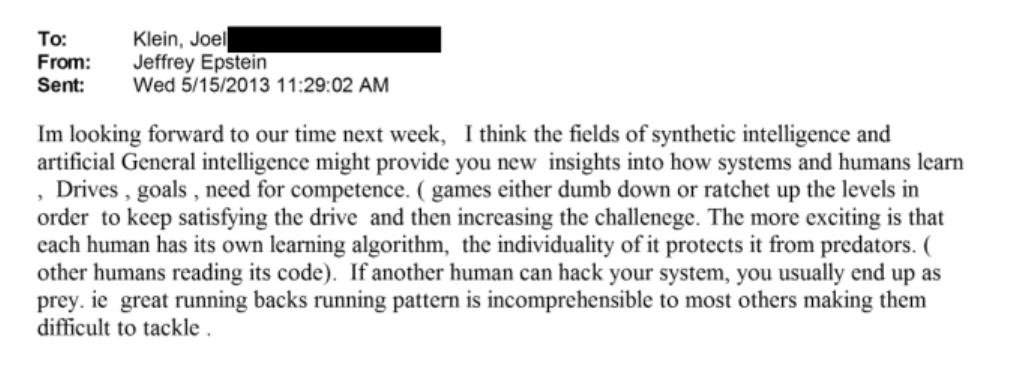
Just look at this email from the Epstein files — EFTA01975154. He talks about “synthetic intelligence” and even “artificial general intelligence,” which in 2013, was pretty much a pipe dream. However, after he namedrops those concepts, he talks about them in a way that has sooo much projection, it’s almost like we have a window into his twisted mind. He seemed fascinated with deception and constantly talked about how biological mechanisms trick people, as he talks about here, also.
Epstein wanted “yes-men” to align with him on his pet topics
I’ve already blogged about all of the scientists linked to him just by my combing through of the Epstein files (that’s not an exhaustive list, I can say). One scientist I did not blog about there, Joscha Bach, is covered extensively by Anand Giridharadas over at The Ink. Bach was supported by Epstein when the MIT Media Lab did not give him a suitable wage, in his opinion, and after that, he becomes someone who aligns with Epstein and thanks him effusively in his messages. Too bad that the Epstein files also reveal Bach as harboring, as Epstein did, racist views about cognition, and warped ideas about morality.
Epstein wanted to make the world more conducive to crimes, scientifically
One explanation I have is more nefarious and I think this is one of those things that has come to light only through the Epstein files. Epstein was looking for empirical ways to justify his lifestyle of crime and trauma. What this looks like to me in the Epstein files is his funding of research into deception, consent, trauma, and more.
Beyond that, we can look to the Epstein files reveal that Epstein loved to fund things that were high-tech and futuristic and that, seemingly, were aligned with his own goals. He poured dollars into the research used to establish BitCoin, which was back then a novel idea for decentralized cryptocurrency that can, incidentally, be used to fund illegal activity. Epstein and his science friends’ interest in deception research would be comical if he was not so obsessed with covering up and hiding negative aspects of his public image. His interest in deception research also involves a deception researcher — his friend Marc Hauser — literally faking data (not work specifically on deception, but in their research work nonetheless) to get published. Hauser left Harvard in 2011.
Epstein thrived on quick, transactional wins
I want to also note that Epstein did not always (at least, not immediately) live up to his own funding hype. In one case, Epstein agreed to fund so-called “telepathy” experiments led by researchers in London, as I Paper reports, until the researchers’ institution became wise to what Epstein was up to, and refused to accept the funds. The researchers shuffled things around and figured out a new funding mechanism on their side, but it was too late — Epstein was no longer interested. However, as the aforementioned I Paper article states, the researchers “carried out the research with Epstein at a later date,” per 2018 emails referencing payments between Epstein and this group of scientists.
Follow us on Instagram for more of our analysis about science in the Epstein files.
 Fancy Comma, LLC