By Sheeva Azma
Participatory action research emphasizes learning and deep community involvement, with objectives that shift and evolve as needs do.
One of the most challenging aspects of the COVID-19 pandemic was the growing tide of vaccine hesitancy, which gained momentum through those times, and has now pervaded US health policy, to experts’ great dismay.
I was a scientist running a science communications company in those times — and even before the pandemic — and to say that I had a solution to communicating about public health, but felt unheard, would be a great understatement.
My idea was simple: include people in messages. Tailor the messages to them. Easy enough, you might think, but messages don’t always “land.” When they don’t, you can go back to the drawing board and try again. Don’t give up until something works. It was part “move fast, break stuff,” but also part “let’s move fast so stuff doesn’t break more.” It was messy but in my gut, I knew it would work, even if that’s not how the science world works. The method I had in mind was akin to a political “war room,” like a political campaign with many different demographics targeted. It’s how the communications world works, even if it’s not how science communication really works.
Sadly, that didn’t materialize, despite my best efforts: reading the news nonstop, writing my lawmakers about how to communicate COVID science, even coming up with vaccine explainers (in both English and Spanish!) and a whole COVID-19 science resource page. I wasn’t working in a lab, so I had time to work 12 hours a day and workshop different types of science communication. Perhaps my scientist colleagues did not have that luxury. I noticed there was also not a super evidence-based way to figure out what might work and not work in such a novel time — after all, COVID-19 was an entirely novel disease, and we had never been in a pandemic before in our lifetimes.
So, while the science was settled in many important ways, it was also not — in also important ways. It all came down to the fact that, while things were moving fast, scientist voices seemed drowned out among all the chaos, overshadowed by faithless naysayers who didn’t believe a safe and effective mRNA vaccine was possible, non-science-informed journalists who posted confusing and often incomplete science breaking news stories, lawmakers who sought to politicize science for personal gain (and were adept in doing so), celebrities who tweeted their vaccine skepticism, a profitable anti-vax movement, and so much more.
If anything, the cards were stacked against scientists. That’s why, in retrospect, I feel that we (the scientific and science-adjacent community) could have done a lot more to tell the world about how great of a tool science was in that time, for whatever reason. It really wasn’t just about vaccines — it was about restoring public trust in science in general.
How do we do that? Well, that’s the question. Participatory action research can be one community-focused key. High-level, coordinated science communication from trusted messengers is another…even on topics that scientists find ridiculous. The little things are the big things in science communication…but I digress.
Before we proceed, keep in mind that I am not a participatory action research scholar…just a science communicator interested in solutions that work. If you are involved in participatory action research (or a related social science field) or science/health communications and have ideas on what I have written here, please get in touch.
Now…let’s move on to the actual problem and my proposed solution.
The problem: growing distrust in so-called “settled science”
In response to misinformation and politicization, scientists doubled down on the idea that facts are facts, even when people started to question them. Luckily, due to high public trust in science, many did heed scientists’ advice, but so many others did not. So, while the strategy there kind of worked, seeing as how we are no longer in a pandemic, it turned out that that wasn’t enough, given where federal health policy has been going under Trump 2.0.
Long story short, the scientists got outsmarted at their own game of science because the unthinkable in science communication happened: the scientists’ certainty and inability to engage people of varying levels of skepticism became a political talking point…among people who had power but no real science knowledge. That’s how we got to be where we are today, well on our way to losing our measles elimination status as a nation.
It’s heartbreaking.
What I wanted to yell from rooftops all through the pandemic — to scientists, to lawmakers, to anyone — was that if you can’t convince people that science facts are facts, or don’t tackle skepticism or community questions and hesitancies, that makes people feel excluded from science, and things fall apart.
I’m not talking about providing a factsheet to someone who believes vaccines will actually make people sicker en masse. I’m talking about having a long-running dialogue with people about that, as a scientist and/or science communicator, even if you can’t understand why someone would think that. Part of your job would be figuring that out and making space for that in your communications. There should be no unanswered questions, at the end of the day — not even the ones scientists find stupid. No question is a stupid question, remember (at least, that’s what my professors used to say — what happened to that)?
Well, as it turns out, there is a whole discipline of social psychology dedicated to the idea of participatory knowledge generation to create social change. It’s called “participatory action research,” and it hasn’t gained traction because it’s not glitzy and glamorous and you can’t get a ton of publications out of it (I didn’t make that up — it’s from a 2006 paper in the Journal of Epidemiology and Community Health on the topic).
Look, I get it. Scientists need to publish, or else their careers go away. However, we could still apply participatory action research on the science communication and public health side, where we are less concerned with how many papers we can publish and more concerned about how to build trust with people (Yes, even in these times. What do you think we’re supposed to do, just give up and let the non-experts win?).
Extraordinary claims require extraordinary evidence (and I do think that “vaccines are safe and effective” is one of those claims, especially for nonscientists), and participatory action research can be a source of evidence-based insights to drive and adapt science communication to reach strategic public health goals.
A potential solution: Participatory Action Research
Could participatory action research be transformative for health and science communication? Keep reading to learn more about action research, and participatory action research, more specifically.
A brief history of action research
Before we talk about participatory action research, let’s get into action research more generally.
Action research emerged in the 1940s through the work of social psychologist Kurt Lewin, an MIT professor who wanted research to both generate knowledge and directly contribute to social change rather than remain purely observational. Lewin proposed a cyclical process that could be repeated to improve practice in settings such as workplaces and communities. First came diagnosing a problem; next was planning an intervention; then was action; lastly was outcome evaluation. In today’s high-tech world, it reminds me of the iterative development in software engineering. If it works for Big Tech, which is known for its large-scale, life-changing products we use every day, can it work for science and health communication, too?
As Clem Adelman wrote in 1993, “Action research gives credence to the development of powers of reflective thought, discussion, decision and action by ordinary people participating in collective research on “private troubles” that they have in common…’No action without research; no research without action,’ Lewin concluded.”
Action research’s goal is not to collect knowledge, but to problem-solve or understand a process or phenomena in a specific situation, or to help participants come up with knowledge they can use to help themselves solve a problem. It is used widely in the educational world these days, but also in “health sciences, nursing, social work, and anthropology,” according to Eileen S. Johnson, who wrote about action research in the Oxford Research Encyclopedias in 2020.
The goal of action research is not to add to a general body of knowledge but, rather, to inform local practice, engage in professional learning, build a community practice, solve a problem or understand a process or phenomenon within a particular context, or empower participants to generate self-knowledge.
Action research is a huge part of education and community development, these days. In the 1970s and 1980s, nurses began to use action research. Angie Titchen, writing in the International Practice Development Journal of the Foundation of Nursing Studies in 2015, gives some applications of action research in the health care realm, such as “realizing person-centered values” and “helping people to empower themselves,” among other, more complex healthcare-focused goals.
After the 1970s, action research became closely associated with participatory and democratic ideals, emphasizing local knowledge, empowerment, and shared decision-making rather than top-down expert control. It also became a way to reduce inequity in education, which suggests to me that this little-used method could be promising for boosting science engagement and literacy where there are inequities.
Participatory action research
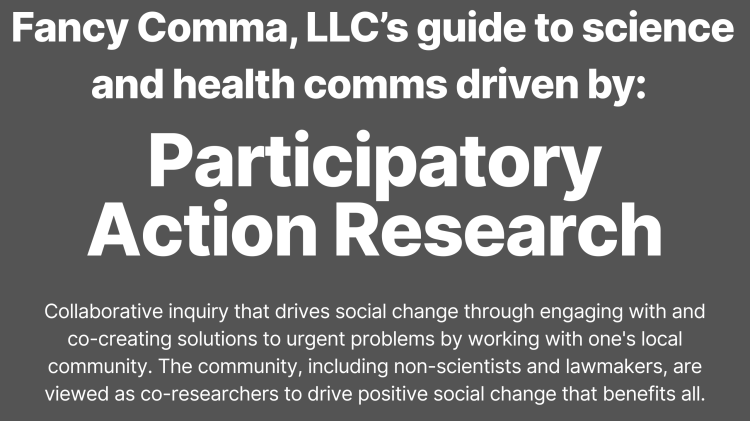
Participatory action research differs from regular action research. It is more collaborative in that members of the community are co-researchers.
In COVID, this could have meant that lawmakers, the general public, journalists, and others were co-researchers on a pursuit to shared truth that could drive public health action in a way that made sense for everyone involved. That shifts the power dynamics of research in a huge way by involving everyone. Participatory action research is not just about solving a local problem but also about collective inquiry and shared ownership of co-created knowledge that can drive social change in ways that combat oppression and help people live better, more empowered lives.
As Baum and colleagues wrote in 2006, participatory action research is based on questioning “the nature of knowledge and the extent to which knowledge can represent the interests of the powerful and serve to reinforce their positions in society.” It also values experience as a “basis of knowing,” with the idea that “experiential learning can lead to a legitimate form of knowledge that influences practice.”
What would that have looked like in practice in the COVID-19 pandemic? Well, instead of calling the people who didn’t believe what scientists had to say some mean name, scientists would embrace the roles of lawmakers and science-hesitant nonscientists in shared knowledge co-creation about the benefits of vaccines in COVID-19. These co-creators would factor into decisionmaking as full partners in order to transform society for the better with everyone on board.
If that sounds scary to you, as a science communicator, to make science-skeptic lawmakers and the people who voted for them, heard, well, then, that’s part of the problem, if you ask me. I am not saying to legitimize anti-science, but to bring it into the dialogue as per participatory action research. There is already a whole literal framework to do this.
If you ask me, relying on principles of participatory action research is what science and health communicators should have been incorporating all along.
Pros and cons of participatory action research
This work, like anything else, has its pros and cons.
For science communication, the pros are what we could have used in the pandemic — a way to bridge theory and practice in a way that could be both data-driven and collaborative enough to drive real-world results on science communication campaigns. Action research can bridge theory and practice, solving real-world problems through data-driven decisions, and more. It can empower practitioners of science and health communication by making them researchers in their own context, boosting leadership skills, and promoting collaboration (for instance, making the person to whom a science communicator is communicating a co-researcher, in a way!).
Unfortunately, in practice, this can be messy and highly context-specific, and better suited for the real world than the research setting. Action research doesn’t lend itself well to being published, because the findings are limited to a unique sample of people, and replication can be a challenge. It can also be difficult to prove rigor and can be a high time commitment. Its focus is to solve problems immediately, which often rules out theoretical depth or being more broadly applicable beyond the immediate context. (If you’re interested in the ethical limitations of action research in the education world, which may or may not translate entirely to application in the science and health communication fields, check out this article.)
Life is messy and complicated, too, though, so in a way, the cons make action research perfect for real life. Science communicators could approach their communication through an action research, and specifically a participatory action research context. The real-world appeal of action research is definitely compelling to me as a science communication method. In practice, this might look like focusing on specific groups, developing messages via a trusted messenger, deploying those messages, and seeing what works and what doesn’t. It would have been a highly useful framework in the pandemic to be able to adapt rapidly and consider leading non-scientist voices on COVID science as co-researchers towards a shared truth. (Wow, hindsight really is 20/20, sometimes, isn’t it?)
Why action research fits “in lieu of a full study”
Scientist Eyer Klaus of Aarhus University writes, “I am fully convinced that researchers must play a bigger role in society to tackle vaccination hesitancy efficiently, but support from different actors is needed to make full use of their potential…Addressing misinformation where it occurs is important, but it requires a comprehensive strategy.” His idea is to support researchers in scientific outreach to meet the need to dialogue “between the scientific community and the public.”
Scientists are all about evidence, but hear me out here: we don’t have to do a whole research study to figure out what works before acting rapidly to communicate and save lives in a health crisis. In a rapidly-evolving pandemic with a novel virus, such as in the COVID-19 pandemic, the ideal of a fully powered, lengthy, randomized communication trial is often impossible, yet decisions still must be made under conditions of uncertainty (might I add, while everyone else is speaking).
That could look like this 2022 paper by Tuckerman and colleagues which came up with a list of conditions in which people would be more likely to get vaccinated, including “strong community engagement.” That’s not to say that there are not systematic reviews emerging about what types of vaccine communications work and what don’t, such as this one by Whitehead and colleagues that was published in Vaccine in 2023. Neither of those articles is a “here is what will work in every context” type of paper, and the challenge remains of reaching out to the vaccine hesitant in positions of power (and the people who voted for them and listen to them) as co-creators of information that can drive public health action, but hey, it certainly is better than nothing, isn’t it?
In participatory action research, rather than waiting for definitive evidence on “the best message,” science and health communicators and teams engage in cycles of rapid prototyping, field-testing, and refinement of messaging within ethical and practical constraints to keep communication aligned with evolving public concerns and information needs. Ideally, this would include media and lawmaker narratives. Without those parts of the problem, vaccine messaging recommendations simply don’t meet the moment.
So, while participatory action research offers a structured alternative that is less rigorous than science itself, but much more systematic than ad hoc messaging (which we saw a lot of in the pandemic). It provides a defensible middle ground where interventions are documented, monitored, and iteratively improved, even if they cannot meet all the standards of conventional experimental design. Even expert brainstorming such as this from Cactus Life Sciences is a good start in the absence of more systematic studies (if you can believe it, this paper is just a whole paper on how to do that for action research in healthcare).
So, there you have it. My intention in writing this post was not to tell public health communicators how to do their job, but to talk about a framework that could be helpful in framing science and health communications approaches as more participatory and inclusive in ways that current communications both are not and need.
By the way, this is not an entirely novel concept – just check out University of Washington’s Health Equity Action Research Team or HEART!
Feel free to ask ChatGPT to come up with a participatory action framework to help you with your next science communication campaign. 😉
 Fancy Comma, LLC