By Sheeva Azma
Scientists named in the Epstein files have largely evaded actual consequences through planned resignations, public apologies, and denial of any wrongdoing.
I’ve spent three months, at this point, combing through the Epstein files and sharing what I’ve learned, both here and on our Instagram.
As I’ve written previously, Jeffrey Epstein not only befriended science’s biggest names, but he also some of the most toxic figures who found themselves forced out of science. Epstein used his science affiliations to gain clout, both in and out of science. Scientists who affiliated with him, predominantly but not always males at elite institutions, became trapped in a web as they pondered their options: seek power and prestige and funds (and, it now seems, access to trafficked women — among Epstein’s science friends, allegations of criminal activity have surfaced) by affiliating with Epstein, perhaps participating in some of his crimes, or miss out on funding and the ability to publish and not perish.
Many of the people I looked up to as an MIT student are Epstein affiliates. Many have lost their jobs or have resigned from them by choice, to evade actions taken against them. Others have not faced any action, other than being named here — which, let’s face it, does nothing. Someone recently tried to link to our blogs on Wikipedia and was told that our website does not count as a legitimate source since it’s self-published. (So weak sauce.)
Anyway, something I’m really proud of as an MIT alum is the institute’s history of uncovering — and responding to — sexism in science. Not too long before I had stepped onto campus as an undergrad, MIT professor Nancy Hopkins had become famous for publishing “A Study on the Status of Women Faculty in Science at MIT.” There was an initial report, and then some changes were made, and then a follow-on report was published as well.
In a nutshell, this work reflecting on how we do science revealed that women faculty felt “invisible” at MIT. There were also differences in “salary, space, awards, resources, and response to outside offers between men and women faculty with women receiving less despite professional accomplishments equal to those of their male colleagues.”
(In a way, I aspire to be like the people who wrote that report (who include some of my favorite professors) by publishing this blog series.)
Sadly, we do not have anything like that going on in science as a whole, and these scientists, if they have not resigned to avoid actual consequences, apparently just don’t care.
At least, that’s the impression I get from this quick run-down and round-up of what scientists are saying about their own newly-surfaced Epstein ties in the emails. Please note that this article is not a comprehensive overview of what every scientist mentioned in the Epstein files is saying about the fact that they are in them. However, looking at this handful of scientist opinions on their Epstein ties, you see an all-too-familiar pattern emerge. It’s not my fault; I had no idea. This is so terrible. I can’t believe I was caught up in it.
These are big names! I’ve heard of these scientists, read their work, and have had at least one of them as a professor, and they’re not dumb people. All of that is why, reading the below scientists’ opinions, I wonder if their lack of knowledge was simply an ignorance of red flags to help advance their projects and careers. Perhaps they knew better, but they didn’t do better…or they were afraid of what would happen if they didn’t have that money or status or influence.
The Epstein files makes these people look greedy and unscrupulous. It all makes me wonder: is there even value in saying you’re sorry once the damage has been done?
Read on and decide for yourself.
AGI researcher: “I was social engineered by the dude”
“I had nothing to do with [Epstein’s] crimes,” artificial general intelligence (AGI) researcher Ben Goertzel was quoted as saying in the Beachcomber. He states that he also “was a small part of [Epstein’s] campaign to make himself look fancier and wash his reputation,” though he stated that he did so unknowing of Epstein’s criminal activity.
The article links to a YouTube video he published on February 20, 2026. He also published a Substack article on the same day.
“I’ve been seeing a bunch of noise on the internet about my interactions with Jeffrey Epstein and my appearance in the Epstein email files, and so I just wanted to say something to clarify what the actual deal was,” he begins in his video statement, which he states that he is publishing as a way to “get a little more nuance across.”
It was his “push for beneficial AGI” that led him to “[expletive] Epstein” in the first place, he says. “Yeah, I did know Epstein for about 17 years, accepted bits and pieces of research funding from him over the years.” In the Substack post, he details that the “bits and pieces” of research funding he accepted over the years amounted to $360,000, much of it at crucial points in his life when he was strapped for cash.
He continues in the video, “I didn’t know him super well, personally, but we were buddy-buddy. I always met with him in office settings, and it was always centered on me pitching him AGI and telling him why beneficial AGI is the most important thing in the history of our species and why he should put some of his money into it, right? I didn’t go on his plane or visit his island or party with him or something. It was always, like, a office pitching type of setting.”
“This is not what I realized was going on at the time,” Goertzel states of Epstein’s criminal actions. “It’s pretty sickening to me that, unwittingly, I was so close to such f***d up things.”
The now father of five, including two daughters and a granddaughter he says he’d never want close to Epstein, states in the video: “I was introduced to Epstein in 2001 in New York by another scientist who had received funding from him. And, you know, at the time, I was essentially flat broke, didn’t know where I going to come up with rent to house and feed my wife and three small children. You know, he ended up, shortly after our first meeting, donating $100,000 to the University of New Mexico to cover a research fellowship for doing research on AGI.”
Goertzel, who is now an established AGI researcher, describes Epstein’s investment in his AGI work back then as ahead of its time: “nobody took [AGI] very seriously. So, to meet this guy, who had a huge amount of money, who was willing to put even a little bit of it toward AGI — this was pretty remarkable.”
This initial research grant got Goertzel through his financial difficulties as he survived in his career path and had many more opportunities to apply for funding and to keep “pitching, pitching, pitching…” people for money over the next 17 years.
Over time, he received more donations from Epstein to different “AGI-oriented entities I was involved with.” However, as he describes in the video, as Goertzel’s career progressed, he was less reliant on Epstein and saw his funding as “like a little footnote … and not my favorite funding source to deal with” — “one of those last-ditch guys you would go to for something.”
“This wasn’t some big patronage thing,” he says. “Where I feel I made a mistake was 2008,” says Goertzel. “I met with him not long before [he was going to jail], and he told me he was going to jail.” Goertzel states that Epstein told him he had been framed by his political opponents, and “pretty much, I believed him.”
“I don’t know that much about political hijinks in high places,” Goertzel states in the video, which now has 3700 views.
“In hindsight, when I look at some of the emails I sent him around that time, it looks pretty cringe to me, but, I mean, I … I was social engineered by the dude, right? Like, I believed what he said about why he was sent to jail. Honestly, I had a lot of other [stuff] going in my life. I was going through a tough divorce with three small kids. There was financial crisis in late 2008, which was putting my AI consulting businesses in a lot of trouble, so I’m doing online research to dig into Epstein’s problems was very low on my priority list, right?”
While he describes himself as strapped for cash through essentially the whole decade of the 2000s, his YouTube bio talks of his current prestige and positioning in the artificial intelligence world, listing him as “CEO of ASI Alliance and SingularityNET, leader of the Hyperon project and the AGI Society, and an AGI researcher who has spent decades working across mathematics, cognitive science, computer science, complex systems (and areas like longevity biology, quantitative finance, algorithmic music, parapsychology, etc.).” He continues to post videos about his projects there.
Physicist: “Your need for money is the handle by which you can be grabbed.”
Brian Keating is a physicist who describes himself as shocked to see his name in the Epstein files. He wrote a whole Medium article about it. “To my horror, my name appears in at least 13 documents, including multiple emails sent to Epstein,” he says of what he describes as a “relatively mild” association with the convicted sex offender.
Despite his horror, he minimizes the importance of his contact with Epstein. “[T]he scientists are not the story. The victims are.”
Amazingly (to me, at least), Keating also drops this line about his feelings from being in the files: “[W]hatever discomfort I feel is nothing — nothing — compared to what his victims endured.”
These are statements that try to minimize the role of science — and even scientists — in Epstein’s crimes. Epstein was heading up whole projects on the science of deception, possibly to be able to get away with more stuff. So, yes, the scientists — and even the science — is part of the story. Scientists legitimized him, helped him look like a great, deep-pocketed humanitarian, while also eagerly accepting invitations to go to his ranch.
That’s part of why I do not trust any of these people anymore. I cannot take this person at his word at any point in this article, except when he says:
“Your need for money is the handle by which you can be grabbed. Know the handle exists.”
Keating, like Goertzel, describes himself as a casualty of the circumstances: “Brilliance without ethical vigilance is just useful naïveté. And useful geniuses, it turns out, were exactly the product Jeffrey Epstein was shopping for.”
He discusses the need for science funding, the need for status, and what he calls “institutional moral outsourcing” as the three main drivers of scientists’ ties to Epstein. If MIT and Harvard did it, then it was okay, he states. It’s a lot of different ways to say the same thing: I am not responsible for my own actions.
He does try to provide some solutions. Make students learn ethics in science, via ethics courses, and we will be free from this problem, he writes, as if scientists just don’t know ethics. Ethics courses in graduate training already exist, by the way — I took one in grad school, and that was in Spring 2009 called “Skills and Ethics.” I don’t remember what exactly we learned, but I can say that it was a good idea. Now I know that there’s a lot more nuance to ethics in science than “don’t accept dirty money from traffickers” — that should be the bare minimum — but that’s a whole other blog post.
So, I guess, according to Keating, I have my ethics course to thank to motivate me to write this whole blog “from the cheap seats,” as he literally calls those who criticize him.
Nobel Prize Winner: “I was completely unaware”
Frances Arnold is Linus Pauling Professor of Chemical Engineering, Bioengineering and Biochemistry and Director of the Donna and Benjamin M. Rosen Bioengineering Center at CalTech. In January 2011, she was one of many academics to attend the MindShift conference on Jeffrey Epstein’s private island.
She was connected to Epstein on her own accord, per the below email from the Epstein files, though a later email regarding the MindShift conference describes her as “unidimensional, not fun, not participating.”
The California Tech, CalTech’s student newspaper, reports that in one of the Epstein files emails after the conference, she wrote: “I want to thank you for hosting that amazing ‘conference’ last weekend… I’m sorry I did not get to interact with you very much, but I hope that you will visit us at Caltech sometime, where I can tell you more about laboratory evolution and all the crazy wonderful things we can make.”
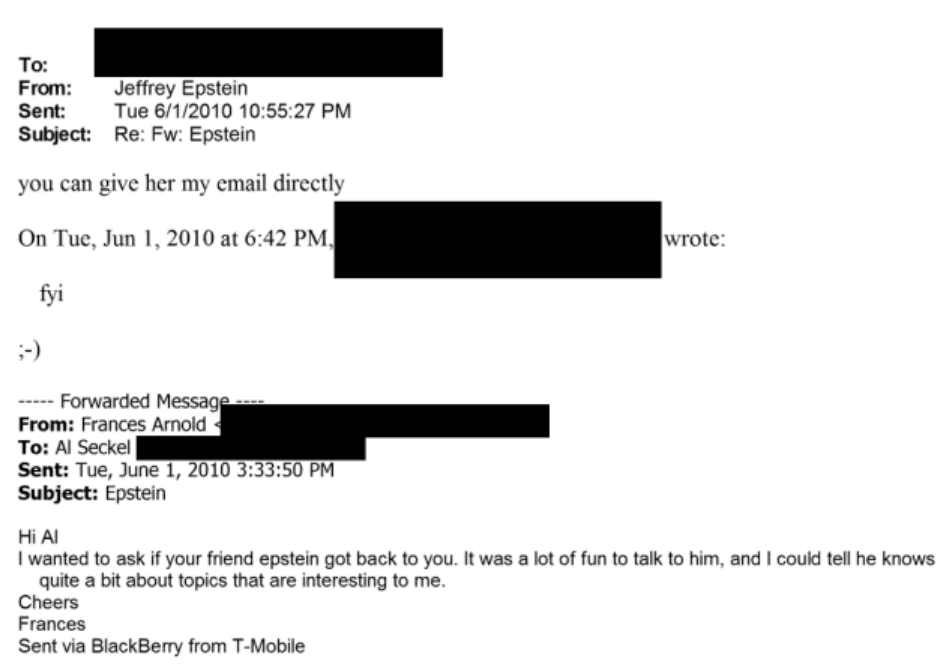
Arnold won the Nobel Prize in 2018 “for the directed evolution of enzymes.”
Regarding her involvement with Epstein and the MindShift conference, Arnold told The California Tech, “Someone organized a conference where I met Epstein briefly. I never spoke or interacted with him before or after, other than the “thank you”. Other than the conference (where he spent little time, as you can see from my note), I had zero connection with the man. Of course, had I know[n] about him, I would have declined to even go to the conference, but I was completely unaware.”
Winner of the largest prize in neuroscience: “Continuing to learn from my mistake”
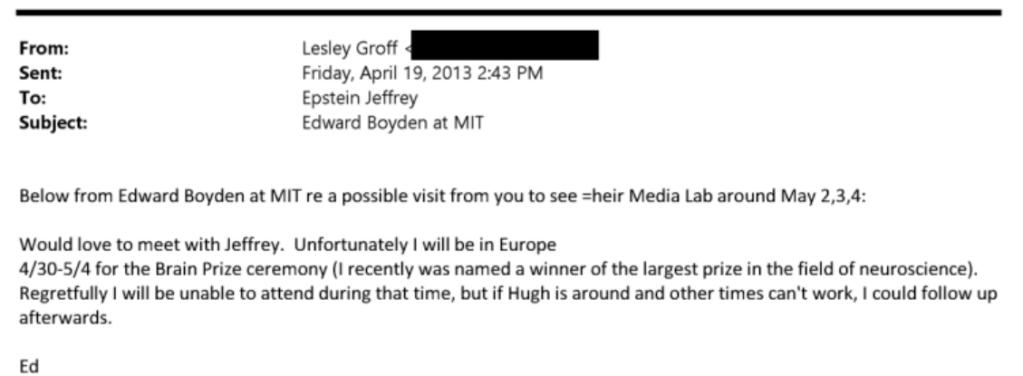
I’ve previously written in detail about how Ed Boyden seemingly lied about his affiliation with Epstein in many places, including here and here. I’ve also posted about it on Instagram here and here. Boyden is an MIT professor who has won the highest prize in neuroscience whose name appears in the Epstein files 969 times.
When he appeared in the MIT report on Epstein’s interactions with them, he issued an apology letter on his website: “I am continuing to learn from my mistake,” Boyden wrote. In his letter, in which he stated that “some of these meetings were off-campus” and that “all took place in group settings with the purpose of discussing research, which is what I did while there.”
He made no mention of the ticket that Epstein purchased for him to visit the Epstein ranch, where he was scheduled to visit with Martin Nowak, now on paid leave from his professorship at nearby Harvard. The Epstein ranch is under investigation by the state of New Mexico for illegal activity.
I don’t know what else can be said about that, honestly…so let’s just move on.
Music and neuroscience researcher resigning in disgrace: “It’s not fair to judge me”
Mark Tramo was my professor in 2004 when I, an MIT student, cross-registered at Harvard to take his class called “Music and the Brain.” On March 6, 2026, The Daily Bruin reported that he resigned from his professorships at the University of California-Los Angeles, where he had been working, due to his affiliation with Epstein.
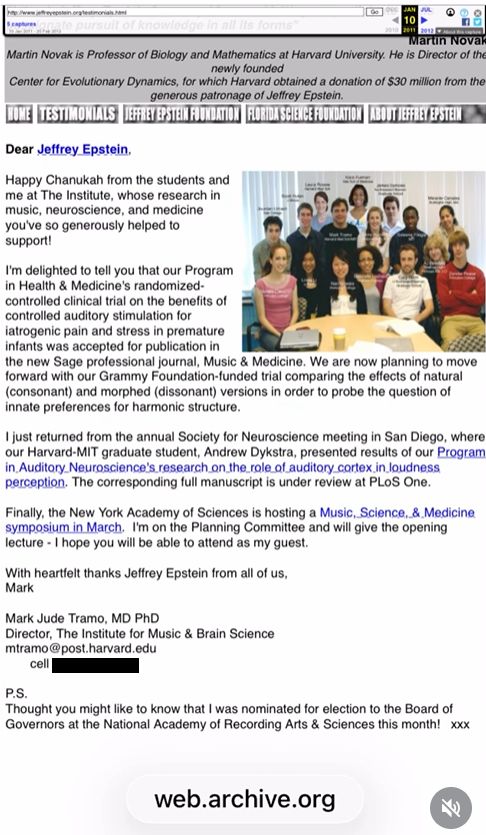
Tramo and Epstein go back a couple of decades — all the way back to the late 1990s, years before I took Tramo’s class, according to The Harvard Crimson. Tramo’s institute appears on Epstein’s website in January 2011, per the Wayback Machine.
The below image appears in a quick screenshot in one of our Instagram posts.
“Dear Jeffrey Epstein, Happy Chanukah from the students and me at The Institute [for Music & Brain Science], whose research in music, neuroscience, and medicine you’ve so generously helped to support!” Tramo writes in this screenshot, dated January 10, 2011.
The Harvard Crimson reported in 2025 that upon the news of Epstein’s guilty plea in court, Tramo, who was then affiliated with Harvard, wrote: “Please remind [Epstein] that boys from The Bronx (even if they end up at Harvard) have long memories, know all about cops, and stay true to their friends through thick and thin (no less peccadilloes).”
More recently, Tramo told the Bruin, “It’s not fair to judge me as if I (and you) knew pre-2019 what we know post-2019 […] I was seeking donations from him and other philanthropists for noble causes.”
Neuroscientist: “I was looking for a prestigious philanthropist, not a criminal”
Antonio Damasio emailed Epstein to ask him to fund research in 2013, per USC Annenberg Media. I’ve written about Damasio here and published Instagram reels about him here and here talking about Damasio’s desire to escape the bureaucracy of science funding and gain more “control” over his research directions.
Talking to Annenberg Media, Damasio stated that his contact with Epstein was “routine” in terms of researchers seeking funding. Furthermore, Damasio stated that he first met Epstein in 2009, though he did not specify the month in his statement; Epstein was in jail through mid-2009.
Damasio told Annenberg Media, “I was looking for a prestigious philanthropist, not a criminal.” He also stated that, while he was invited to fly on Epstein’s plane and visit the private island, he never did so. Annenberg Media reports that Damasio never received funding from Epstein, despite his tries.
Scientist who visited Epstein in jail: “I disempowered his victims”
I had to Google whether Seth Lloyd taught at MIT because he starts his apology letter to Epstein’s victims, published in 2019 after his involvement became apparent through MIT’s report on Epstein’s activities there, talking about all the times he met Epstein at Harvard.
“Mr. Epstein and I met at a dinner for scientists and their supporters in 2004. During his visits to Harvard over the next few years, he and I discussed scientific questions, and his foundation gave me a grant to support my research,” he wrote. Indeed, in addition to grants, Epstein also gave a personal donation to Lloyd sometime between 2005 and 2006, deposited directly into his bank account, per the MIT report.
In his apology letter, Lloyd writes: “When I learned of Mr. Epstein’s arrest and subsequent conviction, I was deeply disturbed. […] But upon reflection, I decided to visit Mr. Epstein during his prison term in Florida. I believed, at the time, that I was doing a good deed. Mr. Epstein expressed remorse for his actions and assured me that he would not re-offend.”
The two stayed friends over the years, and Lloyd accepted funding from Epstein up until 2017, he says.
“By continuing to participate in discussions he had with me and other scientists and by accepting his donations, I helped Mr. Epstein protect his reputation, and I disempowered his victims,” Lloyd writes.
“The job of a scientist is to look for the truth, and the job of a teacher is to help people to empower themselves. I failed to do my job on both counts.”
Amazingly, Lloyd is still on the faculty at MIT, despite failing to do both of his jobs. (Besides how terrible that is for the victims, as he himself has stated, what a ridiculous double-standard that reveals about men and women in science.)
Nobelist and long-time Epstein friend: Mentoring young scientists remains a “meaningful commitment”
Richard Axel received the Nobel Prize in 2004 for his work on the olfactory system. He and Epstein go way back — Epstein describes himself as a long-time friend of Axel’s in the files, as I have written here, and Axel has 933 mentions in the Epstein files.
Axel announced he would step down from some research roles he has on February 24, 2026. However, Axel did not resign from all of his positions at Columbia. “I have informed Columbia University that I will step down as co-director of the Zuckerman Mind Brain Behavior Institute to focus on research and teaching in my lab,” he wrote in an official university statement.
“The research I have pursued as an Investigator at HHMI and as a professor at Columbia, along with the privilege of mentoring generations of young scientists, will continue to be among the most meaningful commitments of my life,” he wrote.
So, Axel remains on the faculty at Columbia, it seems. It is weird to state that you are friends with a convicted sex offender and also talk about how great of a mentor you are in the same letter.
I would love to know what the whisper networks of undergrads, graduate students, and postdoctoral researchers at Columbia say about his lab, and about working with him in general, if anything.
“The term “whisper network” refers to a thriving system of informal communication amongst women to warn each other about male sexual predators within their immediate environment,” writes Sai Amulya Komarraju.
Princeton professor: “I wish I had never known him”
Corina Tarnita was a grad student of Martin Nowak’s, who has been surprisingly mum on his role in the Epstein files (despite Nowak being on leave a second time regarding his involvement with Epstein).
Tarnita emailed Epstein about inane, sometimes random topics, and thanks him in her PhD thesis.
“I never saw him behave inappropriately. Like most people who knew Epstein in his capacity as a donor to scientific research, I am revolted by his depravity and regret having met him,” Tarnita told The Daily Princetonian.
Yes, the scientists in the Epstein files are the story
So, you see, the scientists are the story.
Maybe it’s just me, but the feeling of recognition and familiarity towards scientists who do interesting, high-profile work is kind of the same feeling one gets toward politicians you really admire — who are also, themselves, recently, being increasingly scrutinized for their bad behavior. Colleagues in the United States House of Representatives, spanning both sides of the aisle, former Eric Swalwell and Tony Gonzalez resigned from their political positions on April 14, 2026 within hours of each other, both due to allegations of misconduct.
Follow us on Instagram for more about science in the Epstein files and where science should go from here. You can read our other blogs on the topic, too.


4 thoughts on “Science in the Epstein files: What are implicated scientists saying?”