By Sheeva Azma
This blog discusses details of Jeffrey Epstein’s criminal activity and may not be appropriate for all audiences.
In July 2009, Jeffrey Epstein returned from his jail time to reconnect with a welcoming community of elite scientists who treated him both as a friend and intellectual equal.
Jeffrey Epstein did not have any science degrees. He was a rich man who could influence science primarily through donating to it, and he loved doing that after he left jail, since his funding of science could drown out all the news of his jail time.
(By the way, it’s been over three months, at this point, that I’ve been looking into the topic of science in the Epstein files. I’ve been talking about everything I’ve learned here on our blog, on our Substack, and on our Instagram.)
I have to level with you, dear reader, and tell you that, up until this blog, I have quite intentionally avoided discussing the specifics of what Jeffrey Epstein did that caused him to go to jail.
The reason has been that discussing the wrongdoings have been out of the scope of the discussion of scientists’ involvement…until now.
Epstein’s scientist friends have stated they did not know about his crimes
By now, several of Epstein’s scientist friends have stated that they had no idea what he did when they were taking him up on offers of funding, retreats to his private island and ranch, and more. A lot of the science in the Epstein files does happen after he got out of jail in 2009.
Scientist perspectives on Epstein’s jail time are actually mixed. Some scientists say they knew he went to jail, but didn’t know the extent of the crimes. Other scientists visited him in jail.
Why Epstein went to jail and the circumstances of his interactions with the legal system matter because they reveal excessive leniency that he, evidently, leveraged in his interactions with scientists. It’s tough to say whether scientists are misrepresenting their ties with him or whether he really was good at hiding things, so let’s just get to the facts.
I would like to preface this explainer of what Epstein’s legal history looks like from the mid-2000s to late 2010s by saying that I could write a whole blog post just on what happened from the legal side, but that’s not the point of the science in the Epstein files series. The reason I include these details is because so many scientists say they were blindsided by the news of Epstein’s crimes, as I wrote about here. So let’s get to the essential details that many scientists have told media outlets that they did not know.
In short, Epstein was allowed to live above the law at multiple points in his encounters with the legal system.
The story starts in 2005 when Jeffrey Epstein is accused of paying a minor for a massage. As a grand jury commences in the state of Florida to look into the matter in 2006, local law enforcement in Palm Beach actually finds evidence that Epstein paid at least 35 girls of high school age “$200 to $300 to give him sexualized massages,” per NBC Washington.
Despite that, Epstein’s only charged with one state count of soliciting prostitution. The outcome of this case allowed Epstein to evade charges of sexual activity with a minor (or multiple minors) while federal investigators looked into the matter.
After that, as the government investigated, Epstein was embroiled in legal negotiations as he sought to reduce his case from a federal one to a state one to avoid more serious charges.
The mild outcome of the 2006 case surely set the scene for Epstein’s controversial 2008 plea deal where Epstein signed a “non-prosecution” agreement with federal prosecutors there in the Southern District of Florida.
The federal side of the effort was led by Alex Acosta, who from 2005 to 2009 served as the top federal prosecutor for the Southern District of Florida, following his appointment to that role by George W. Bush. When Epstein went to jail the second time, Acosta was the US Secretary of Labor in the first Trump administration.
Ultimately, in 2008, Epstein pled guilty to two counts of crimes on the state level: one count of solicitation of a minor and one count of solicitation of prostitution. This allowed him to avoid federal charges, but he did have to go to jail — the county jail, at that — for 18 months.
Epstein was booked into the Palm Beach County Jail on June 30, 2008.
Epstein’s plea deal was also lenient in terms of how he served time. “Epstein was allowed to spend most days at his West Palm Beach office. Reports show Epstein also was able to visit his Palm Beach mansion, despite restrictions on home visits,” wrote WUSF in 2019 when this arrangement was dropped when Epstein did end up facing federal charges for sex trafficking of minors.
He was released early, serving only 13 months, due to good behavior.
Epstein was released from the county jail in July 2009.
He was arrested again on July 6, 2019, this time on federal charges from the Southern District of New York, and then denied bail due for reasons including being dangerous to the community. While awaiting trial, Epstein died in a federal jail in Manhattan, just over a month after he was booked.
(In addition to the linked sources, this timeline from the Associated Press was helpful in forming the above analysis.)
It’s clear that Epstein really, really wanted to avoid being in trouble for his crimes. It’s less clear what he actually said about those crimes to scientists. On one hand, we have this NPR account that states that younger women followed Epstein around everywhere, and that was back in 2006 or so. In 2008, both an artificial intelligence researcher, Ben Goertzel, and a music neuroscientist, Mark Tramo, corresponded with Epstein around his jail time, as did MIT professor Seth Lloyd, who even visited Epstein in jail, as he writes in his apology letter on Medium. So did Harvard professor (at the time — now professor emeritus) Stephen Kosslyn, and others from the Harvard community.
In a self-published video, Goertzel states that Epstein told him he had been framed by his political opponents. “Pretty much, I believed him,” Goertzel says. “I don’t know that much about political hijinks in high places.” While Goertzel describes the emails he sent to Epstein around that time as “pretty cringe,” he also states, “I was social engineered by the dude, right? Like, I believed what he said about why he was sent to jail.” Goertzel cites a tough divorce and the 2008 financial crisis squeezing his business as to why “doing online research to dig into Epstein’s problems was very low on my priority list, right?”
Scientists rallied around Epstein amidst his legal woes
By the looks of it, going to jail was a trauma bonding experience for Epstein and his scientist friends. MIT and Harvard scientists visited him in jail and offered him words of encouragement.
Harvard Crimson reports that several Harvard professors stayed in touch with Epstein through his prison woes. At that time, Stephen Kosslyn, Howard Gardner, and Mark Tramo were all active faculty at Harvard in the realm of mind and brain research. Kosslyn is now a professor emeritus, Gardner remains on the faculty but only as a research professor, and Mark Tramo moved to UCLA, but he has stopped teaching classes and will retire from at the end of the school year due to his Epstein ties.
Epstein has funded the work of all three of these researchers, and has particularly deep ties at Harvard, where he provided the initial funding to establish the university’s Program for Evolutionary Dynamics, an institute that gave him his own office right in Harvard Square.
Per the Crimson, Mark Tramo, who was then at Harvard, wrote in 2007 when it became clear that Epstein would be facing prison time, wrote this encouraging message to him: “Please remind [Epstein] that boys from The Bronx (even if they end up at Harvard) have long memories, know all about cops, and stay true to their friends through thick and thin (no less peccadilloes).”
In 2008, a couple of months after Epstein got his plea deal, the Crimson reports that Gardner told him to “take a deep breath” as well as to “take one day at a time.”
Kosslyn was the head of Harvard’s psychology department, where he had made Epstein a visiting fellow for the 2005-2006 school year, which renewed for the 2006-2007 school year, but then was rescinded in September when Epstein was arrested, per the official Harvard report on Epstein ties.
Around the time Epstein was going to jail, Kosslyn was up for a promotion to become the Divisional Dean for Social Sciences, a position in which he served from 2008-2010. The Harvard Crimson states that “he discussed accepting the deanship with Epstein via email, writing again a month later that he wanted to visit Epstein” in jail. Kosslyn did visit Epstein in jail, per multiple news reports.
In fact, the New York Times reports, “[a] number of Harvard faculty members” visited Epstein in jail.
So did MIT professor Seth Lloyd. “I decided to visit Mr. Epstein during his prison term in Florida. I believed, at the time, that I was doing a good deed. Mr. Epstein expressed remorse for his actions and assured me that he would not re-offend,” he writes in his self-published apology letter.
How did Epstein interact with science once he left jail in 2009?
The New York Times describes an “ebullient exchange” with Kosslyn “on Mr. Epstein’s release day in 2009.” Epstein also “eagerly sought to reconnect with Mr. Summers not long after leaving jail” according to the same article in the New York Times.
A couple of years after Epstein left jail, he linked up with Joi Ito, director of the MIT Media Lab, where he was given prolific influence. Ito has stated that he and Epstein were “of the same mind.”
Emails show Ito and Epstein discussing different research ideas, including work that helped cryptocurrency research make it through a dark financial time. Epstein often promised to throw money at different projects, even diverting funds from other institutions to send to MIT. Ito also emails Epstein to ask whether he (Ito) should fund an undergraduate cryptocurrency initiative, to which Epstein says yes. Ito entertains Epstein about having a live-in school for K-12 students at the MIT Media Lab.
Others professors, such as Seth Lloyd of MIT, reached out to Epstein frequently to meet up.
I’ve previously shared a reel called “Epstein, scientist” that talks about what it would be like if Epstein were allowed to run his own research lab like the scientists he funded, and all of those emails are from his post-county-jail-sentence era. His science influence wasn’t limited to the East Coast — he also had many friends at the Santa Fe Institute in New Mexico, just a 40 minute drive away from his Zorro Ranch.
In 2013, just a few weeks after chatting in a lengthy, multi-month email chain with Ed Boyden about plant communication, Epstein invited both Boyden and Martin Nowak to the ranch. The ranch is currently being investigated for criminal activity by the state of New Mexico.
Indeed, Epstein was back to his science + crime life after he was out of jail — given the freedom to shape science’s research directions, both through funding scientists to work on his pet projects and by providing strategic advice to help scientists gain access to more and more academic power so that Epstein could influence that work as well. He also had his own research interests in things like deception and consent that tied in bizarrely well to his criminal activities.
Post-jail time, he wanted to be seen as a generous, deep-pocketed humanitarian — just look at his websites of what I want to call his “post-2009-jail-time era,” which I’ve posted screenshots of here and here. He also wanted to avoid negative publicity due to his jail time (on our Instagram, I talked about how he’s helped by his friend, Al Seckel, in that regard to show up better in online searches).
It is not surprising that he looked to scientists for validation and even less surprising that these most toxic people in science continued to associate with him.
Academia continued to be kind to him as well, at least in part because he continued to fund science. Scientists he funded at the PED publicly thanked him in an August 2010 Nature paper.
It’s pretty standard, combing through the Epstein files, to see laundry lists of science topics Epstein wanted to fund. These were, basically, research directions that he preferred that he wanted to pay scientists to figure out for him.
In August 2009, just a few weeks after Epstein had left prison, he emailed Lisa Randall, a Harvard physicist, with a laundry list of research topics he wanted to fund.
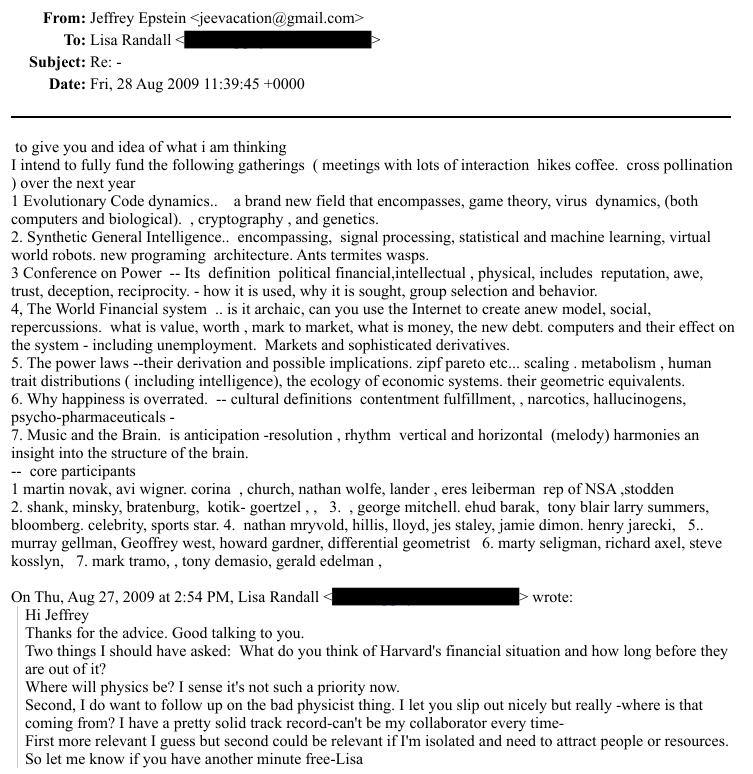
Epstein’s jail time did not do much to stop him from his crimes, or from influencing science in both indirect (funding) and direct (telling professors cool things to study or helping them get jobs) ways.
Check out our Substack, Instagram, and/or blogs for more science in the Epstein files analysis.


9 thoughts on “Science in the Epstein files: Epstein’s post-jail welcome from elite scientists meant he could continue to influence science”