By Sheeva Azma
Al Seckel, skilled in fighting people’s efforts to reveal the truths of his life, also led the effort to clear Epstein’s name post-jail time.
Remember how I told you not to listen to a word coming out of Epstein-affiliated scientists’ mouths? Al Seckel’s life exemplifies that.
He is (well, was) another Epstein-affiliated man, also a self-styled scientist with no science degrees (and, like Epstein, no college or grad school degrees). He had a vast amount of science clout despite that…and despite being one of those people with whom I would not want to associate based on the details I have learned about him.
Al Seckel, skilled in fighting people’s efforts to reveal the truths of his life, also led the effort to clear Epstein’s name post-jail time.
Despite their lack of science degrees, and documented history of crime against women, both Epstein and Seckel were able to hobnob with scientists in ways marginalized scientists (like women in science, for example) would never dream of doing. Seckel and Epstein were on the same level in terms of spinning webs to deceive. Seckel studied optical illusions and published several books on them.
Seckel also was married to Ghislaine Maxwell’s sister towards the end of his life, which appears to be one way that he got affiliated with Epstein.
Seckel was kind of a master of deceit, in my eyes. Besides exaggerating his biography (even going so far as to edit his own Wikipedia page to sound better), he also evidently pleaded “no contest” to a domestic violence charge that is normally a felony, but was reduced by a judge — he did not have to serve jail time. Does any of that sound familiar to you?
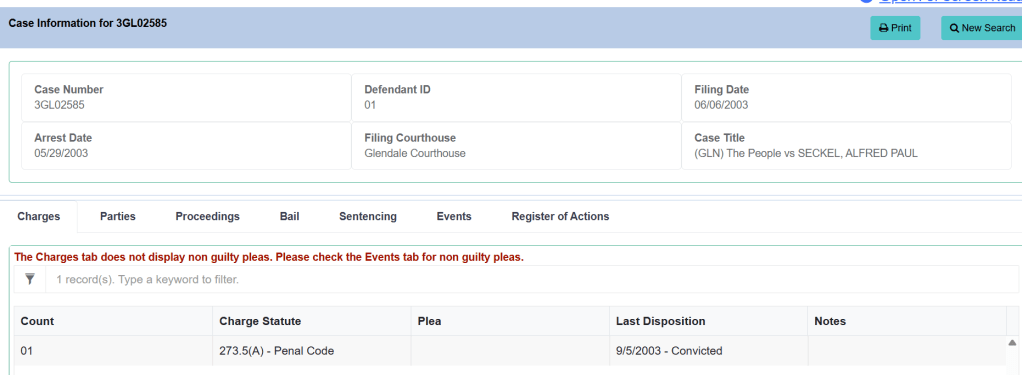
Is it even shocking anymore that yet another person affiliated with Epstein in the science world dabbled in misogyny?
After Seckel did that, though, he gave a talk at MIT, just steps away from my dorm, at the MIT Media Lab. Nope, that is not an exaggeration. Seckel’s talk was during MIT’s Independent Activities Period in January 2004, per the Wayback Machine. I was on campus doing research (possibly also visual perception research, which I did do at MIT around 2004) and taking cognitive neuroscience courses.
I wonder if any of my classmates or professors attended this talk. I did not.
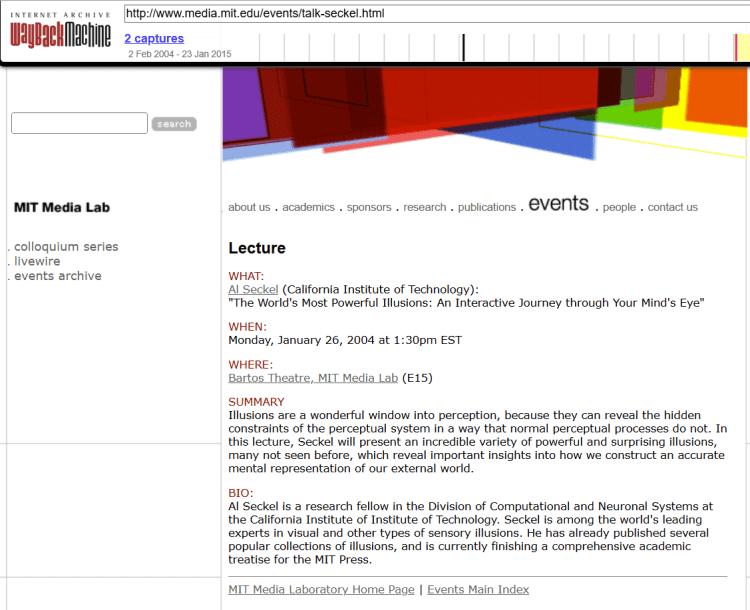
I actually came to learn about Al Seckel’s life thanks to a man named Tom McIver, who has been keeping a detailed log of everything Seckel’s been up to — with receipts.
McIver details how Seckel never earned degrees at Cornell and Caltech, but affiliates himself with those institutions anyway, so much so that the Los Angeles Times prints those claims. While, from the looks of it, he appears to be more of an optical illusion enthusiast, he casts himself as a “cognitive neuroscientist” of optical illusions, even though he has no science degrees (or college degrees at all, it seems).
In 2006, per McIver, Seckel edited his own Wikipedia page to say that he is “the world’s leading authority on visual and other types of sensory illusions and how they relate to perception.”
Al Seckel died in 2015, and thankfully, this obituary does not print any of the things he wanted people to believe about him throughout his life; however, it does omit his Epstein friendship.
Throughout his life, Seckel also claims to be affiliated with various labs at Caltech and Harvard, and even has a website hosted by Caltech that, from its URL, looks like that of a cognitive neuroscience researcher (but is not, or at least, was not in 1998).
This next part of his self-edited Wikipedia page, as described by McIver, sounds more like what he probably did instead of be an actual neuroscientist on this topic (if this sounds harsh, it is because I have two neuroscience degrees): “Seckel extensively collects, researches, and experiments with illusions to understand what conditions are necessary for them to work. Illusions can provide a wonderful window into how the brain works by revealing hidden underlying mechanisms in a way that normal perception fails to do.”
In McIver’s chronology, Jeffrey Epstein’s name first appears in 2004 as both Epstein and Seckel, both members of the Edge Foundation, answered the question “what’s your law?”
“Seckel presents his two laws of visual perception. Other responders include Marvin Minsky, Freeman Dyson, Stephen Kosslyn, Jeffrey Epstein, Chris Anderson, Michael Shermer, Richard Dawkins, Ray Kurzweil, Lisa Randall, Craig Venter,” writes McIver.
Reading through McIver’s chronology, Seckel’s dealings with scientists reveal names familiar to me from the Epstein files. In 2009, as McIver writes, Epstein emails Seckel, per the Epstein files, about what would eventually be the 2011 Mindshift Conference, a gathering of scientists on Epstein’s private island.
Optics is a field of physics that relates to the properties of light — including how it is perceived by the human eye. The optics that Seckel worked best was, evidently, the way that he wanted to be seen in the world. In fact, Seckel was a pro at making not-so-great things look amazing. Al Seckel never graduated from either Caltech or Cornell, where he claimed he had studied, and per McIver’s research, he was never even really a professor, even though he gave talks all over the place at elite institutions throughout his life. Many people claimed him of financial fraud and he did not always settle his debts.
As I mentioned, Tom McIver has been keeping track of all of the things Seckel has said and done over the years — and Seckel actually sued him for that!
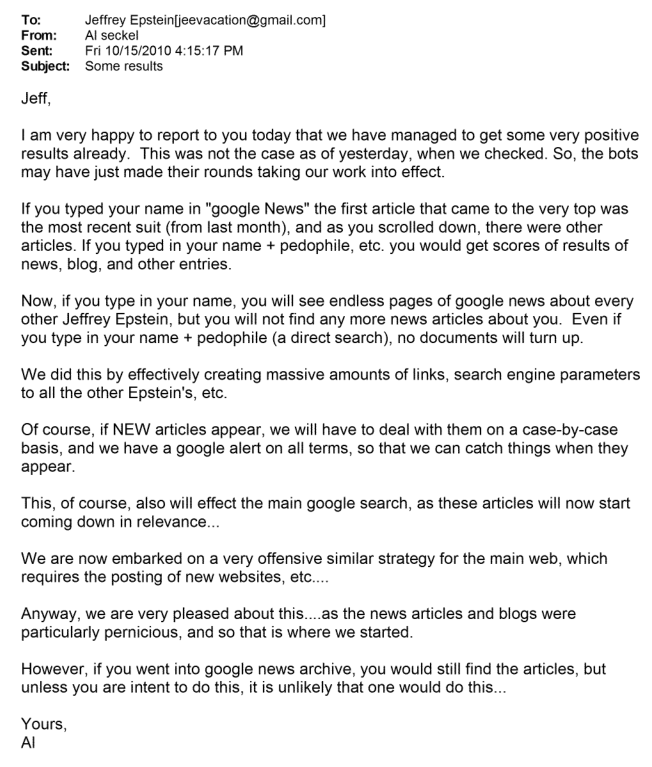
In 2011, Seckel organized a conference in which Jeffrey Epstein hosted scientists on his island. It was called the Mindshift Conference. I’ve also already written about how Seckel helped Epstein clean up his digital image post-jailtime. McIver posts some more receipts about how exactly that worked, such as this Epstein files email from Seckel to Epstein on October 15, 2010:
This Epstein files email from Seckel, five days later, sure gets into the nitty-gritty of it all.
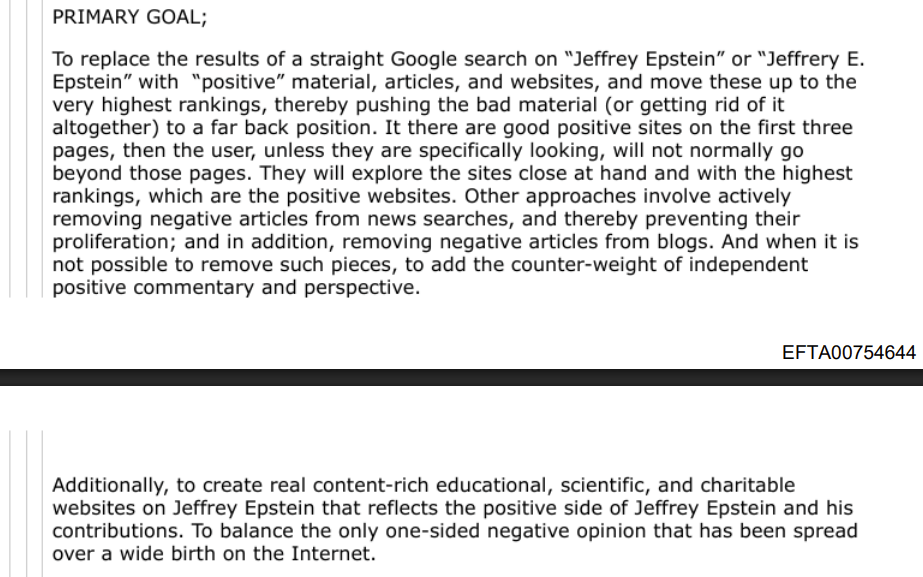
Fixing Jeffrey Epstein’s image was a dedicated operation supported by Seckel, who was himself well-connected in the science world.
It was just another way the science community supported Epstein through his run-ins with the law — which was something Epstein evidently perceived as political persecution, according to one researcher who spoke with him around the time he was in jail.
Read more of our Science in the Epstein Files series here, on our Instagram, or on our Substack.


3 thoughts on “Science in the Epstein files: Optics-obsessed Al Seckel, Epstein’s post-jail PR person”