By Sheeva Azma
Many professors in the Epstein files are eminent people I’ve met, read about, and (unsuccessfully) tried to work with. It’s all irrelevant when considering the actual crimes against women and girls they enabled.
One reason I started investigating science in the Epstein files is that I’ve been trying to figure out how much Epstein’s involvement in elite science overlaps with my career in, and exit from, academic science. I had hypothesized that, maybe, if it was easier to get a job in any of the labs to which I applied at MIT and (especially) Harvard (since it was my dream school growing up), maybe I would be more successful.
It’s not a productive line of thought, in a way, but it feels like a legitimate empirical question.
Since I started looking into science in the Epstein files a few months ago and publishing little storytime shortform videos on Instagram, I’ve since learned that Epstein was heavily involved at Harvard and perhaps MIT when I set foot on MIT’s campus in August 2001. In fact, starting in 2003, Epstein had his own office in Harvard Square. Nothing against Harvard Square: eating at Fire & Ice (now closed at that location, but it was a good run) was one of my greatest memories of my first year of college, and I always feel nostalgic thinking about grabbing a delicious coffee at Cardullo’s before hopping on the Boston subway, which they just call the T in Massachusetts.
In 2004, I took a class on music and the brain at Harvard, which meant I took the T from MIT to Harvard once a week. The class was taught by Mark Tramo, an Epstein friend who just resigned from UCLA, where he’d been teaching and doing research more recently, over his ties. Back then, Epstein had his little office in Harvard, a short walk away, at the Harvard Program for Evolutionary Dynamics. I don’t know if Tramo and Epstein were friends back then, but when Epstein went to jail a few years later, several Harvard and MIT professors literally visited him in jail.
Sometime around the time I graduated from MIT in 2005, I applied to work in, and, as I remember, interviewed to work in the lab of Marc Hauser, an evolutionary biologist and deception researcher who ended up leaving Harvard for scientific misconduct in 2011. I didn’t get that job.
I also applied to jobs in the Harvard psychology department in 2005 and 2006, including applying to the Harvard Psychology program, and both emailed with and met with professors there, when Epstein had been accepted as a visiting researcher there. Many of those professors have since shown up in the Epstein files. I did not get any of those jobs, either.
In 2006, when I had gotten my first “big girl” job working as a research assistant in Boston, MIT physicists flew to the Epstein island, even though one MIT prof, Alan Guth, stated in retrospect that he did not consider him an intellectual equal. Guth also talked about the fact that Epstein always had a few young girls around him during that conference.
A year before, in 2005, I had known Guth as the physicist that spoke at the MIT Time Traveler convention, a much-anticipated event held at my dorm at MIT that I had no intention of attending (sorry to disappoint, but for one thing, it was held right before my last finals week ever as an MIT student). The idea was that, since time travelers could travel to any point in time, only one convention was needed to convene all of them. LOL!
The economy was good enough, when I was an undergrad, that I landed a job right as I graduated from college. I became a research assistant supporting research into decision-making using MRI.
I was lucky to have a supervisor who was a woman and saw through all the antics of toxic scientists, such as the time a man came up to me at a conference and told me my research wasn’t “sexy.” I still maintain that only tools say things like that to young women at conferences.
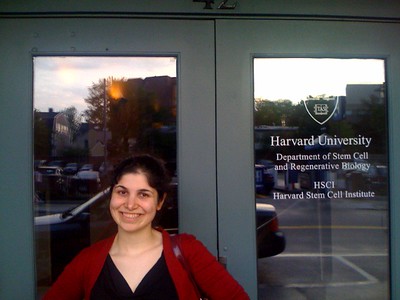
I have a picture of myself I took in front of some random science institute in Harvard Square in 2008, right before I wrapped up my research job and headed to Washington, DC to pursue a PhD in neuroscience at Georgetown.
Back then, I didn’t know who Jeffrey Epstein was or that he had an office in Harvard Square, but it was only about a three minute walk away from me in this photo.
It’s mind-boggling to me that something so bad could be happening for so long without people knowing about it.
It’s not like I didn’t know about toxic people in science, or whisper networks — it was all the background noise from which my science career as a woman in neuroscience somehow took shape anyway…for a while, at least.
I never met Jeffrey Epstein, nor had I heard too much about him before the Epstein files. His science friends, though, are another story. I read their papers, looked up to them, talked about how great both they and their research projects were with my classmates, met with them, applied to their grad school programs — and so on. Their forwarded (benign) emails to my friends who were also applying to grad school in neuroscience are still in my inbox.
I’ve read their research with interest many a time — and have often been impressed by it. In 2011 or so, when I was a grad student studying PTSD, I remember the hype around optogenetics and Ed Boyden (who, it seems, was introduced to Epstein by Joi Ito in 2013). The fact that Boyden could delete memories from the brain seemed incredible to everyone who learned about it, it seemed, including me.
My career in science was nowhere near as cutting-edge. I left academic science in mid-2013 after my projects ran out of funding. That time was actually also quite the scientists-in-the-Epstein-files heyday. By then, the MIT Media Lab was accepting donations from him anonymously despite some internal strife about it all, per the MIT report on Epstein interactions. I had nothing to do with MIT by then, as I was in Washington, DC, starting a new career as a freelance writer (unbeknownst to myself).
We had joked, as MIT undergrads, about the fact that none of us knew where the MIT Media Lab got its money. The research was all high-tech and interdisciplinary, much of it was “woo-woo” (which Epstein actually loved to fund), and some of it was so futuristic, it almost didn’t make sense.
Epstein visited MIT, including the Media Lab, on June 28, 2013. This is the first campus visit of Epstein’s listed in the MIT report, though it also states that, as far back as 2002, he had donated to Marvin Minsky, the famous “father of artificial intelligence” at MIT. Now, mind you, back in the day, this was the famous “Minsky” that all of us smart MIT kids talked about and looked up to, so it’s kind of sickening in retrospect.
Back to mid-August 2013, though, because the plot thickens. “Lots of interesting scientists” visited the Epstein ranch in mid-August. To date, I can’t figure out everyone who visited, but the “digital footprints” in the Epstein files reveal visits by Barnaby Marsh, Ed Boyden, Martin Nowak, and potentially others, including people from the nearby Santa Fe Institute.
After the visit with Boyden and Nowak, Epstein keeps emailing people, including Reid Hoffman, the co-founder of LinkedIn, to visit the ranch, since he would be there for a couple weeks more.
As Epstein was recounting the time he had with Nowak to Joi Ito, he convinced Ito to drop by from nearby Utah, as well. The digital paper trail is not looking good for these scientists.
Beyond riling up people at the MIT Media Lab, Epstein also “ignited a furor,” per STAT News, at Harvard Medical School, where biologist George Church had collected cell samples from him, which were subsequently lost, for a research study.
People say that scientists did not know about Jeffrey Epstein, which is why they associated with him, but I’ve learned that that is not entirely correct. Scientists persisted in associating with Jeffrey Epstein despite many people calling them out on it and trying to stop them.
Whatever these people’s role was in my science career, especially now that I am a science journalist and get to write about the terribleness of it all, becomes irrelevant in comparison to the crimes against women and girls they enabled by befriending and having professional relationships with Epstein.
There’s much more science in the Epstein files
Since early February 2026, I’ve been writing about science in the Epstein files on our blog, Substack, Instagram, and YouTube.
Subscribe to our blog, YouTube channel, Substack, or Instagram for more.

