By Sheeva Azma
Jeffrey Epstein’s death ultimately exposed the fraud he had been enabling in an MIT Media Lab study on plants.
Jeffrey Epstein used science as a cover, as a way to network with smart people to gain clout, and as a way to learn useful things about manipulating people.
One of Jeffrey Epstein’s last “pet projects” was a study on whether plants could think like humans. I don’t know why he did this study, but I suspect it was because 1) science is fun; 2) really important scientists liked to talk to Epstein about science (even despite knowing he was a criminal), which made him feel powerful and legitimized; and possibly that 3) figuring out new things about the natural world is not a bad way to compartmentalize and disengage from your own life falling apart (not that scientists would know or anything).
What can I say? I love to overanalyze stuff. So let’s get into it.
This story starts with a plant metaphor in the Epstein files
In April 2017, Epstein met with MIT Media Lab researchers to kick off a study about plants. Two months later, he sent his collaborators a creepy plant joke.
“Why do we plant our dead?” Jeffrey Epstein emailed two MIT researchers in June 2017, per the Epstein files. It is an eerie email, in retrospect, to two men who, also per the Epstein files, have purportedly visited Epstein’s Zorro Ranch, where women are allegedly buried.
“To push up the daisies,” wrote Joi Ito, the former MIT Media Lab head who once said he was “of the same mind” with the disgraced financier and convicted sex offender.
“Environmental metaphor for eternal life?” wrote Ed Boyden, an MIT Media Lab neuroscientist.
Epstein had been bouncing science ideas off of Boyden for at least three or four years by that point.
“My guess is biological hash functions exist,” Epstein had written Boyden on July 22, 2014.
“Absolutely!” Boyden wrote back.
Prior to embarking on a project looking at plant communication with Ito and Boyden and, eventually, others, Epstein had kept up with Boyden’s efforts to learn math and computer science on sabbatical in 2016, writing to inquire: “did you start your algebraic geometry lessons?”
“Not yet,” Boyden had replied.
“this is going to be fun.”
On April 15, 2017, per the MIT report on its Epstein ties, Ito, Boyden, and Caleb Harper, who directed the OpenAg project at the MIT Media Lab, met up at MIT. It was a Saturday.
It seems the meeting happened earlier in the day and that Epstein left before the scientists did. Ito writes Epstein, “We stuck around a bit planning next step. Well work on this as a collaboration with ed and Caleb.”
I wish I was making this up, but it is documented in the Epstein files.
In that same email chain, Epstein celebrates the new research direction: “this is going to be fun.” A couple weeks later, he tells another one of his friends to study plant biology because “if done well, you would get lots of press.”
What happens with this project is not as covered in the MIT report on Epstein ties, but relatively well-documented in the Epstein files.
A redacted researcher, it seems, writes Epstein a long email about plant biology early on April 20, 2017. “Plants don’t have nerves per se but they have cell that behave in a similar way for similar purposes as our nerves. Plants do use what we call neurotransmitters …. catecholamines like dopamine and norepi- they have tons of acetylcholine and the same degradation pathways, and even the same glutamate pathways and receptors humans do. And, more.”
The researcher continues. “I’ve collected nearly 100 papers in the literature. We will have to connect all the dots because none of the plant scientists are thinking about human science, and vice versa. […] Tonight I am curating the papers and putting them into a google drive that you can click on anytime.”
When the redacted researcher shares the Google drive around that same time, Epstein forwards it to Boyden and Ito. Boyden replies: “Thanks, will read — what an exciting new nexus of interesting biotech and computational insight…”
Boyden and Epstein get to chatting over email in the ensuing days and they agree that, in Boyden’s words, “mapping out the ways plants communicate, would be fascinating. Perhaps we can write down the words and rules akin to a language.”
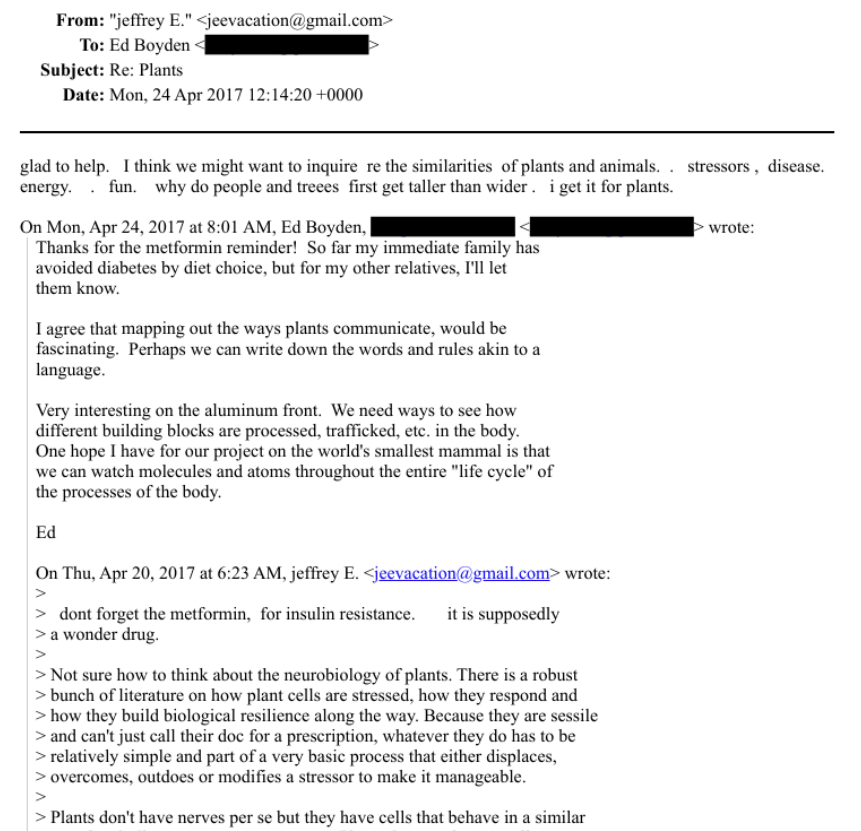
Why Ito and Boyden’s names are omitted from a proposal on this exact topic in the Epstein files is unclear to me, because it basically describes what Boyden was chatting Epstein up about (or vice versa — who is chatting up who else there?).
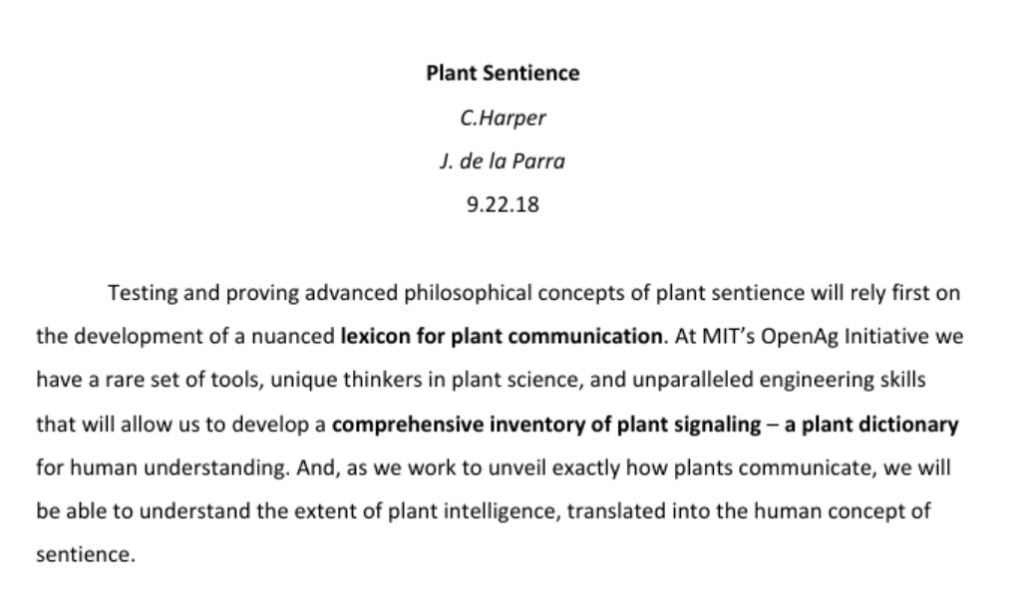
This research proposal in the Epstein files dated September 22, 2018, reads:
“At MIT’s OpenAg Initiative we have a rare set of tools, unique thinkers in plant science, and unparalleled engineering skills that will allow us to develop a comprehensive inventory of plant signaling — a plant dictionary for human understanding.”
“And, as we work to unveil exactly how plants communicate, we will be able to understand the extent of plant intelligence, translated into the human concept of sentience.”
The researchers listed here are Caleb Harper and John de la Parra, who ended up losing their jobs after the Epstein links to MIT Media Lab were uncovered and the OpenAg project was shutdown, thanks to media coverage of the whistleblowers and journalists’ investigations (more about that in a bit).
Among the “unique thinkers” they brought on to help with this project was another Media Lab researcher named Ed Boyden, who brainstormed research ideas with Epstein not only in April 2017, as I mentioned above, but also on June 22 of that year (“I’m thinking more and more about how we can screen the molecules produced by plants, for interesting health benefits or computational network properties”).
On July 20, 2017, Boyden writes Epstein and Ito about plant research he is undertaking in his own lab: “We are proposing a mathematical way to characterize plant immune systems: look for sequences in the plant genome that vary, from cell to cell, far more than they should.” This work would not be the first research study involving plants in the Boyden lab; it would follow a study submitted in mid-2015 by the Boyden lab and published in early 2016 which looked at genetic diversity of photoreceptors in “archaea, bacteria, fungi, protists, and land plants.”
“Sending you some confidential notes”
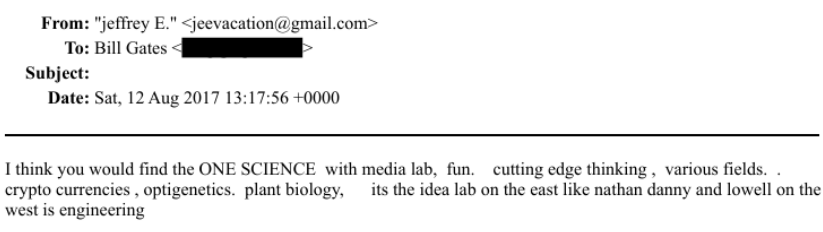
On August 10, 2017, Epstein emails Ito to tell Bill Gates that “cutting edge” science such as “plant and human interaction” is “the most exciting.”
Ito writes back and says “Ok. Btw. Sending you some confidential notes from Ed.”
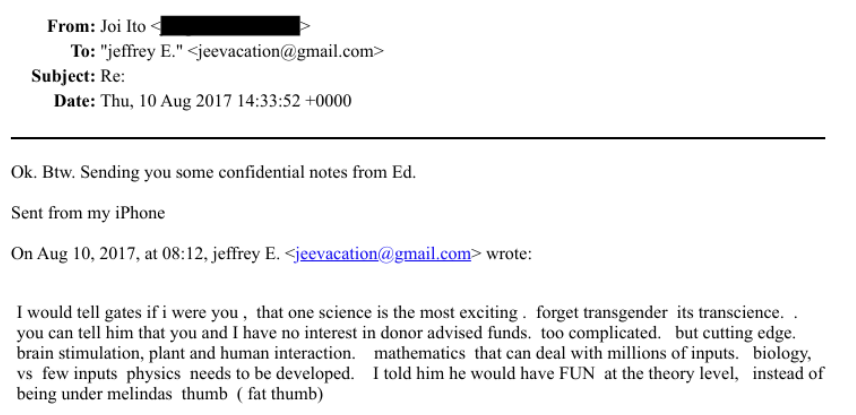
Unfortunately, we don’t know what those notes were about, but we do know that Boyden knew that “Epstein had been convicted of a serious crime,” as Boyden later wrote in an apology letter after the MIT report on Epstein ties was released. Too bad much of what he said in his letter has been contradicted by his own actions in the Epstein files.
Technically, someone could play devil’s advocate and say “hey, that could be any Ed!” since the last name is not specified, but 1) Ito calls Ed Boyden by his first name a few times in the Epstein files (see one of the earlier emails I screenshot above); 2) Epstein later emails Bill Gates himself and talks about how great “plant biology” is; and 3) going back to the creepy joke about people burying their dead I started this blog with — that was weirdly personal smalltalk between this trauma-bonded threesome.
“This machine will kick off the collaboration between Caleb and Ed”
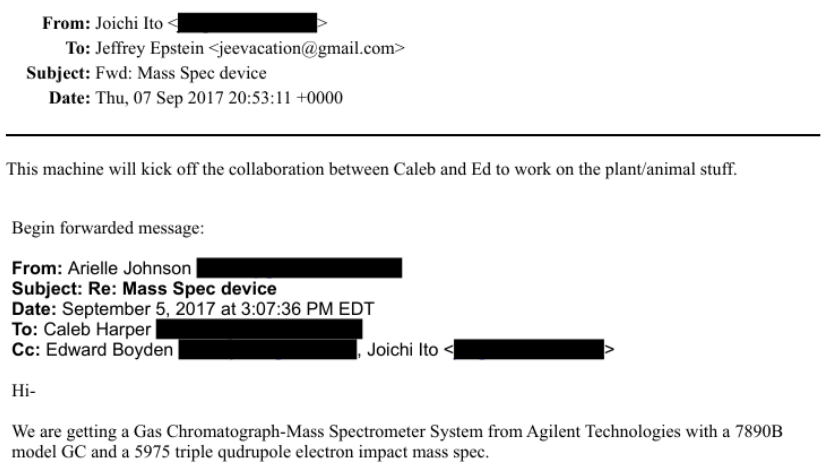
On September 5, 2017, Arielle Johnson writes Caleb Harper (director of OpenAg), cc-ing Boyden and Ito, saying, “We are getting a Gas Chromatograph-Mass Spectrometer System from Agilent Technologies with a 7890B model GC and a 5975 triple quadrupole electron impact mass spec.”
Per the email, they are getting a refurbished model that can “accurately extract, sample, separate, and identify/quantify mixtures of volatile […] molecules.” This method is highly automatable, Johnson explains, though not entirely so: “It’s still necessary to prep the samples by hand and there’s a lot of hands-on parts to the data analysis, but it greatly increases throughput and accuracy.”
Two days later, Ito forwards Epstein the email about the GC-MS machine, and says, “This machine will kick off the collaboration between Caleb and Ed to work on the plant/animal stuff.”
In late 2017, per the MIT report on Epstein ties, Media Lab staff complained about his on-campus visits there. Even though on December 27, 2017, Ito emailed that Epstein wanted to “come brainstorm a big idea,” but after Media Lab staff members, who called him “Voldemort,” complained, Ito decided not to host him on campus anymore, and presumably, future visits were off-campus.
“Are we good to move forward with the 500k”
Emails continue between Epstein and the scientists.
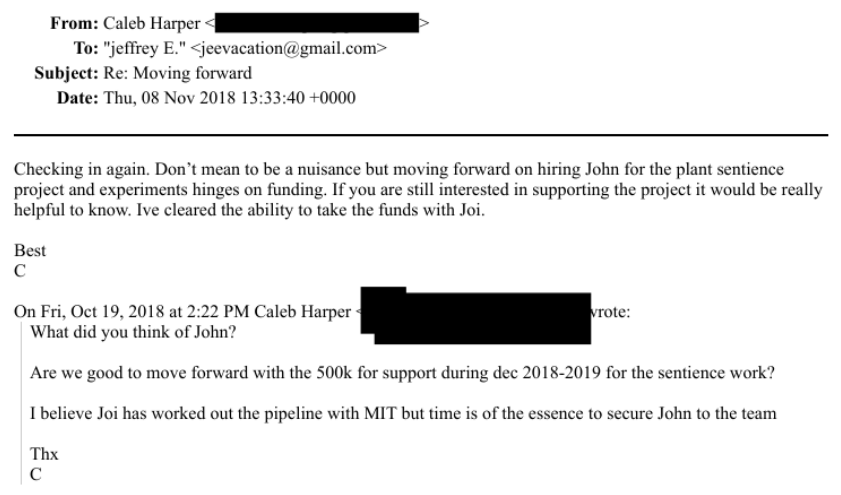
The MIT report on Epstein ties states that, “In September 2018, Ito raised the possibility of a $500,000 donation from Epstein,” as one part of a “proposed $1.5 million donation to support research by Caleb Harper into whether plants think and communicate. That donation never actually materialized.” Per the report, MIT approved the donation.
Epstein meets with John de la Parra, an OpenAg researcher, to talk about the OpenAg plant sentience project, and Caleb Harper, the director of the OpenAg project, emails Epstein a few times in 2018 to ask for the funds. Epstein does not write back, so Harper sends a follow-up on November 8, 2018.
Despite not funding the study, Epstein tells his friend Larry Summers, on January 21, 2019, that “I’m finding [sic] plant biology.”
On April 3, 2019, a paper using the GC-MS technology from the OpenAg project was published in PLoS One, but it was retracted in 2021 due to issues with “the article’s methods and reporting.” Interestingly, Ed Boyden is not acknowledged in this paper, though he was named as a collaborator in the Epstein files reviewed above.
Harper gets to be known as the “plant guy” by Epstein’s administrative assistant. On May 22, 2019, Lesley Groff, Epstein’s assistant who had planned the logistics of the scientist ranch visit, sends a woman named Victoria Brown “the email address for Caleb Harper, the plant guy!”
Not even a couple months later, on July 6, 2019, Jeffrey Epstein was arrested on federal trafficking charges. A federal judge did not allow him to leave prison, deeming him both a flight risk and a danger to the local community to roam free prior to his upcoming federal trial. He died in prison, awaiting trial.
Two MIT Media Lab whistleblowers, both in September 2019, forced MIT to investigate its Epstein ties and shut down OpenAg
Not one, but TWO, whistleblowers raised alarms in September 2019, about a month after Jeffrey Epstein’s death.
In early September 2019, a whistleblower named Signe Swenson, who formerly was a staff member at the MIT Media Lab, was quoted in a New Yorker article that said that the lab was accepting funds from Epstein. The MIT Media Lab director, Joi Ito, resigned the very next day. Swenson’s comments prompted MIT to investigate its Epstein ties — it published a report about them in early 2020.
A couple weeks after Swenson spoke to the media, another whistleblower named Babak Babakinejad, formerly working on the OpenAg project, came forward with complaints, stating he had been illegally fired for raising internal alarms about scientific misconduct. Babakinejad told the media that the project was engaging in illegal dumping and that a test ‘food computer’ they made was fake and just used to convince people that the project was really working. This caused the OpenAg project to shut down and for the OpenAg scientists to be fired.
The research project that happened and didn’t happen at the time time
It is common for research projects to undergo a lot of “pilot” or initial work to be able to collect data that could be used for a grant. In this case, since Epstein had already signed off on the project, even if he did not fund it, there was a green light to proceed with a pilot project. It looks like we see that with the PLoS One paper which was later retracted. Perhaps it was all hype to get money from Epstein. Who really knows anymore.
There’s more science in the Epstein files
Since early February 2026, I’ve been writing about science in the Epstein files. Subscribe to our blog, Substack, Instagram, and YouTube for more.


One thought on “Epstein’s last sciencing”