By Sheeva Azma
This blog talks about Jeffrey Epstein’s and Sean ‘Diddy’ Combs’ crimes and is not suitable for all audiences.
Plants that erase memories, brain damage that affects moral judgements, and deception are some of the more nefarious neuroscience topics in the Epstein files.
There’s actually a lot of neuroscience happening in the Epstein files. Not all of it seems to have the purpose of benefiting humanity. Some of it is downright nefarious.
I did two shortform videos on this topic when I first found out about it. Both videos went viral and received upwards of 125,000+ views. You can watch Part 1 and Part 2 on Instagram, or buckle in for the first six months of my Science in the Epstein files from February to July 2026 – a nearly 5-hour watch – here.
This blog summarizes the main points of both of those two viral reels, while also commenting on a blog that I encountered summarizing them. I ran that blog through an AI detector and it came back 100% AI-generated. “We are highly confident this text was AI-generated,” GPTZero told me about that blog.
The AI article disagreed with my conclusion that Jeffrey Epstein had a nefarious agenda for science research. It also said that we should stick to what is documented rather than drawing our own conclusions. The AI misunderstood me or did not realize (can AIs have realizations?) that you can learn something in one science experiment and apply it in another.
I was happy to see that the AI agreed with me on the receipts I provided. However, it did also overlook some nuance I had included in my videos, and also stated that “the investigation should stop where the evidence stops.”
That sentence, alone, makes no sense. It goes against everything that investigative journalism represents – stuff like digging deeper and always learning more, against all odds.
I won’t boost that blog’s clicks by linking to it here. Instead, I am going to write my own human-written synthesis of the two reels.
Now that I know AI makes a terrible neuroscientist + journalist of the Epstein files, this work has become even more relevant. So, let’s just get into it.
Here’s all the neuroscience that I, as an ethical neuroscientist, found unnerving in the Epstein files.
Epstein kept trumpet plants in his nursery, some species of which are used as a drug to make a person more suggestible and erase their memories – and Epstein knew that was possible, per the Epstein files
I start off Part 1 talking about an email from Jeffrey Epstein to Ann Rodriguez, the longtime manager of Epstein’s private island, Little St. James, who had a “filial” relationship with the convicted sex offender and known trafficker, according to the Miami New Times.
The email, which was sent in March 2014, simply says: “ask chris about my trumpet plants at nursery, ?”
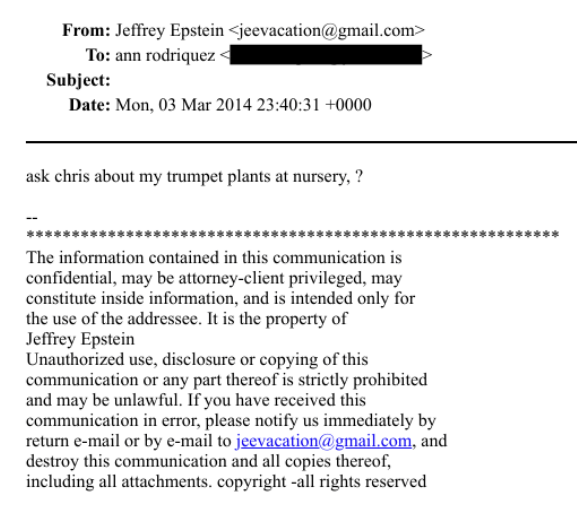
She replies with a simple “Will do.”
That seems innocent enough, right?
It turns out that there are many kinds of trumpet plants, and some kinds of trumpet plants contain a chemical called scopolamine. Those trumpet flowers are called Datura, and VICE, who called scopolamine the “world’s scariest drug,” traveled to Colombia to do a documentary on it. The documentary also says that scopolamine is grown by crime rings in Colombia.
The documentary says that the flower can actually be consumed to achieve scopolamine’s effects, which include memory loss and making a person more suggestible to things they normally would not want to do. The end result is a person who can be convinced to do things they would not normally, without any memory of it happening. Datura use can be fatal; it actually contains not only scopolamine, but also atropine, another anti-muscarinic and anti-cholinergic compound. It’s not something to mess around with.
Scopolamine, applied via a patch on the skin, is also used in controlled and much lower doses as an anti-nausea drug in places including the US. It works by blocking the neurotransmitter acetylcholine via blocking the actions of the muscarinic subtype of the acetylcholine receptor, which is found in both the brain and gastrointestinal tract, as well as the heart and a few other areas in the body.
The Epstein files do not give us the satisfaction of knowing what kind of trumpet plants Epstein was talking about or what he did with them (maybe they were purely ornamental, for instance – if we give him the benefit of the doubt). I did try to look at pictures of Jeffrey Epstein’s island to see where he might have had trumpet plants, but did not find much. Despite that, a type of trumpet flower from a plant called Datura inoxia, a small shrub growing white trumpet-shaped flowers, is often found on roadsides on the Virgin Islands, according to the United States’ National Park Service, which labels it as a type of plant to avoid.
While I found no definitive indication that Epstein grew Datura specifically, another email about the use of the flower in a criminal capacity is highly concerning. This email, sent in 2015, makes me think that Epstein did know about the use of this flower in a criminal setting.
This 2015 email is forwarded to Epstein from a redacted person who, per the signature line, appears to be Julien Verglas, sending it along from his father, Antoine Verglas. The senior Verglas, who is famous for photographing President Trump’s wife, Melania, naked, corresponded with Epstein discussing nude photo shoots and seeking advice from Epstein for Julien’s eventual career in finance, according to Vanity Fair.
The forwarded email is an article from the Daily Mail titled “Scopolamine: Powerful drug growing in the forests of Colombia that ELIMINATES free will.” The Daily Mail article references the VICE documentary and talks about how the plant can “block free will, wipe memory, and even kill.”
In the Epstein files, there is a concerning 2022 witness statement to a federal attorney in Florida describing a December 2014 event where Joseph Manzaro recounts being drugged by scopolamine and driven around Palm Beach, Florida (where Epstein served jail time . However, this statement does not mention Jeffrey Epstein, and while NewsNation has reported on the “victim impact statement,” it does not clarify who Dr. Joseph Manzaro is, or what his link is to Jeffrey Epstein.
It looks like the Epstein files have a bit of a mix-up from another person who resides in southern Florida and was brought to federal prison. USA Today reports that Manzaro actually sued Sean ‘Diddy’ Combs, who is serving time at FCI Fort Dix until 2028 after being convicted of transporting prostitutes. Manzaro sued Combs, accusing Combs of kidnapping, drugging, and assaulting him. A judge dismissed the case, calling it “objectively frivolous,” according to IMDB.
As CBS News and NewsNation both reported, a 69-page document with many redactions in the Epstein files shows that the eponymous convicted sex offender and known trafficker, along with 14 other people, was investigated by the Drug Enforcement Administration for, as the document states, “illegitimate wire transfers tied to illicit drug and/or prostitution activities ocurring in the U.S. Virgin Islands and New York City.”
I end this reel talking about the significant amount of what I would call “evil neuroscience” that goes into such crimes, questioning whether actual scientists were involved. Many of Epstein’s science friends did visit him on his island – I have published an incomplete list of names here. By the way, I checked, and a form of Datura does also grow in New York, where Epstein lived, and it can also grow in New Mexico, where the Zorro Ranch, a hub for visits from elite scientists in August 2013, was located. “Why isn’t anyone asking these scientists directly?” I question.
Epstein himself taught science and math at a prep school, where he had a reputation for being a creep, long before the Epstein files. He also got along well with the scientists with whom he associated. Saying Epstein pursued evil neuroscience makes him sound like a super-villain, but it is not implausible. In fact, he did pay for a rather questionable study I’ll talk about next.
US taxpayers subsidized an Epstein pet science project
Jeffrey Epstein contributed to several influential science papers.
In one study he financed, in part, he paid brain researchers to study whether brain damage makes people more suggestible to crimes. That research was published on March 25, 2010; this was just a few months after Epstein was released from his Palm Beach County jail sentence which was quite lenient and allowed for visits from scientists and working-from-home, which also helped him pursue criminal activity, according to an interim staff analysis from Democratic lawmakers on the U.S. House of Representatives Committee on Oversight and Government Reform.
In the first part of my viral reel series, I mentioned another reel I did about a paper funded, in part, by Epstein. This paper was named “Damage to Ventromedial Prefrontal Cortex Impairs Judgment of Harmful Intent,” and it was published by Liane Young, Antoine Bechara, Daniel Tranel, Hanna Damasio, Marc Hauser, and Antonio Damasio in 2010 in the well-known-to-neuroscientists journal Neuron. The paper is available for all to read here. It appears to be a follow-up to an earlier version of this project in Nature that was submitted in November 2006 and accepted in February 2007. This earlier paper only has six patients with vmPFC damage, uses a moral decision-making paradigm in which the participant has to choose one moral outcome over another, and does not acknowledge Jeffrey Epstein as a funding source.
It is important to know, for the purposes of understanding scientists’ roles in the Epstein files, that both Hauser and Damasio (Antonio, who is married to his wife, Hanna) approached Epstein for funding. Of the two, only Hauser received any, it appears – including for this 2010 Nature paper.
Antonio Damasio, who met Epstein in 2009 (month unclear, but Epstein was in jail through mid-2009), described a 2013 outreach to ask for funding as “routine” to USC Annenberg Media. It appears that Damasio wanted to escape science funding bureaucracy and gain more “control” over his research directions. Both he and his wife dined with Epstein back in 2009, according to USC Annenberg Media.
Marc Hauser left Harvard in 2011 due to eight counts of scientific misconduct relating to fabricating data, results, and methodology, and making false statements. I talk about Hauser’s role in the Epstein files in this shortform video.
In that video, I also recount a time I attended a talk at Harvard sometime in the late 2000s where he was presenting some work (?), and when a woman scientist asked him a question that required further clarification from him, he became frustrated and basically called the woman stupid. It was ridiculous. Mind you, I had also applied to graduate school at Harvard a year or two before that, so at that point, I was so glad I had never worked in his lab – not even the short-term gig I applied to in his lab that I visited his lab to interview for back then.
Hauser was a morality researcher, and in 2009, which would be after I had moved away from Boston and no longer could hop over to Harvard’s psychology department for colloquia anymore (thankfully!). That’s when he reached out to Epstein for money for a massive project.
This is the full email he sends on September 2, 2009 to Jeffrey Epstein:
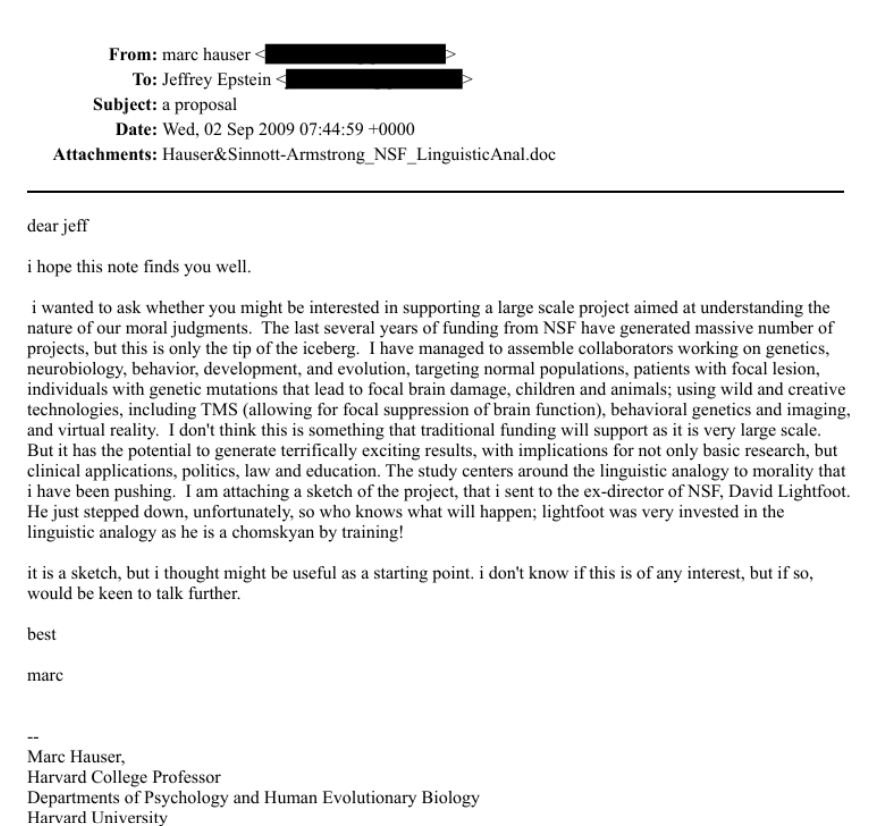
Epstein writes back and says, “at your convenciene i would be happy to orgaize a day for you to come to palm beach to discuss.” Then Hauser gets handed off to Lesley Groff, who was the same person who organized Zorro Ranch visits for several scientists. They talk not too long after, according to this planning email.
Epstein invited him to Palm Beach, Florida to talk about funding a study of morality funded by Epstein because “traditional” funding would not support it. He proposes studying morality via many methods, including using transcranial magnetic stimulation or TMS – but more about TMS later.
According to the acknowledgements section, Hauser received “gift funds” from Epstein. “Gift funds from J. Epstein and S. Shuman (M.H.),” the acknowledgements state. Funding also came from the National Science Foundation and the National Institutes of Health – in other words, from taxpayers.
Liane Young, the lead author of this paper, is now a professor at Boston College where she runs the Morality Lab, studying “moral judgement and social cognition.” Having collaborated with a Harvard professor fired for misconduct, and running a study funded, in part, by a convicted sex offender and known trafficker, I have to wonder if she ever reflects back on this paper and regrets pursuing this research that propelled her career forward. I have never had an experience like that, to my knowledge, and I simply do not know what it is like to collaborate with these types of people. From 2011 to 2014, she received $6,234,749 (if my math is right – adding up all the Templeton Foundation grants on her CV) from the John Templeton Foundation, a philanthropic organization linked to Jeffrey Epstein via Barnaby Marsh, an Epstein friend and executive of the foundation who worked there from the mid-2000s to the late 2010s. Young’s grant money was used to study morality as well as social behavior, thought, and norms.
It’s unclear how the timeline of this funding lines up with Epstein’s jail time. The following email makes it sound like Hauser had little idea of Epstein’s whereabouts in 2008 and 2009. Hauser wrote to Epstein in mid-May 2009 (when Epstein was still serving time until July 22, 2009) and says, “how are you? I haven’t seen you around here in a long time, but wanted to touch base just to say hello, and pass on more papers that, thanks to your help, have emerged.”
Now that we’ve talked about the authors and Epstein ties back then (and perhaps after), let’s get back to what this 2010 Neuron paper actually found.
It looked at patients with damage to a part of the brain called the ventromedial prefrontal cortex (vmPFC). The vmPFC is located in the very middle of the prefrontal cortex, along the midline of the brain. It can get damaged by things like brain trauma or stroke. This study found 9 people with vmPFC damage and asked them to make moral judgements.
The hypothesis was that “VMPC patients would deliver abnormal moral judgments of harmful intentions in the absence of harmful outcomes, as in failed attempts to harm.” Indeed, they found support for their hypothesis: “VMPC patients judged attempted harms including attempted murder as more morally permissible relative to controls. These results highlight the critical role of the VMPC in processing harmful intent for moral judgment.”
That’s the TL;DR, but it is alarming in the context of being funded by someone on the federal sex offender registry. This is knowledge that, in the wrong capable hands – someone like Epstein, who had a digital rolodex of scientists of all stripes – could be misused to potentially make people view serious crimes as less serious. Isn’t that exactly what someone living above the law would want?
As a side note, and I did not talk about this in my reel, but Hauser is the author of a book called Evilicious: How we evolved a taste for being bad. He describes it to Epstein’s assistant as “a book about the nature of evil, and what the sciences have to say.”
That same email to Epstein’s assistant talks about Hauser’s morality research purportedly ongoing in “unique patients in South Africa” with a calcified amygdala who reportedly make “rule-based” morality decisions, as well as “an extremely remote Amazonian Indian tribe” where his research group was looking for “moral principles uncovered in more traditional western populations.” His work also allegedly involved testing dogs’ IQ as well as using virtual reality to help treat “psychopaths.”
If that all seemed larger-than-life, it probably was. Hauser was fired from Harvard for scientific misconduct in early 2011, and he emailed Epstein for help with his case in late 2010.
The two continued to be friends after that and met up in October 2011.
On November 6, 2011, Hauser appears to have sent a PDF of his book, Evilicious, to Epstein “for your reading entertainment…”. Hauser had been fired from Harvard for scientific misconduct by then.
Jeffrey Epstein loved to ask elite scientists about deception and get their scientific opinions on it
Can studying deception make you more evil? I mean, I can think of specific ways learning to evade the law through empirical investigation can help one become a better criminal. Given that Epstein did live above the law pretty much his whole adult life, maybe some scientists should have been studying him…
Having said all that, it really speaks volumes that Epstein wanted to start his own deception lab. He refers to himself as a deception researcher, as I have talked about before. I did a whole blog on deception research moved forward by Epstein here. Some of that work also comes from the now dismantled lab of former Harvard professor Marc Hauser.
Deception – whether by a person or by something like DNA which is not a person and cannot technically ‘lie’ – was a huge interest of Epstein’s, and it was something his scientist friends also entertained.
Jeffrey Epstein told a friend scientists deleted his short-term memories using transcranial magnetic stimulation
Transcranial magnetic stimulation or TMS uses magnetic fields to stimulate brain cells noninvasively. When I was an undergraduate, TMS was a new technology, but these days, the US Food and Drug Administration (FDA) has approved it to treat a few conditions, including migraines and some depression and anxiety disorders.
It’s not a big logical leap to apply what Epstein found in the study he paid for on the role of damage to a particular brain region called the VMPFC in reducing the severity of moral judgements to noninvasively lesioning that area using TMS to see if people view serious crimes as less severe. That particular research study, in which the paradigm in the 2010 Nature paper is replicated while patients undergo TMS on the vmPFC, does not seem to have been done, per a quick Google Scholar search. As I detail in a minute, scientists have studied the vmPFC using TMS, however.
However, according to his own words, Epstein let scientists test TMS out on his own brain.
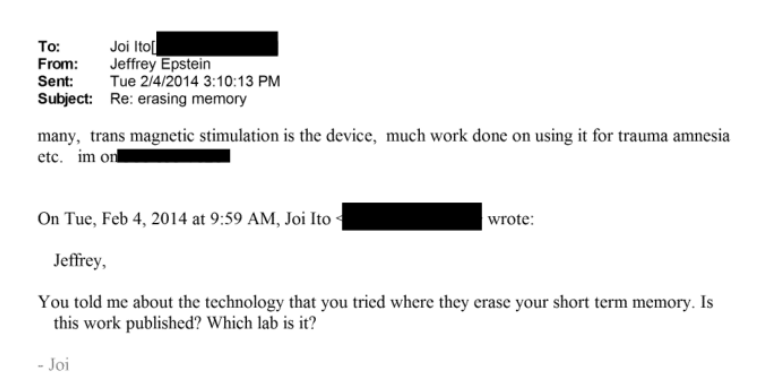
Theoretically, TMS could be used to stimulate the vmPFC, and researchers unaffiliated with Epstein have done a similar study using transcranial direct current stimulation or TDCS, which uses electrical current rather than magnetic fields to stimulate brain areas.
A quick scan of the literature shows that researchers have successfully used TDCS and TMS on the brain to target the vmPFC, but instead of revealing deficits in moral judgement processing, these studies have demonstrated potential therapeutic benefits for people living with addiction.
In 2022, Kroker et al. found that noninvasive stimulation of the vmPFC using TDCS actually improved risk-related decision making. “These findings recommend further research towards clinical applications of vmPFC-TDCS as in addictive disorders,” they wrote.
Another study by Soleimani and colleagues published in 2025, this time actually studying TMS, targeted a circuit connecting the vmPFC with the amygdala, a region of the brain involved in emotion. The researchers concluded that the study showed “the potential of an individualized VMPFC targeting framework to enhance treatment outcomes for addiction, specifically modulating the personalized VMPFC-amygdala circuit.”
TMS research specifically into vmPFC and moral judgement continues. Given Hauser’s misconduct, one might assume that the 2010 Neuron paper’s finding was advanced by Hauser (or even Epstein) specifically and fraudulently. However, this 2011 study from Swiss researchers published in Nature Neuroscience, replicates and elaborates on the findings. The 2011 Swiss paper used repetitive TMS to look into the vmPFC’s role in overriding “self-interest in favor of normatively valued goals.” “A parsimonious prefrontal network, the activation of [right dorsolateral prefrontal cortex (DLPFC) and posterior vmPFC], and the connectivity between them, facilitates subjects’ willingness to incur the cost of normative decisions.” In other words, deciding what should be done based on rules, values, or ideals, according to these researchers, uses a brain circuit involving the vmPFC and the nearby dlPFC.
In a quick skim, many papers that continue to get at deficits in moral decision-making and how it is different in people with vmPFC lesions, continue to rely heavily on work from the researchers named in the 2010 Nature paper.
There’s too much science in the Epstein files
There’s far too much science in the Epstein files! Yikes. We have been unpacking it since February 2026. Follow us on Instagram, Facebook, YouTube, our blog, and Substack, for more.

