By Sheeva Azma
This blog mentions crimes against women and children, including by scientists, and is not suitable for all audiences.
Being at the scene of a crime is not the same thing as not being at the scene of a crime.
After almost nine months of poring through the Epstein files, I have learned that being in the Epstein files means something. Being mentioned, even in passing, is not the same as never being mentioned at all.
Not being mentioned in the (unredacted) Epstein files means that you had no dealings with Epstein or his friends. I realize that this point of view gives non-mentioned people the full benefit of the doubt that they did not go out of their way to hide their Epstein ties — and I think that is a fair assumption to make. The files are vast and, in their fully unredacted form, they are not random mentions of happenings. Sure, there are random newsletters and email lists that Epstein subscribe to that provide mentions of important people, including scientists, but these are the two main ways I have seen scientists be mentioned:
- Corresponding directly with Epstein, often after his 2008 conviction
- Being mentioned by someone in a conversation with Epstein
In my experience reading the files, it is rare to see a scientist pop up just by name in email lists and news stories arriving in Jeffrey Epstein’s inbox (in fact, I cannot come up with any such situations off the top of my head). Generally, the scientists talked about in the Epstein files are either in direct contact with Epstein, are indirectly in Epstein’s orbit through who they know and what they are doing, or are doing work that, for whatever reason, is attractive to Epstein. Going by my list of scientists in the Epstein files, the philanthropist-predator loved to fund high-tech things in artificial intelligence, neuroscience, and physics above all.
Being mentioned in the Epstein files without corresponding with Jeffrey Epstein can include things like:
- Being mentioned by someone who is working with or knows the scientist, who is describing the scientist and/or their work to Epstein, and sometimes trying to set up collaborations
- Being the author of a paper or internet article sent to Epstein or from Epstein to someone, which ties into Epstein’s research interests as a donor to science and scientists and his desire to advance research that he liked, even publicly funding at least a dozen papers
So you see, all of that is not nothing — it is definitely something. For examples of what these mentions, both direct and indirect, might look like, check out what I’m calling Science in the Epstein files: The Movie.
Being mentioned in the Epstein files means that you were in a social circle that included a known sexual predator…or that you were somehow interesting to said predator. This could be due to many reasons.
As an observer of it all, what that means to you, exactly, depends on who you are. For women in science, it can reinforce the idea that science is hostile to women and girls. For someone not in science, it can reinforce the idea that academia is disconnected from society — not just intellectually, but also morally.
There’s also the opinion that the Epstein files don’t matter and that scientists mentioned in the Epstein files are just doing their job. How could they know what they were getting into? To be quite honest, I do not agree with these people, who have sometimes called my journalism “lazy” or “careless.”
All because I looked up someone in the Epstein files, and — get this — FOUND SOMETHING.
Why is this small subset of people, who (if they are not bots) are almost always identifiably male, blaming their cognitive dissonance feelings about the truth on my work as a journalist?
It’s because they can’t handle the truth.
Maybe it’s because they don’t know what I know about science as a woman all but forced out of the academic scientific establishment. I continue to publish without using up even more taxpayer funding, by the way.
We have written about sexism in science and the social structure of science, and how we never think about it, many times.
Just because we — the collective “we” that includes everyone in the United States — haven’t decided what Epstein files mentions mean for us culturally, socially, economically, intellectually, or even carcerally (some of these people really need to be in jail, possibly), doesn’t mean pointing out scientists in the Epstein files is wrong.
In fact, my opinion is quite the opposite.
Everyone in the Epstein files has some explaining to do about why they are there — and some reflecting needs to be done about whether they should still be accepting taxpayer funds to do science, shape impressionable minds, and get to do the technologies and breakthroughs of the future.
My official opinion, having spent most of the year reading about scientists’ in the Epstein files (with no intentions of stopping) is that Epstein files mentions are the epitome of tell me who you know, and I will tell you who you are.
In other words: scientists’ Epstein files mentions matter…A LOT. No matter why they’re there.
There are very, very rare exceptions to that rule, in my experience as an Epstein files investigative journalist. However, people get very mad hearing that their favorite scientist — or any scientist — is in the Epstein files.
On October 6, 2026, I was shocked to learn that being mentioned in the Epstein files does not disqualify you from winning the Nobel Prize.
I had escaped the wrath of the internet the day before talking about (and almost crying about) why I was so happy that Ed Boyden, a father of optogenetics with 968 Epstein files mentions, had not won the Nobel Prize for physiology or medicine.
I had woken up the next day with two questions: 1) who won the physics Nobel and 2) are they in the Epstein files?
I found the answers to my questions: there was only one Physics Nobelist this year, Francis Halzen, had three mentions. He was in there!
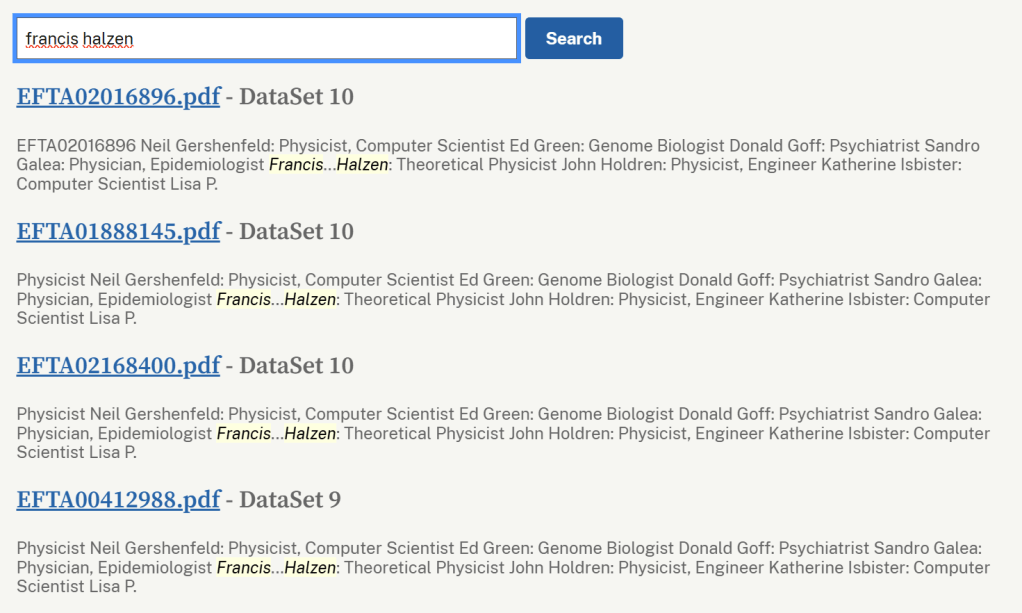
To summarize what I had learned from these quick searches of Google and the Epstein files, Halzen was a scientist participant in World Science Day, founded and run by Brian Greene thanks, in part, to Epstein’s funding and support of the day. Epstein’s people had emailed Greene for a printed-out list of the scientists’ names, which had included Halzen.
You can watch part 1 of my post here and a quick update and part 2 here.
As I pointed out to a commenter on my posts, Halzen’s Epstein files mentions mean…something. I mean, having 3 (now 4, if you look at my screenshot above) Epstein files mentions like that doesn’t mean nothing.
Just having to defend why being in the Epstein files matters is exhausting. I can’t imagine what it is like for someone surviving the activities of Epstein and his friends, and allegedly, some scientists in the mix, while these people get to live above the law. It’s not fair but it is allowed by society.
So, no: not being in the Epstein files is not the same as being mentioned in them.
Not being at the scene of a crime is different from being at the scene of a crime. Being at the scene of a crime means something. What it means might be unclear and require further investigation…but it is meaningful.
Investigating all of this, I felt crushed by the symbolism of it all that someone winning the highest achievement in science could casually be namedropped in conversations with a sexual predator and even participate in an event funded by one. It took me back to my experience dropping a class with a physics professor who ultimately was fired by MIT for sexual harassment.
My reason for dropping the course back then was not even that I was wronged by the professor in any way! It was just a feeling of hopelessness about my ability to remember the right-hand rule and bad vibes.
I have heard so many bad stories about navigating the science life from my women friends. I was distraught that the Nobel Prize had not done its due diligence in screening Epstein files mentions (not that really anyone else has, to be fair).
Does the Nobel Prize not vet these people? I wondered.
I was even more shocked that many people did not care when I pointed this out. It made me feel like all my negative experiences in science did not exist. It felt like these people were afraid of the truth and where it might lead.
A young man, who looked no older than high school age and who had a picture of himself playing baseball on his Instagram bio wrote me and told me to take down my post. A male astrophysics student at Caltech and other physicists called my reporting “lazy.” One person simply wrote: “Are you stupid?”
The experience of simply pointing out this fact to our 14,900 followers was, in a word, exhausting, just because of this very vocal, and almost entirely male, contingent.
Women interacting with the post, including women in science, had more concerned reactions.
It was so, so exhausting. I deleted and blocked the mean people I could and took the rest of the week off.
I want to be optimistic and say that these reactions are the gut reactions any sensible person would have to hearing the news that a literal Nobel Prize winner is publicly connected to a convicted sex offender in any real way. The truth will set you free, but first, it will make you mad.
I started off my initial reel simply stating that the physics Nobelist — the only person to be awarded the prize for a hugely collaborative project — had three Epstein files mentions. I did not speculate what that meant. I just stated what I had learned and shared it with people.
I still don’t know what to make of it, to be honest. People’s wildly differing reactions also did not help me in that effort to make sense of it all and move forward from what I consider to be a tragic situation of having all of the people who I looked up to be in the Epstein files. I have been reading the Epstein files for almost nine months now with no real answers and lots more questions.
I mean, being in the Epstein files means something — it does not mean nothing. Just what that something is, though — I’m working on that.
As a journalist, I am frequently surprised what I find in the Epstein files — my own professors, colleagues, and so on. I was not prepared to find the name of a literal Nobelist — yet another one! — in the post-Epstein files era.
The fact that the Nobel Prizes don’t screen out sexual predators is a huge red flag for me as a woman in science. To me, true scientific achievement includes being a good person while making discoveries.
In 1976, a man named Daniel Carleton Gajdusek won the Nobel Prize for his work on kuru. In 1996, he went to jail for child molestation. He got to keep his Nobel Prize, and his bio on the Nobel Prize website lists the day he died, but makes no mention of his jail time.
Recall that Epstein was to have lunch with Nobelist James Watson, who got to keep his Nobel Prize despite disparaging remarks towards women and minorities, on the day he was arrested by federal authorities. Watson got to keep his Nobel Prize, which relied upon work he stole from his woman colleague Rosalind Franklin, through all of that, too.
I mean, it makes sense — science is about achievement. It is not about whether you took the time to do a nice thing for someone. People in society will gladly overlook the worst of a scientist’s personality if they have discovered something cool.
It’s definitely a weird morality that the scientists in the Epstein files leveraged.
It’s messed up, though. Should we prioritize curing kuru, a rare though incurable disease, over the mental and physical health of children?
Why do we celebrate scientific achievement at all costs?
Why do we give a free pass to people in science who should not be there?
I feel like I’m one of the few people to care about this, but I know I am not — based on the feedback I have gotten throughout this project.
It is easy to read the comments of people who do not care about this project and do not enjoy the feeling of cognitive dissonance they get and be discouraged and feel like my experience in science should be the status quo. I am here to tell you that it should not be, nor should we allow toxic people in science.
I worked my tail off to graduate from MIT and get into grad school, all to be told that I did not have what it took to be an academic scientist after becoming a PhD candidate. I’m still so bitter about it that I continue to publish outside of academia out of spite and because I love science. How can you tell someone who just published a book chapter on alcoholism that she doesn’t have what it takes to be a scientist?
You can’t. Not anymore. (Check out my Google Scholar. My most recent paper I published outside of academia already has 5 citations.)
Did I mention I also was recognized by the National Science Foundation for my “potential” to advance science as a Graduate Research Fellowship Honorable Mention? (Search for me here for the proof.) How does someone like me get kicked out of science? It still makes no sense to me.
I submitted my NSF GRFP application before I met many people who stood in my way — professors who told me upfront they did not think I was a “strong” scientist, people who did not take me seriously, and the people who just did not seem invested in my career success.
It feels significant to me that the summer I left grad school due to my professor’s opinions of my work output was the summer that Jeffrey Epstein invited a bunch of scientists to his ranch…and that a handful of people I emailed to inquire about graduate school, and who told me there were no openings, are all in the files.
Suffice it to say, academic science did not work for me as a career option, and now I look at science from the outside, wondering if I am just missing something or if it really is broken.
Just a few weeks ago, though, I had a realization.
I am so glad I am not working in this broken system with people who do not get it.
They just don’t understand what it means to be a good scientist. Being a good scientist, to me, is one who actually does meaningful work without ruining the careers, and more importantly, lives of others.
I want to be completely transparent here: it has taken me years of therapy to get to this point.
I do not wish my journey on anyone, even though I know it’s not even that bad compared to the experiences of other women in science, and especially not bad compared to that of the experiences of Jeffrey Epstein’s survivors.
I entered my undergrad at MIT a young, happy young lady who was determined to use science to change the world. I left MIT still holding on to that, while becoming more and more aware that being a woman in science was a liability and something that would hold me back in life — so, in some ways, I stopped trying…but not entirely.
I was excited to be accepted to my dream grad school, Georgetown, where I could do science and pursue my dream of working in science policy. I left grad school at Georgetown feeling like a failure, confused as to why I had gone to the world’s best science and engineering school in the first place if it was all going to end like this.
Hey, at least I got a Master’s degree! Many people leave science with nothing to show for it.
Waking up to see a Nobelist in the Epstein files was way more important to me than the people who saw my Instagram reel about it.
I find this shocking. I mean, the Nobel Prize is the pinnacle of academic achievement. Shouldn’t it also reward people who are living ethical lives?
I realize that that is a controversial statement. Since I started my project looking at science in the Epstein files, a very vocal minority has been, exhaustingly, in my DMs about it all.
Don’t ruin these scientists careers! they write.
Your research is lazy and uninformed. (Wow, it’s now lazy to point out stuff?)
It doesn’t matter that these people’s names are in the Epstein files.
The Epstein files mean nothing.
Oh, really?! I want to write back.
I don’t write back. I say nothing and continue to feel exhausted by the weight of it all. Why am I the only person who is talking about this day after day, week after week?
Yes, the Epstein files matter, and scientists are not exempt from that, no matter how smart they, or others, say they are
It’s upsetting how much science there is in the Epstein files. It would be a disservice to scientists and everyone, including Epstein survivors, to just chalk it up to people who were forced to make an unfortunate choice to accept money from a sexual predator. Life doesn’t work like that — especially not for the most brilliant scientists society reveres, whose names populate the Epstein files. If you’re smart enough to be a scientist, you’re also smart enough to not finance your important work on a sexual predator’s dime.
We’re talking about science in the Epstein files on our blog because people, especially those of us in the United States where the vast majority of these scientists live and work, deserve to know what is happening with the science they pay for each year with their tax dollars.
Follow us on Instagram, Facebook, YouTube, our blog, and Substack, for more. Check out all our blogs about science in the Epstein files here or view a list of all scientists in the Epstein files at the top of this blog.

