By Sheeva Azma
You know when you have a vision for something, but know it will take a while to make reality…if even possible? That was me six years ago.
Fancy Comma has affiliate partnerships to support its content. We may earn commissions for products purchased via affiliate links.
When I founded Fancy Comma, LLC, I didn’t want to be “just another science communication company.” I wanted to create an organization which was attuned to major challenges and issues of the day, which could pivot rapidly to address emerging science communication challenges in STEM, and which wasn’t just for “scientists” or even for “a general audience.”
Looking back, I believe this was because I grew up surrounded by nonscientists and nonelites who always asked really commonsense questions and never pretended not to understand something (or at least its impacts if it was something super complicated) just because some expert told them it was too complicated. I admired that in my local community.
I’ve learned a lot about what it means to be a scientist over the past six years, working outside of academic science (though, as I write this, I am working on publishing my first scientific book chapter ever, so some science activities continue outside of “science science“).
Redefining what it means to be a science “elite”
When I went to MIT for college in the early 2000s, I met many elites disconnected from the larger public discourse on science (I also met some amazing people who were mission-driven and humanity-focused, but that’s a subject for another post). I later learned (as I have been discussing in depth on our Instagram for basically all of February 2026) that many Boston science elites did not have the public interest in mind, as they hobnobbed with now-disgraced financier and predator Jeffrey Epstein. Without going into too much detail, “hobnobbed” is a light way to put it, as the world is now learning.
These recent developments with the recent release of the Epstein files have redefined how I think about what it means to be a scientific elite. In fact, I think being a “scientific elite” has lost its real meaning — thankfully so, for public trust in science does not come from listening to these people, many of whom will continue to be disgraced and be forced to step down from their roles due to their Epstein ties.
Because of all that, I feel that, in many ways, the torch has been passed to those of us who admired these great thinkers, back in the day, when they were just big-name scholars and not predator accomplices. We learned from them … and now, from their very public mistakes … and now it’s time for us to do better than them.
I’m happy to carry forward the torch of evidence-based decisionmaking with the end goal of helping humanity, and science, improve. I know that people can be empowered to make their own decisions on science based on facts and evidence that meet them on their level of understanding and inspire them to ask more questions and engage with whatever the issue of the day is.
It is a time to redefine scientific eliteness. Maybe it should not even exist? We’re here for the discussion!
“We are the ones we’ve been waiting for”
The words “we are the ones we have been waiting for” were originally written by poet, activist, writer, and teacher June Jordan, and were later quoted by Alice Walker in her book of the same title. I had never heard this quote before until Colette Delawalla, founder of Stand Up for Science, paraphrased it in a LinkedIn post.
For years, I waited for a science communications and policy consulting firm who would “get it.” There was none, so here we are. In our first year, I imagined Fancy Comma’s work supporting a community of people who were attuned to the scientific challenges of the day, regardless of where these were actual science challenges, communication challenges, or even policy challenges.
I thought it would be a cool idea to do that through Fancy Comma, LLC, if it only were possible. The things holding me back were money, time, and energy. I was lucky enough to connect with what is now our team and, over the years, we have thrived despite all kinds of uncertainty: the pandemic, economic woes, and even our current time when writers and thinkers have all but been replaced by ChatGPT (though that last one is changing now).
We’re so grateful to have worked with so many amazing people and organizations over the years, but it was not always this way.
Here’s a look back at our humble beginnings — via our blog posts from our first year of operations, which was 2020. Fancy Comma, LLC was formally established just three weeks before COVID-19 was declared a global pandemic! That sure made our work much more important and relevant (despite it all, we are grateful that we could play a useful role communicating science in COVID-19).

Blast from the past: blogs from our first year
March 2020: “How to Start Blogging“
This was our first blog post, written by the wonderful Kevin Ho. Kevin is a detail-oriented writer and we had many lively discussions in Fancy Comma’s early days that led to some interesting opportunities for both of us. A little over a year after he wrote our first blog post, Kevin and I co-wrote an article about diversity in video game development (since we are both video game aficionados — Sonic the Hedgehog for life, I say!) called “Tennis for More than Two.” It’s about how diversity in video game development affects the video gaming experience!
April 2020: “How to Research and Write Skillfully on Something You Know Nothing About“
We’ve all been there. We have to learn about something (for a reason largely unrelated to that topic, specifically) and we have no idea about it. Kelly wrote this blog in April 2020, just a couple of months after we were formally established, based on her background as a sociology PhD student (at the time). She’s now a sociology professor at a small, liberal arts college! Way to go, Kelly!
May 2020: “Seven Tips to Take Your Resume to the Next Level”
Since I had helped scientists upskill as Vice President of the Society for Neuroscience Washington, DC chapter in grad school, it was a no-brainer to write something to help the scientific and science-adjacent communities upskill. What a time it was as businesses closed their doors due to the shifts in the way we lived our day-to-day lives (going from being in contact with our fellow humans to a more remote world). “According to recent data from the U.S. Bureau of Labor Statistics, 14.7% of the population is unemployed,” I wrote. Wow, that was a lot. To me, this real-world impact of COVID I mentioned in the blog was a difficult reality, even with scientific evidence, since it concerned people’s literal livelihoods. Was it the correct decision? Sadly, we can’t run two versions of reality, one in which everyone continues life as usual in a pandemic, and one where we are all isolated, to see which one is better. We’re in a similar time with unemployment on the rise again, so I hope resharing this blog can help anyone in a career “pickle.”
June 2020: “Sarah Mark, the Author of “A Spoonful of Vanilla,” Dishes on Baking and Blogging“
In the summer, as the world anxiously awaited a COVID vaccine, we interviewed Sarah Mark, a blogger and baker based in Scotland who told us that her favorite advice she received about blogging was to “be yourself and don’t compare your blog to any others.”
July 2020: “What’s It Like to Participate in a Clinical Trial for a COVID-19 Vaccine?“
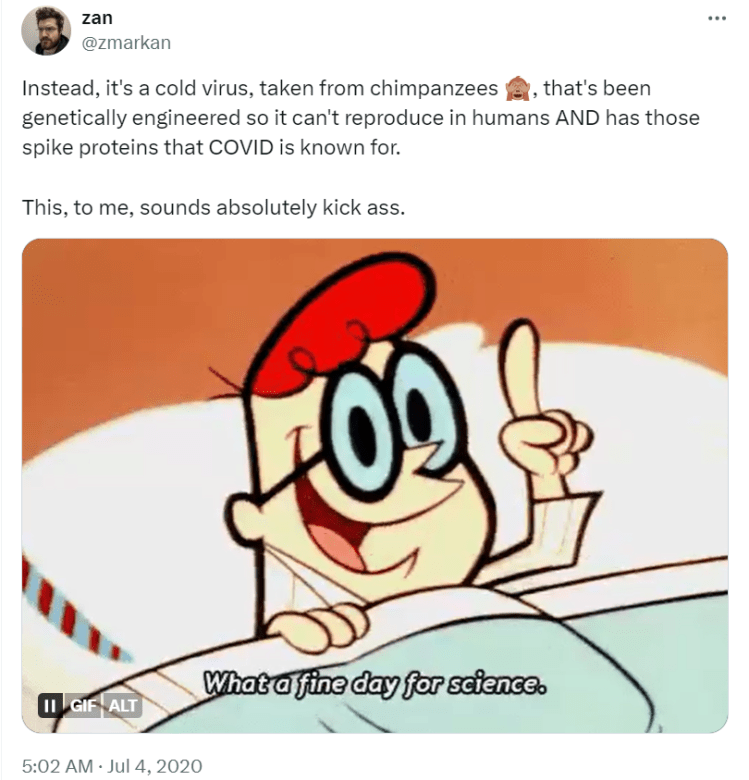
Nidhi Parekh was one of our early collaborators — we even published a whole explainer on our blog as to how the COVID vaccines work (also translated into Spanish!) thanks to her tireless attention to detail and knack for explaining the intricacies of immunology. Here, she profiles a man who was a volunteer for the AstraZeneca COVID vaccine trial in England. Nidhi is a brilliant thinker and writer!
August 2020: “The Simplified Guide to Understanding Statistics in the Social Sciences“
In July and August, Kelly published our Simplified Guide to Understanding Statistics in the Social Sciences, Part I and Part II. So began our quest to help people understand how to interpret social sciences information and make sense of it in the “real world” amidst a pandemic in which limited evidence was being released on the daily, often being reported by breaking news reporters (who, typically, had no scientific training and usually had some kind of formal journalism education where they were not required to take too many science and math classes)! In August 2020, I also wrote a critique of that media landscape on our blog, but the same media ecosystem persists through the present day. Some serious issues emerged with science in the media in the pandemic that we are dealing with today. We talk a lot about these topics on our Instagram, by the way!
September 2020: SciCommers Weigh in on How to Write about Science in a Pandemic
September marked half a year of being a science communications company in a pandemic. COVID-19 brought many unusual challenges as a science marketing company. For one thing, traditional tools such as keyword analysis did not work for COVID, since the databases of keywords had been updated over years and years, and audience analysis — talking to people to figure out their concerns — was therefore much more useful than any marketing analytics software or platform. We took this information vacuum as an invitation to pivot and start filling that void. Here’s one of our first articles specifically on the topic of science communication! We also published scientific analyses of COVID-19 impacts, such as on the brain, by this month. We were doing this alongside serving clients needing pandemic science explained — balancing a bunch of different projects and running a marathon, not a sprint. We were in this COVID thing for the long run!
October 2020: Science Nobel Prizes Could Be A Lot More Diverse and Inclusive
Since I was a little kid — and this intensified when I was an MIT student — I have been obsessed with the Nobel Prizes and finding out who won these important awards each year. In 2020, I decided to bring my love of scientific achievement to Fancy Comma and publish a blog about the Nobel Prizes each day, in collaboration with Nidhi Parekh, during Nobel Prize week (which occurs annually in October). In this blog, I unpacked the diversity problem that has affected the Nobel Prizes (it has gotten slightly better in recent years, but continues to be a challenge, all the same).
November 2020: “How to Promote Science on Capitol Hill“
In November, I had been glued to all types of news — my perfectly-curated Twitter list of scientists and science reporters, broadcast television, blogs, and more — and finally started putting the pieces together about how the broader science ecosystem works in concert with media. It was around this time that I started blogging about my experience working in Congress in an effort to help others in the science ecosystem have a chance to work in the hallowed halls of our highest legislative body here in the United States. Since then, I’ve written all sorts of Congress explainers, including one on how to plug in as a scientist in a Congressional office, how to get involved in a Congressional campaign as a scientist, and a series about how I got into science and politics, called “A Scientist in Politics.”
December 2020: 4 Life Lessons from Squirrels That Apply to Freelancing
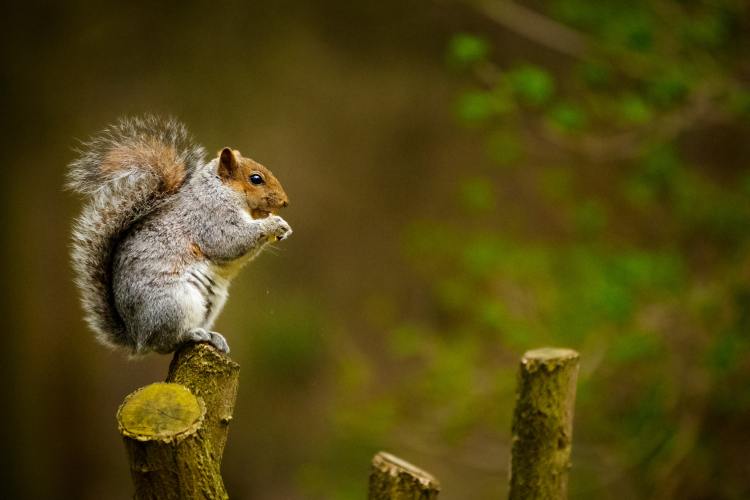
We conclude our whirlwind tour of Fancy Comma’s first year blogging with this banger from me about how squirrel-watching (my favorite solitary activity in the pandemic) inspired my freelancing. Wow, what a year 2020 was, in retrospect.
We are very grateful to continue to persevere to tackle the pressing science, health, technology, business, finance and policy issues of the day.
We continue to write and innovate at the intersection of evidence-based decisionmaking and living our collective best lives as humans. Subscribe to our blog here or find us on Substack! You can find us at all our social media handles on our main page.
 Fancy Comma, LLC