By Sheeva Azma
This project is entirely self-funded. Donate to the GoFundMe here.
This blog may not be suitable for all audiences due to its discussions of a mature nature.
The public health impacts of trafficking alone make it important to root out Epstein-related corruption in the sciences, but practically speaking, it’s just bad for science to be tacitly complicit with crimes against women and children.
It’s tough to explain to people that exposing scientists in the Epstein files doesn’t “ruin their careers.”
They somehow made it to the top in the first place, despite it all, when so many others could not. Then, at the top, they enabled horrific crimes against women and children. Therefore, they should not be part of the scientific ecosystem.
Their careers could have gone to hardworking people who would find it repulsive to associate with a known trafficker.
If you think that doesn’t matter — maybe it’s because you have never been a woman in science.
Early on in this project, I received a direct message on Instagram from a graduate student and fellow MIT alum who literally dropped out of her PhD program due to the Epstein files.
She shared with me a “farewell, academia” letter she had written to her PhD advisor about why she is leaving academia.
“I am now watching both my outer and inner worlds shatter as our society confronts its history of sexual violence through buried emails at the same time that I am uncovering my own through buried memories,” she wrote in that letter.
The now former PhD student in climate science continued, justifying her decision to leave academia: “[I]t’s becoming harder and harder to ‘show up’ everyday and pretend like none of this is happening. Whereas I used to worry that made me a bad graduate student or a bad scientist, I am now starting to wonder if I’ve just been conditioned to feel that way by a system that was carefully and intentionally crafted by these men to always minimize harm perpetuated against women, immigrants, and other marginalized groups. And when I see all the women around me express the same version of self-doubt, it suddenly becomes clear how the harmful and violent acts facilitated by Jeffrey Epstein have echoes across space in time…Maybe we were never meant to ‘lock in’ to a system that wasn’t built for us.”
It’s worth reading the whole letter, because it is a good letter. I also appreciated this image from the letter — it sums up everything I’m trying to communicate in this blog post.
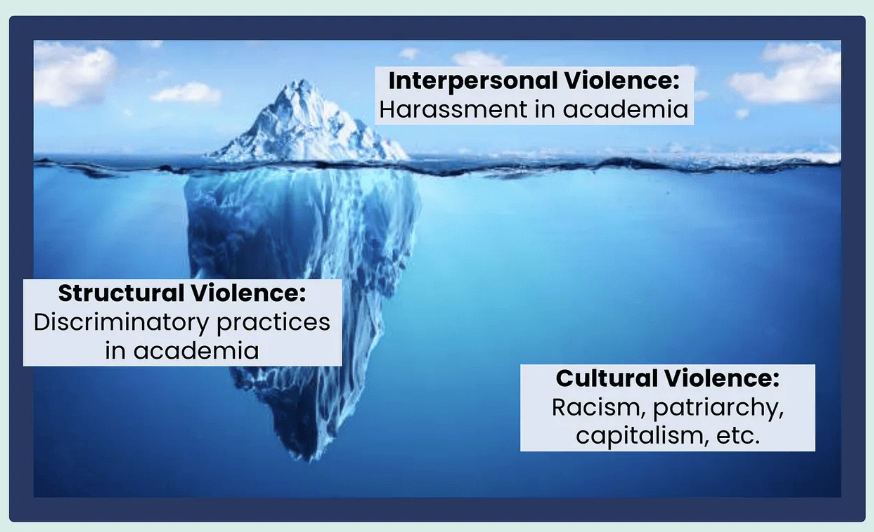
There are things we can observe that are really, really bad — like Epstein’s trafficking, which important people went the extra mile to hide, just because it was so bad.
Then there are lesser things — a woman not getting a job in a sexist lab, or a woman leaving science due to structural inequalities, despite showing up every day, like Lily.
These are all interconnected, and these all impact humanity, as scientific work is good and important work that is meant to benefit the whole world.
There are three truths I want to highlight here.
It’s unfair for science to be self-sacrificing to the people who have the odds stacked against them the most — women and other marginalized groups in science.
It’s also wrong for science to be complicit in trafficking and violence against women and girls.
Lastly, science is for everyone.
Those three truths bring me back to the thesis of this blog post, and its very title, in fact: EVERYONE WINS when we investigate scientists in the Epstein files.
So far, the information uncovered by me, government entities, and others, have sought to piece together a story that was hidden from view by some of the most important people in the world.
It is an important story to tell. If you would like to support me in this independent, grassroots journalism project, please donate to my GoFundMe here.
The world is in the early stages of understanding how Epstein harmed the world and scientific community
The number of people who have been harmed, career-wise, by the inclusion of Epstein-affiliated scientists is not lost on me as a woman in science.
Just imagine what your personality would have to be like if you actually enjoy hanging out with a known trafficker. You would most certainly have to be male, for one thing, and you would have to listen to crackpot theories of a person who never graduated college, but is rich beyond belief.
Now, imagine that personality teaching young undergraduates, mentoring graduate students, supervising postdocs, and coming up with research ideas to “help humanity.”
These scientists were not helping humanity. They have been only helping themselves, which means it’s time for them to go.
Here, I would like to add that we also know that toxic science culture and a misogynist academic culture affects 1 out of every 3 students on college campuses, who deal with sexual assault.
That’s a lot of bad academic culture.
All of that still says nothing of the actual impact on Epstein’s trafficking endeavors from scientists who supported him through it all.
According to the science, we know that the impacts of trafficking are quite severe.
“Policymakers have so far failed to hold perpetrators in Jeffrey Epstein’s trafficking network accountable, but the medical and public health community should confront the resulting health crisis,” wrote medical doctors Nicholas Peoples, Preeti Panda, and Hanni Stoklosa in the prestigious journal the New England Journal of Medicine in September 2026.
The lead author of the paper “The Epstein Files Transparency Act and the Health of Trafficked Children,” Dr. Peoples, had this to say as he dropped a link to that paper in my LinkedIn mentions the other day: “[S]cientists and physicians have an innate professional responsibility—to children, to civil society, and to our respective fields—to advocate for more transparency in these investigations and accountability for perpetrators.”
That view considers one way that Epstein harmed society — by his crimes.
However, Epstein harmed more than the physical and mental health of women and girls through his crimes. His involvement with science, and reliance on it to boost his reputation, damaged it as an enterprise — or perhaps pointed out existing structural issues — or both.
Unfortunately, the information ecosystem on Epstein is highly fragmented — but some truths are emerging
The information ecosystem on Epstein is so fragmented that it took me eight months to discover that Silicon Sallie, a former journalist and ad executive, and I, a neuroscientist turned science writer and journalist, were both researching science and tech in the Epstein files.
Silicon Sallie and I have since joined forces to expose Epstein’s corrupt influence on science and tech through a coalition of journalists at HumanWrites.Info. My work is featured there on the “Science/Academia” page.
It also took me a whole eight months to come up with a list of scientists with involvement with Epstein ranging from questionable to substantial: you can find that list here, at the top of this page.
Policymakers, though called out for their inaction by the doctors I mentioned earlier, have been paying attention. That matters since they write the policies that can help eliminate Epstein’s influence in science and make it tougher for people like Epstein to succeed in their crimes.
Evidence is slowly emerging from the New Mexico Truth Commission, House Oversight Democrats, the Senate Finance Committee staff of ranking member Sen. Ron Wyden (who could soon chair the committee with the new Democratic majority), and the House Judiciary Democrats as to what the first-line impacts of Epstein were (and who helped it happen).
The report from Sen. Ron Wyden’s office casts blame on big banks including JP Morgan Chase, Deutsche Bank, and Bank of America for looking the other way and actively ignoring many different red flags. The former two, JPMC and Deutsche Bank, were Epstein’s banks, and the latter, Bank of America, was a source from which Epstein received money from Leon Black, a billionaire who walked out of his Congressional hearing in June 2026, declining to answer questions from the House Oversight Committee.
The government reports clue us in to what policymakers know about Epstein’s involvement in the sciences — at least, in terms of Epstein’s most serious, criminal involvement with scientists, where that may exist.
A report from House Oversight Democrats names Martin Nowak (p. 14 of this document) as participating in Epstein’s trafficking activity. The New Mexico Truth Commission report also has a whole section called “Investigative Area 4 – Medical and Scientific Improprieties” (starting on p. 108 here). The NM Truth Commission notes that it does not allege wrongdoing, but it does talk about “Epstein’s documented interest in and support of medical and scientific advances, sometimes for unethical or improper purposes,” which we have talked about here, as well as “Epstein’s interest in eugenics and transhumanism” and “Epstein’s attempts to manipulate persons engaged in scientific research to further his own interests.”
I would like to note here that I did send the NM Truth Commission the blogs I had written at the start of this project; I’m not sure how much that factored into their conclusions.
As I mentioned, my work as an investigative journalist has identified a whole August 2013 bender of scientists visiting the ranch, which, incidentally, corresponds with Epstein being debanked at JP Morgan Chase and re-banked thanks to a former JPMC connection who pitched Epstein as a client to the Deutche Bank, where he became an ultra-high-net-worth client.
By the way, JPMC continued to work with Epstein after he was de-banked, according to the Wyden report.
I have also pondered whether scientists engaged in crimes against women and children in this blog, which identifies even more scientists visiting the ranch in the August 2013 scientist-invitation-spree that Epstein seems to have as his banking officially ends, but his ties do not end, at JPMC.
A Senate Finance Committee investigation reveals that big banks enabled Jeffrey Epstein’s illicit activities
The investigative staff working for Sen. Ron Wyden, in his capacity as Ranking Member of the Senate Finance Committee, discovered a lot about Jeffrey Epstein in a four-year investigation into Epstein’s finances.
The results of the investigation were published in a 67-page report, “Looking the Other Way: How Wall Street Banks enabled Jeffrey Epstein’s sex trafficking,” which was announced in a press release on August 4, 2026.
The Wyden report helped me piece together another part of this big, important puzzle that is science in the Epstein files.
It implicates major banks and reveals that they failed to do their due diligence to report his suspicious transactions to federal authorities in a timely manner.
According to the Senate report, the summer Jeffrey Epstein invited “lots of interesting scientists” (his words, not mine) to his ranch, his income came almost exclusively from his friend and former client, Leon Black.
This implicates Leon Black financially in whatever happened with the scientists at the ranch that summer.
The Zorro Ranch is currently under criminal investigation by the state of New Mexico (check out the NM Truth Commission report for what they’ve found so far — a full report is due by the end of 2026).
Why hasn’t anyone been talking about this?
One reason is that there’s been way too much news going on.
Another reason sounds like the ultimate cliche, but according to the report, it’s true: the Trump administration, big banks and CBS news have also looked the other way when it comes to examining Epstein’s suspicious financial transactions, according to the report.
The TL;DR summary of this report is that Epstein banked with JP Morgan Chase (JPMC) from 1998 to 2013, and during that time, executives noted and even discussed his suspicious transactions, and things like the fact that he made lots of cash withdrawals (which was known to high-ranking bank staff to be used for trafficking), but they did not de-bank him until 2013.
A 2011 internal document mentioned in the report states that Jes Staley, a friend of Epstein’s and JPMC exec, decided with Stephen Cutler, another exec, to “keep Mr. Epstein as a private banking client.”
The bank knew about the allegations as early as 2006 that “Epstein had been accused of paying cash to have underage girls and young women brought to his home,” the report notes. “Regardless of these allegations, Epstein was treated as a star client.”
Not only did JPMC look the other way and continue to enable Epstein’s crimes by being his bank, they also failed to report, in a timely fashion, suspicious activity, as required by federal law.
The execs finally decided Epstein was a big enough risk that they wanted him to move on from JPMC. This involved internal emails in mid-2013, such as this message sent internally at JPMC on July 19, 2013, just a few weeks before the scientist ranch visits, workshopping what to tell Epstein: “The repetitive nature of your cash transactions is a problem for us and our relationship with you,” JPMC high net worth account executive John Duffy wrote to Mary Erdoes, who worked closely managing Epstein’s JPMC account. Erdoes still works at JPMC and makes millions of dollars a year, the Wyden report states.
In 2013, when Epstein left JPMC, he took his business to Deutsche Bank, where his primary banker was someone who had worked with him at JPMC. Epstein banked at Deutsche Bank until he died in 2019.
Additionally, Leon Black’s accounts at Bank of America paid Epstein “approximately $170 million between 2012 and 2017,” the report notes on page 6.
Reading through that report, I was surprised to find that Epstein’s activity with scientists wove quite easily into his financial narrative – banking with JP Morgan Chase until being de-banked and then moving to Deutsche Bank.
Without the banks, Epstein could not commit his crimes. Without the scientists, he could not clear his name. It was a vicious cycle of abuse of people and systems, made possible by people who knew better and could do better, but did not.
Epstein’s financial activity and philanthropic status are deeply intertwined with his scientific affiliations
It’s important to know what Epstein did, but it’s also important to take stock of what science, and more generally, elite higher education, looks like these days.
In a previous post, I wrote, “Elite academic institutions do not care about the women who matriculate there. Anyone who disagrees with me probably has not been a young woman studying at an elite academic institution.” I talked about the danger to our physical bodies and mental health, not to mention our careers, as women pursuing careers in science.
My work, since February 2026, has uncovered almost 200 scientists in the Epstein files.
We’re talking almost 200 people whose involvement is more substantive than their papers just being emailed around.
I’ve also discussed how all those scientists in the Epstein files mean something.
These are literal scientists. These people get to mold impressionable minds and shape cutting-edge advances in science, which obviously impacts the whole world.
Somehow, these people enabled heinous crimes against women and girls at the same time as pushing the boundaries of knowledge.
The worst part of it all was much of these scientists’ work — and, by extension, their enablement of Epstein — was made possible due to taxpayer funds. I have previously reported about how Jeffrey Epstein subsidized taxpayer-funded work on his pet projects — and was thanked publicly in scientific articles after he left jail as a registered sex offender.
If you discover some new scientific thing, but you’re friends with a convicted sex offender and known trafficker, does the work you are doing, and, of course, the way you are doing it (down to the day-to-day operations of running your lab), justify you, the big fancy scientist with poor choice in friends, in having a job so important and influential?
If it’s really true that anyone can be a scientist — why do we celebrate these top names who are also in the Epstein files? If anyone can do this work, we should have good, ethical people doing this work, not self-important people who did not bat an eyelash being friends with Jeffrey Epstein — and then publicly denied any (criminal?) wrongdoing as a blanket strategy.
It’s a question I’ve thought about a lot since I started scouring the Department of Justice’s Epstein Library for scientist mentions.
Scientists like Richard Axel have jeopardized science’s legitimacy and usefulness to humanity by befriending Jeffrey Epstein
Socially, we value scientists because we know that scientific work benefits humanity.
All around the world, people hold scientists in high esteem, but scientists such as Richard Axel have abused that privilege.
Axel shared the 2004 Nobel Prize in Physiology or Medicine with Linda Buck for discovering how receptors in the olfactory, or smell, system work to transmit smell information to the brain.
Something “smells” really off about his conduct, too. Pun intended, of course. (If you like puns, support this work on GoFundMe, because there’s a lot more where that came from.)
In 2010, Jes Staley sent his daughter Alexa’s resume to Epstein, who wrote back, “she can sit with Richard Axel when I get back, he won the Nobel Prize .. he has guaranteed me.”
If you recognize Staley’s name from earlier in this blog post, you have been paying attention — good job! Jes Staley was a bank executive at JP Morgan Chase at the time. He has since been ousted from his role at Barclay’s, but according to the August 2026 Senate Finance Committee report, in 2011, he was one of two people to decide whether Epstein should bank at JPMC or not — and he gave Epstein a pass.
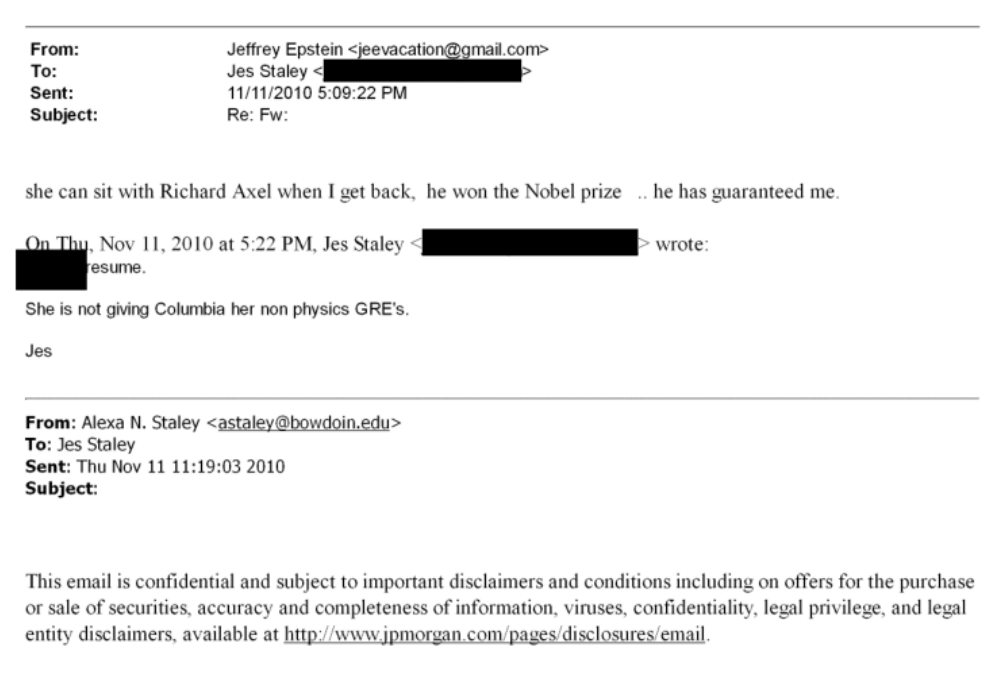
Perhaps the leniency was, at least in part, because Epstein helped Staley’s daughter get into Columbia for a physics PhD. Jes Staley has 7,903 Epstein files mentions.
Just look at the official JP Morgan Chase disclosure at the bottom of that email! Staley was a bank executive at JP Morgan Chase, where Epstein banked until 2013 until his account was flagged for withdrawing so much cash that the bank executives starting considering him a risk, though he was one of their most lucrative clients as part of their “Wall of Cash.”

Epstein also touts his Axel connection to his ex-girlfriend, Eva Dubin, when she’s looking for a person to speak at her child’s high school in 2012, after Epstein was a registered sex offender.
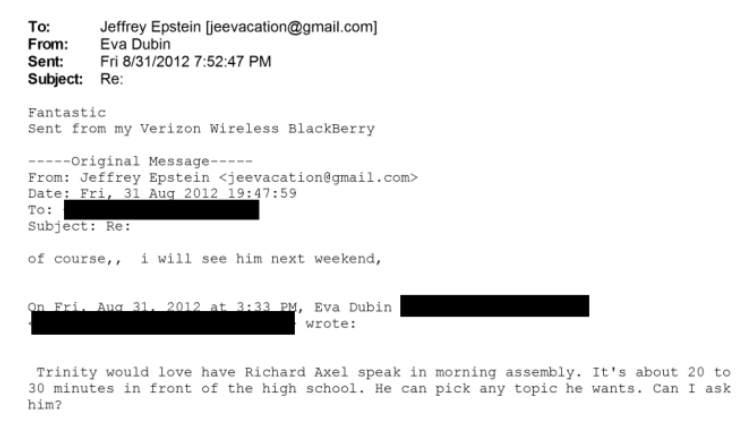
Reaching out to a registered sex offender for connections to a Nobel Prize winning scientist to talk to your high schooler’s class is highly problematic, to put it lightly.
There’s so much more in the files about Axel — I seem to recall Epstein mentioning his 20-year-running friendship with Axel somewhere in the files to some other person, but I can’t find it at the moment. (If you would like me to do a deeper dive into Axel’s ties with Epstein, please send me a message.)
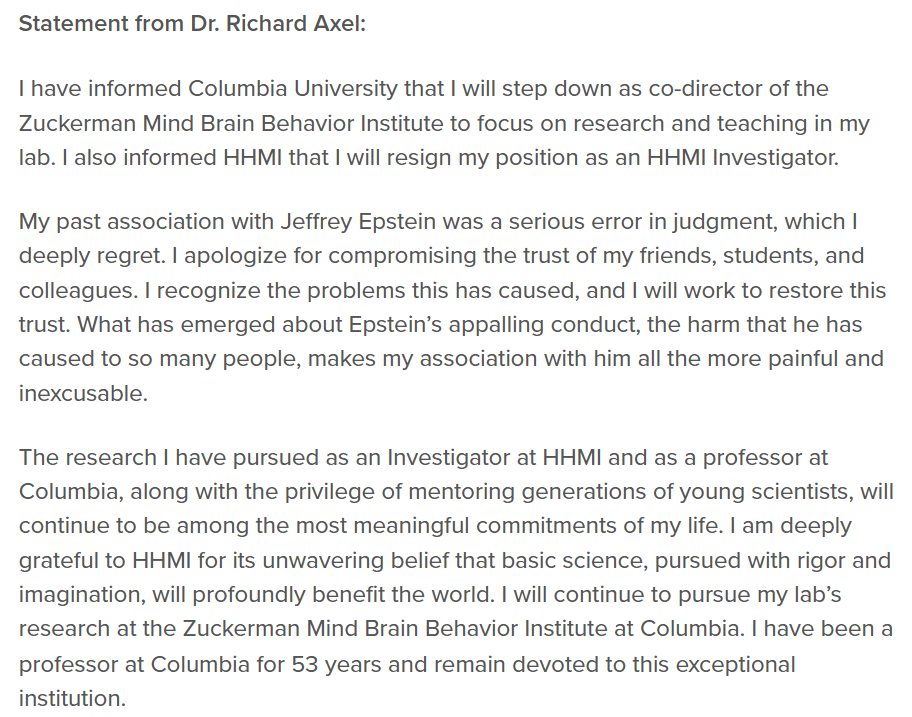
When Axel’s long-standing Epstein ties were uncovered, he resigned from his role as a Howard Hughes Medical Investigator, as well as his co-directorship of the Zuckerman Mind Brain Behavior Institute.
“The research I have pursued as an Investigator at HHMI and as a professor at Columbia, along with the privilege of mentoring generations of young scientists, will continue to be among the most meaningful commitments of my life,” wrote Nobelist Richard Axel, a long-time friend of convicted sex offender and known trafficker Jeffrey Epstein, in a February 24, 2024 statement announcing his resignation from some, but not all, of his academic affiliations at Columbia.
“My past association with Jeffrey Epstein was a serious error in judgment, which I deeply regret. I apologize for compromising the trust of my friends, students, and colleagues. I recognize the problems this has caused, and I will work to restore this trust,” he wrote in a February 24, 2026 his apology letter.

If you’d like to read this letter and, like me, feel a rising sense of anger with each passing word, here you go:
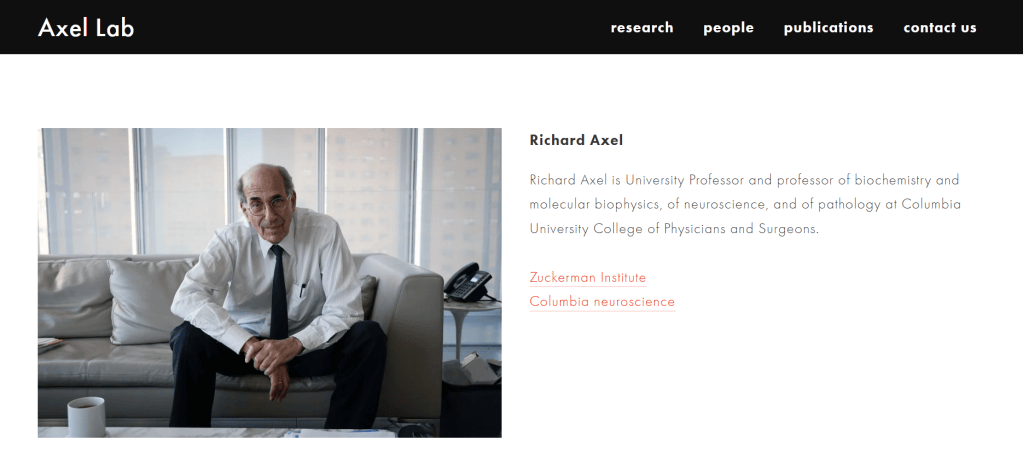
I guess he never updated his website, since it still links to the Zuckerman Institute, from which he resigned from several months ago by now. The following screenshot of the “members” page of his website was taken on November 8, 2026.
The scientific establishment is, in fact, taking notice — so now is the time for public action
Scientists, doctors, and public health professionals are noting the broad public health significance of the Epstein files.
International editor of the British Medical Journal, Jocalyn Clark, wrote in February 2026 that “The theme for International Women’s Day 2026 is rights, justice, and action for all women and girls. By contrast, 8 March this year will be marred by the grim reality that it took a dead man’s emails for the world to believe the testimonies of hundreds of women and girls.”
In a different article, written on March 12, 2026, Clark wrote, “Whether you believe the war with Iran is a diversionary tactic to distract from the Epstein files or not, the abuse scandal must not go away—not least because the sheer scale of Epstein’s cabal and harm demands more action to protect women and girls from sexual violence.”
The BMJ gets it: fixing science culture and improving living conditions for women and girls benefits everyone. It is truly a win-win-win.
This project continues because of you, its audience. Thank you.
We have been unpacking science in the Epstein files since February 2026 on Instagram, Facebook, YouTube, our blog, and Substack. You can subscribe to this blog so you’ll never miss an update. One cannot look at all of the things we have uncovered in the past several months and reasonably conclude that science should preserve its status quo.
It’s been almost a year since we started this project; it is currently entirely reader-supported. If the thought of this project not existing makes you uneasy, please donate to the GoFundMe.

